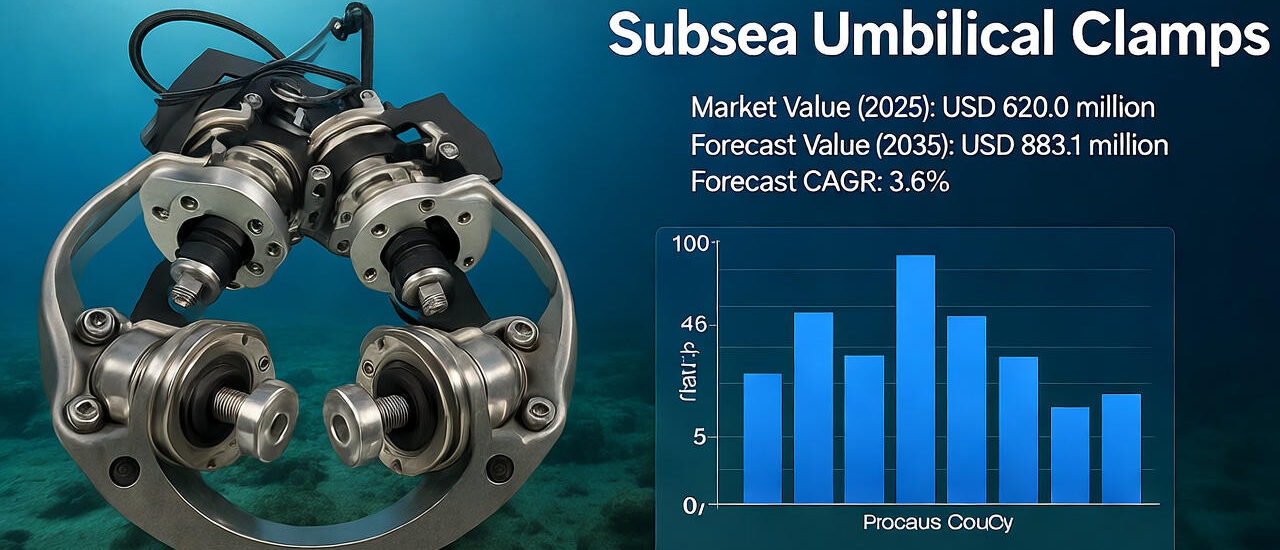
The global subsea umbilical clamps market is on a steady growth trajectory, expected to increase from USD 620.0 million in 2025 to USD 883.1 million by 2035. This absolute gain of USD 263.0 million represents a 42.4% expansion, underpinned by a compound annual growth rate (CAGR) of 3.6%. The market, growing by nearly 1.42 times over the decade, reflects the rising importance of deepwater oil and gas exploration, expansion of subsea infrastructure, and growing reliance on robust umbilical protection systems.
Get this Report at $5000 Only (Report price) | Exclusive Discount Inside!: https://www.futuremarketinsights.com/reports/sample/rep-gb-25495
Market Growth Shaped by Two Distinct Phases
Between 2025 and 2030, the market is set to climb from USD 620.0 million to USD 739.9 million, capturing 45.6% of the decade’s total growth. This initial surge will be driven by expanding deepwater exploration, greater reliance on subsea production systems, and investments in offshore renewable energy. During this period, manufacturers are scaling production capabilities to meet increasingly complex subsea requirements.
From 2030 to 2035, the market is projected to grow further to USD 883.1 million, accounting for 54.4% of the decade’s expansion. This later phase will see heightened demand for ultra-deepwater solutions, advanced composites, and custom clamp designs tailored for extreme subsea environments. As floating production systems and subsea processing gain momentum, engineering expertise and innovation will define market competitiveness.
Why Demand for Subsea Umbilical Clamps is Rising
Modern offshore production facilities depend on intricate umbilical networks that connect blowout preventers, manifolds, and subsea processing equipment. Even minimal damage to these critical components can lead to costly downtime and environmental hazards. Increasingly stringent safety standards, coupled with the need for long-term reliability, are pushing operators to adopt advanced clamp systems engineered to perform under immense pressure and dynamic conditions.
The demand is reinforced by growth in both oil and gas operations and offshore renewable energy, with subsea clamps playing a vital role in cable protection for offshore wind farms and subsea grids.
Segmental Insights: Material, Clamp Type, and Application
Polyurethane and elastomer materials are forecast to dominate the market with a 45% share in 2025, thanks to their flexibility, chemical resistance, and long fatigue life. Their ability to withstand vibration and absorb stress ensures durability across risers, flowlines, and umbilicals.
Bolt-on clamps are projected to command 50% of the clamp-type segment in 2025. Their secure, modular, and field-tested designs make them the industry standard for subsea protection. Their adaptability ensures broad application across risers and control umbilicals, where maintenance opportunities are often limited.
By application, risers and cables/control umbilicals together will account for nearly 70% of demand. These applications face the most dynamic subsea stresses, requiring designs that combine resilience with precision to protect vital infrastructure.
Regional Outlook: Brazil Leads, Asia and Europe Follow
Brazil emerges as the fastest-growing market with a 4.4% CAGR through 2035, powered by its pre-salt oil field developments and robust offshore infrastructure programs. Saudi Arabia follows closely with 3.8% growth, supported by new offshore field development and subsea production projects.
In the United States, Gulf of Mexico deepwater developments continue to sustain a 3.2% CAGR, while the United Kingdom records steady growth at 3.0% as it balances North Sea maintenance with offshore wind expansion. France, growing at 2.8%, emphasizes renewable energy applications and subsea cable protection.
Elsewhere in Asia, Japan is prioritizing polyurethane and elastomer-based clamps for their superior performance in deepwater projects, while South Korea focuses heavily on bolt-on clamp technologies, reflecting its shipbuilding expertise and subsea engineering strengths.
Innovation and Technology Trends
The market is witnessing rapid integration of advanced composites, such as carbon-fiber reinforced plastics, to enhance durability while reducing weight and cost. Manufacturers are also designing clamps for next-generation umbilical systems, including high-voltage cables and fiber optic lines. Ultra-deepwater projects are pushing the boundaries of material science, requiring solutions that can endure extreme subsea pressures and temperatures.
These innovations are not only addressing oil and gas applications but also creating new opportunities in marine renewables, where subsea clamps safeguard cables and interconnectors in offshore wind farms and subsea grids.
Buy Now Report Here: https://www.futuremarketinsights.com/checkout/25495
Competitive Landscape: Established Leaders and Emerging Innovators
The subsea umbilical clamps market is defined by a blend of established manufacturers and newer entrants bringing fresh technologies. Established players like Advanced Insulation, Balmoral Comtec, CRP Subsea, Oceaneering, Tekmar Group, and Trelleborg Offshore have built reputations for reliability, material innovation, and subsea engineering expertise.
At the same time, companies such as Deepwater Buoyancy in the U.S. and Matrix Composites & Engineering in Australia are gaining ground by introducing advanced composite designs and integrated subsea solutions. Nexans Umbilicals in France leverages its strength in cable systems to integrate clamp technologies, while DOF Subsea in Norway offers engineered solutions tailored for harsh environments.
This competitive mix highlights an industry where partnerships, regional expansions, and material innovation are central strategies. Companies are not just competing on product reliability but also collaborating to deliver full lifecycle subsea solutions, from design and testing to deployment and long-term maintenance.
Outlook
With a forecasted 3.6% CAGR between 2025 and 2035, the subsea umbilical clamps market represents a steady growth opportunity for manufacturers, suppliers, and engineering firms. The dual drivers of deepwater exploration and renewable energy expansion are shaping demand, while advanced materials and evolving clamp designs are setting new performance benchmarks.
Both established leaders and ambitious new entrants are positioned to benefit, provided they continue to innovate and adapt to the increasing technical challenges of subsea operations. The decade ahead promises not only steady expansion but also transformative advancements that will redefine reliability and protection standards in subsea infrastructure.
Related Reports:
Cathodic Protection Market- https://www.futuremarketinsights.com/reports/cathodic-protection-market
Industrial Battery Chargers Market- https://www.futuremarketinsights.com/reports/industrial-battery-charger-market
Industrial Condensing Units Market- https://www.futuremarketinsights.com/reports/industrial-condensing-units-market
About Future Market Insights (FMI)
Future Market Insights, Inc. (ESOMAR certified, recipient of the Stevie Award, and a member of the Greater New York Chamber of Commerce) offers profound insights into the driving factors that are boosting demand in the market. FMI stands as the leading global provider of market intelligence, advisory services, consulting, and events for the Packaging, Food and Beverage, Consumer Technology, Healthcare, Industrial, and Chemicals markets. With a vast team of over 400 analysts worldwide, FMI provides global, regional, and local expertise on diverse domains and industry trends across more than 110 countries.
Join us as we commemorate 10 years of delivering trusted market insights. Reflecting on a decade of achievements, we continue to lead with integrity, innovation, and expertise.
Contact Us:
Future Market Insights Inc.
Christiana Corporate, 200 Continental Drive,
Suite 401, Newark, Delaware – 19713, USA
T: +1-347-918-3531
For Sales Enquiries: sales@futuremarketinsights.com
Website: https://www.futuremarketinsights.com
LinkedIn| Twitter| Blogs | YouTube