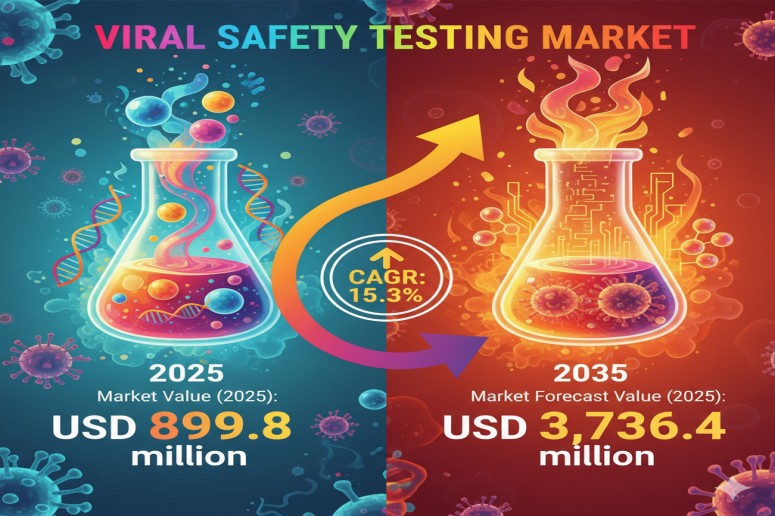
The global Viral Safety Testing Market is entering a decade of unprecedented growth and transformation, projected to expand from USD 899.8 million in 2025 to USD 3,736.4 million by 2035, reflecting a robust CAGR of 15.3%. This remarkable progression represents a 315.2% total value increase over ten years, driven by the surge in biopharmaceutical manufacturing, regulatory tightening, and adoption of advanced viral detection technologies.
Rising Regulatory Demands and Biopharma Expansion Fuel Growth
The driving forces behind this growth are unmistakable. Increasing biopharmaceutical manufacturing volumes, stringent viral safety standards, and cutting-edge testing methodologies are transforming the global pharmaceutical testing ecosystem. As biologics, gene therapies, and cell therapies gain commercial momentum, the demand for viral safety testing services has surged to ensure patient safety and regulatory compliance.
Regulatory agencies like the FDA, EMA, and PMDA have reinforced testing mandates, requiring comprehensive viral contamination detection before drug approval. These regulations, coupled with the expansion of biologics production and the complexity of therapeutic modalities, have made viral safety testing indispensable across the pharmaceutical value chain.
Global Market Segmentation: Adventitious Virus Tests Lead
By product type, Adventitious Virus Tests dominate the market with a 47.2% share, valued for their ability to detect unknown viral contaminants in complex biopharmaceutical systems. These tests outperform targeted assays, offering comprehensive detection sensitivity and superior regulatory compliance. Meanwhile, Antibody Production Tests (28.6%) and Retrovirus Tests (15.3%) continue to serve critical roles in quality assurance and product safety validation.
In application terms, biopharmaceuticals represent the largest segment, accounting for 68.4% of total market share. The surge in monoclonal antibody production, gene therapy, and vaccine development has made viral safety testing integral to pharmaceutical quality systems. The medical industry follows with 24.7% share, driven by increasing adoption of biologics and cell-based therapies.
Regional Outlook: Asia Pacific Takes the Lead
Regionally, the Asia Pacific market is emerging as a powerhouse, spearheaded by China (20.7% CAGR) and India (19.1% CAGR). Both countries are rapidly expanding biopharmaceutical manufacturing ecosystems, supported by government initiatives and international investments. China’s strong regulatory modernization and export-oriented pharmaceutical production drive exceptional demand for viral safety testing. India’s growth, meanwhile, stems from increasing contract manufacturing and domestic biopharma innovation under national healthcare initiatives.
Europe maintains its position as a quality assurance stronghold, led by Germany (17.6% CAGR)—a global hub for pharmaceutical excellence and biotechnology research. The United Kingdom (13.0% CAGR) continues to champion innovation in gene and cell therapy, supported by its post-Brexit push for domestic testing capacity and regulatory independence. Other key European markets such as France, Italy, and Spain collectively contribute 31.7% of regional growth through biopharma modernization and research infrastructure development.
In North America, the United States (14.5% CAGR) continues to set global benchmarks in biotechnology and precision testing for advanced therapeutics. The country’s leadership in gene therapy and cell-based manufacturing requires sophisticated viral detection systems integrated with FDA-compliant quality assurance frameworks. Brazil (16.1% CAGR) leads Latin America, fueled by pharmaceutical modernization and regional healthcare initiatives emphasizing viral contamination control.
Technology Innovation and Industry Transformation
The viral safety testing industry is undergoing a paradigm shift with rapid technological advancements. The integration of next-generation sequencing (NGS) is revolutionizing viral detection by improving sensitivity and speed, particularly in gene and cell therapy applications. Similarly, automation and AI-enabled analytics are reducing turnaround times, minimizing human error, and enabling real-time contamination monitoring.
Digital transformation is also reshaping the landscape. Analytical laboratories are deploying connected systems to centralize testing data, ensure regulatory traceability, and improve decision-making in pharmaceutical quality management. The convergence of automated testing, machine learning, and data-driven quality control represents a defining shift toward precision-based viral detection.
Competitive Landscape: Established Leaders and Emerging Innovators
The Viral Safety Testing Market features a dynamic mix of established global players and emerging innovators, each contributing to the industry’s growth through technology advancement and service expansion.
Charles River Laboratories stands out for its comprehensive viral testing solutions and deep regulatory expertise, providing trusted support for major pharmaceutical clients worldwide. Eurofins BioPharma continues to expand its testing portfolio, focusing on operational efficiency and analytical accuracy. Clean Cells and Texcell emphasize advanced contamination detection and reliability across complex biological systems.
Merck Millipore plays a pivotal role in providing precision testing equipment and integrated pharmaceutical support solutions, while Syngene International combines cost-effective service delivery with cutting-edge analytical technologies. Nelson Labs, Sartorius Stedim BioOutsource, and WuXi Biologics further enrich the competitive landscape with their specialized expertise in regulatory testing, biologics safety, and comprehensive analytical services.
Emerging companies such as ViSpot Co., Ltd., Creative Biogene, and Asahi Kasei Corporation are pushing the boundaries of innovation through R&D in viral detection technologies and expanding service networks to capture high-growth opportunities in Asia, Latin America, and the Middle East.
Government and Industry Collaboration Driving Infrastructure Development
Governments and regulatory bodies are recognizing viral safety testing as a cornerstone of pharmaceutical safety. To strengthen local infrastructure and adoption, several countries are introducing subsidies, R&D incentives, and testing mandates within national pharmaceutical strategies. These initiatives encourage laboratory establishment, technology transfer, and talent development to bridge capacity gaps in emerging markets.
Regulatory authorities are also working toward international harmonization of testing protocols, fostering global compatibility and enhancing cross-border pharmaceutical trade. Training networks and policy advocacy programs are promoting advanced testing competencies among industry professionals.
Claim Your Copy for $5,000 Only | Exclusive Offer for Early Buyers!
https://www.futuremarketinsights.com/reports/sample/rep-gb-26754
Checkout Now to Access Industry Insights:
https://www.futuremarketinsights.com/checkout/26754
About Future Market Insights (FMI)
Future Market Insights, Inc. (ESOMAR certified, recipient of the Stevie Award, and a member of the Greater New York Chamber of Commerce) offers profound insights into the driving factors that are boosting demand in the market. FMI stands as the leading global provider of market intelligence, advisory services, consulting, and events for the Packaging, Food and Beverage, Consumer Technology, Healthcare, Industrial, and Chemicals markets. With a vast team of over 400 analysts worldwide, FMI provides global, regional, and local expertise on diverse domains and industry trends across more than 110 countries.
Contact Us:
Future Market Insights Inc.
Christiana Corporate, 200 Continental Drive,
Suite 401, Newark, Delaware – 19713, USA
T: +1-347-918-3531
For Sales Enquiries: sales@futuremarketinsights.com
Website: https://www.futuremarketinsights.com
LinkedIn| Twitter| Blogs | YouTube