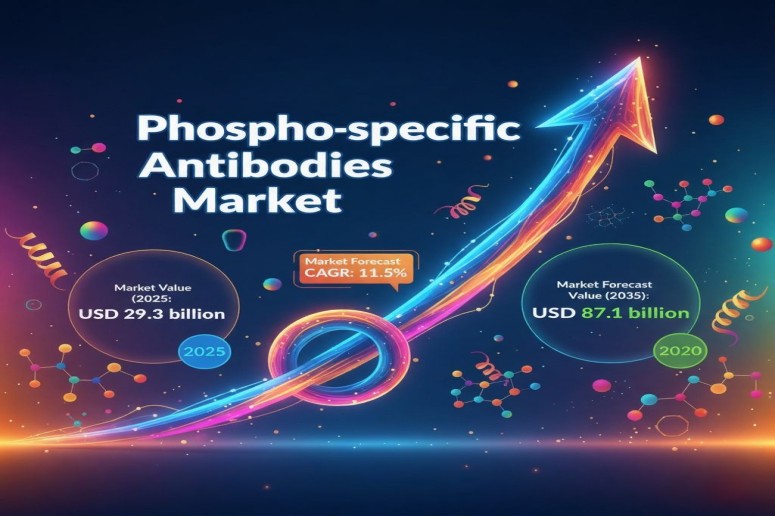
The global Phospho-specific Antibodies Market is on a dynamic growth trajectory, poised to expand from USD 29.3 billion in 2025 to USD 87.1 billion by 2035, reflecting an impressive CAGR of 11.5% over the forecast period. This growth highlights a transformative decade ahead for established biotechnology firms and emerging players alike, as innovation in antibody design, production, and application reshapes the biomedical landscape.
A Surge in Precision Research Driving Market Expansion
The increasing demand for highly specific antibodies in biomedical research and drug discovery has emerged as a major growth catalyst for the phospho-specific antibodies market. As chronic and complex diseases become more prevalent, the need for detailed molecular and cellular analysis has intensified, especially for understanding phosphorylation-dependent mechanisms.
Phospho-specific antibodies, designed to detect and bind to phosphorylated amino acid residues, have become indispensable in studying cell signaling pathways, post-translational modifications, and protein activation patterns. The growing adoption of high-throughput screening techniques and advanced molecular diagnostic tools has further strengthened their role in preclinical and translational research.
Segmental Insights: Gab2 (Phospho-Tyr643) Antibody Leads the Market
In 2025, the Gab2 (Phospho-Tyr643) Antibody segment is anticipated to dominate, holding 32.6% of total market revenue. Its leadership is attributed to its high specificity in detecting phosphorylation at the Tyr643 site—an essential aspect in oncology and cell signaling research.
Gab2 antibodies have become a preferred choice for academic and pharmaceutical laboratories due to their accuracy and reproducibility in experimental conditions. As research institutions increasingly emphasize molecular pathway elucidation and targeted drug development, the Gab2 (Phospho-Tyr643) Antibody segment is set to retain its leadership through 2035. Ongoing advancements in antibody production, purification, and validation are expected to enhance their precision and cost-efficiency, opening new opportunities for both established and emerging manufacturers.
Binding Property Analysis: Phosphorylated Antibodies at the Forefront
By binding property, phosphorylated phospho-specific antibodies are forecast to command 57.8% of the total market share in 2025. This dominance reflects the increasing need for reagents that can detect phosphorylation-dependent protein activity across complex biological systems.
These antibodies play a pivotal role in cellular signaling research and are essential for understanding protein function in health and disease. Their superior reproducibility and specificity make them ideal for biomarker discovery, systems biology, and preclinical studies. As technological innovations enhance sensitivity and reduce cross-reactivity, their application in precision medicine and drug discovery is expected to accelerate significantly.
Application Insights: Western Blotting Remains the Leading Segment
Among applications, Western Blotting continues to be the leading analytical technique, accounting for 28.4% of market share in 2025. This technique remains a cornerstone for protein detection, validation, and phosphorylation quantification, allowing researchers to generate accurate and reproducible data essential for biomedical studies.
Phospho-specific antibodies have elevated the reliability of Western Blotting, especially in oncology, molecular biology, and signaling pathway research. Their compatibility with this method ensures that scientists can efficiently validate complex phosphorylation events across various experimental conditions.
As research into protein function and post-translational modifications intensifies, Western Blotting is expected to maintain its prominence, reinforced by the growing integration of automated platforms and digital imaging systems in research laboratories worldwide.
Geographic Outlook: Asia-Pacific and North America at the Helm
Regionally, the phospho-specific antibodies market demonstrates diverse growth patterns. North America, backed by robust biotechnology infrastructure and substantial R&D funding, continues to hold a significant market share. Meanwhile, Asia-Pacific is emerging as the fastest-growing region, fueled by increased government investment in life sciences, rapid expansion of pharmaceutical manufacturing, and rising academic research initiatives.
At the country level, China (CAGR 15.5%) and India (CAGR 14.4%) are leading growth markets, driven by expanding bioscience ecosystems and collaborations with global pharmaceutical giants. Germany (13.2%), France (12.1%), and the UK (10.9%) sustain strong momentum in Europe, while the United States—estimated to be valued at USD 10.6 billion in 2025 and projected to reach USD 26.9 billion by 2035—continues to drive innovation through its research-driven antibody manufacturing sector.
Market Overview: Technological Evolution and Research Expansion
Phospho-specific antibodies have become one of the most sought-after tools in molecular and biomedical research. They play a vital role in post-translational modification analysis, which influences diverse cellular processes such as signal transduction, protein-protein interactions, and enzymatic regulation.
Their versatility makes them indispensable in various research applications including flow cytometry, immunohistochemistry, immunofluorescence microscopy, ELISA, and chromatin immunoprecipitation assays. Moreover, their usage is extending beyond academic research into clinical diagnostics and drug discovery, particularly in the areas of oncology, endocrinology, and metabolic diseases.
Competitive Landscape: Established Leaders and Emerging Innovators
The global market landscape is characterized by a mix of established biotech giants and agile emerging manufacturers who are leveraging new technologies to capture market share.
Leading companies such as Thermo Fisher Scientific, Genscript, Bio-Rad Laboratories, Cell Signaling Technology, Abcam, and Merck Millipore continue to dominate through their comprehensive antibody portfolios, proprietary validation techniques, and large-scale production capabilities. These firms are increasingly focusing on custom antibody development services to meet specific research and therapeutic needs.
Meanwhile, emerging and mid-tier players including Innovagen AB, Davids Biotechnologie GmbH, AnaSpec Inc., Neo Scientific, Rockland Immunichemicals Inc., Creative-Biolabs, and Creative Diagnostics—are rapidly expanding their presence through innovative antibody engineering, regional collaborations, and integration of AI-based antibody design tools.
Get this Report at $5,000 Only | Exclusive Discount Inside!
https://www.futuremarketinsights.com/reports/sample/rep-gb-7840
Checkout Now to Access Data Insights:
https://www.futuremarketinsights.com/checkout/7840
About Future Market Insights (FMI)
Future Market Insights, Inc. (ESOMAR certified, recipient of the Stevie Award, and a member of the Greater New York Chamber of Commerce) offers profound insights into the driving factors that are boosting demand in the market. FMI stands as the leading global provider of market intelligence, advisory services, consulting, and events for the Packaging, Food and Beverage, Consumer Technology, Healthcare, Industrial, and Chemicals markets. With a vast team of over 400 analysts worldwide, FMI provides global, regional, and local expertise on diverse domains and industry trends across more than 110 countries.
Contact Us:
Future Market Insights Inc.
Christiana Corporate, 200 Continental Drive,
Suite 401, Newark, Delaware – 19713, USA
T: +1-347-918-3531
For Sales Enquiries: sales@futuremarketinsights.com
Website: https://www.futuremarketinsights.com
LinkedIn| Twitter| Blogs | YouTube