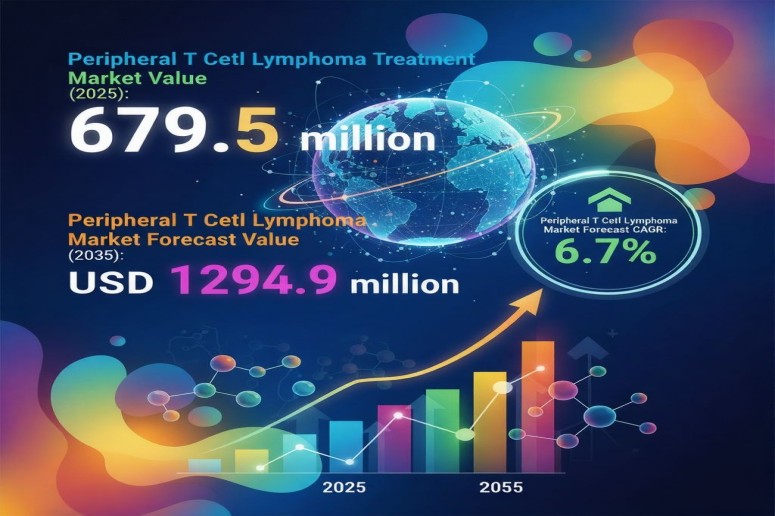
The global Peripheral T-Cell Lymphoma (PTCL) Treatment Market is entering a decade of strong transformation and clinical advancement. Estimated at USD 679.5 million in 2025, the market is projected to nearly double to USD 1,294.9 million by 2035, expanding at a compound annual growth rate (CAGR) of 6.7%. This consistent upward trajectory underscores the growing demand for effective, personalized, and accessible treatments to address one of the most aggressive and complex forms of non-Hodgkin lymphoma.
Peripheral T-Cell Lymphoma remains a rare but life-threatening malignancy affecting T-lymphocytes and natural killer (NK) cells, often diagnosed in older adults. Despite its rarity, the burden of PTCL is increasing across both developed and developing regions, driving the need for advanced therapies, early detection, and expanded clinical care access.
Understanding Peripheral T-Cell Lymphoma (PTCL)
Peripheral T-Cell Lymphoma is an aggressive subtype of non-Hodgkin lymphoma that arises from mature T-cells. It accounts for roughly 6–7% of all non-Hodgkin lymphoma cases in the United States, according to CDC data. However, incidence rates are notably higher in Asia, Africa, and the Caribbean, largely due to environmental and viral exposure factors, including Epstein-Barr Virus (EBV) and Human T-Cell Leukemia Virus-1 (HTLV-1).
Unlike B-cell lymphomas, PTCL has historically exhibited limited treatment success with conventional chemotherapy, often leading to relapse and poor survival rates. However, emerging genetic and molecular research has opened new frontiers, enabling targeted and immunotherapeutic approaches that are reshaping clinical outcomes.
Market Outlook: Growth Catalysts and Key Trends (2025–2035)
The Peripheral T-Cell Lymphoma Treatment Market’s growth is driven by multiple converging factors:
- Rising Prevalence and Diagnosis Rates:
Improved diagnostic technologies, including molecular profiling and genomic testing, have enhanced early detection and classification of PTCL subtypes, increasing treatment eligibility and market demand. - Advent of Targeted and Personalized Therapies:
The approval of targeted drugs such as Beleodaq, Folotyn, and Istodax by the FDA for relapsed or refractory PTCL has significantly improved therapeutic outcomes. These histone deacetylase (HDAC) inhibitors are revolutionizing treatment by focusing on molecular pathways specific to PTCL cells. - Increased Oncology Investments:
Pharmaceutical and biotech companies are intensifying investments in oncology research, particularly in rare haematological malignancies, fostering innovation and accelerating the introduction of next-generation therapies. - Improving Healthcare Infrastructure:
Expanding cancer specialty hospitals and clinical networks, particularly in Asia-Pacific and Europe, are providing better patient management, supporting both drug distribution and adherence. - Integration of Combination Therapies:
Hybrid regimens that integrate chemotherapy and targeted therapy are gaining momentum, aiming to improve response rates while mitigating toxicity and enhancing patient quality of life.
Segmental Analysis: Treatment Regime and Distribution Channels
Treatment Regime Insights
The PTCL treatment market is segmented into various chemotherapy and targeted therapy protocols, including CHOP, CHOEP, EPOCH, Hyper-CVAD, ICE, DHAP, ESHAP, and GND regimens. Targeted therapies, including HDAC inhibitors and metabolic inhibitors, are increasingly complementing traditional approaches.
- Chemotherapy for Aggressive PTCL remains the leading segment, projected to account for 46.8% of total market revenue in 2025.
This dominance stems from its established efficacy, strong clinical validation, and widespread adoption as a first-line therapy.
Moreover, improvements in combination protocols and supportive care have enhanced patient tolerability and adherence. - Targeted therapies for relapsed/refractory PTCL are expected to gain significant traction during the forecast period as the industry shifts toward precision oncology and individualized treatment.
Distribution Channel Insights
By distribution channel, Hospitals remain the primary hubs for PTCL treatment, holding 64.2% of market revenue in 2025.
This prominence reflects hospitals’ ability to deliver comprehensive care, encompassing diagnosis, drug administration, and continuous monitoring. Hospitals also ensure adherence to complex chemotherapy regimens and provide critical supportive services such as transfusions and infection control.
Cancer specialty clinics are expected to witness moderate growth, supported by the expansion of outpatient oncology services and improved access to biologics and targeted therapies.
Regional Outlook: Where the Growth Lies
The PTCL treatment market is geographically diverse, with significant growth potential across both mature and emerging regions.
- North America remains the largest market, led by the United States, which is estimated to grow from USD 254.3 million in 2025 to USD 441.0 million by 2035, at a CAGR of 5.7%.
The region’s growth is driven by strong clinical research capabilities, high healthcare expenditure, and the availability of FDA-approved therapies. - Asia-Pacific is expected to exhibit the fastest growth, driven by higher prevalence rates and improved healthcare access.
China leads with a 9.0% CAGR, followed by India at 8.3%, reflecting rapid improvements in cancer diagnosis and therapy availability. - Europe continues to represent a stable and mature market, with Germany (7.7%), France (7.0%), and the UK (6.3%) contributing significantly to global revenues.
- Latin America and the Middle East & Africa are also poised for gradual development as oncology infrastructure strengthens, particularly in Brazil, which is forecast to grow at 5.0% CAGR.
Competitive Landscape: Leading Players and Strategic Developments
The PTCL treatment market is moderately consolidated, with global and regional players investing heavily in clinical trials, regulatory approvals, and strategic collaborations.
Key Market Participants Include:
- Bristol-Myers Squibb
- Pfizer
- Leadiant Biosciences
- Pacira Pharmaceuticals (Skyepharma)
- Spectrum Pharmaceuticals
- Merck & Co.
- Genmab A/S
These companies are focusing on expanding their oncology portfolios through novel biologics, immune-oncology agents, and combination therapy development. Partnerships with research institutions and healthcare providers are also increasing to facilitate early access programs and real-world evidence studies.
Get this Report at $5,000 Only | Exclusive Discount Inside!
https://www.futuremarketinsights.com/reports/sample/rep-gb-7839
Checkout Now to Access Data Insights:
https://www.futuremarketinsights.com/checkout/7839
About Future Market Insights (FMI)
Future Market Insights, Inc. (ESOMAR certified, recipient of the Stevie Award, and a member of the Greater New York Chamber of Commerce) offers profound insights into the driving factors that are boosting demand in the market. FMI stands as the leading global provider of market intelligence, advisory services, consulting, and events for the Packaging, Food and Beverage, Consumer Technology, Healthcare, Industrial, and Chemicals markets. With a vast team of over 400 analysts worldwide, FMI provides global, regional, and local expertise on diverse domains and industry trends across more than 110 countries.
Contact Us:
Future Market Insights Inc.
Christiana Corporate, 200 Continental Drive,
Suite 401, Newark, Delaware – 19713, USA
T: +1-347-918-3531
For Sales Enquiries: sales@futuremarketinsights.com
Website: https://www.futuremarketinsights.com
LinkedIn| Twitter| Blogs | YouTube