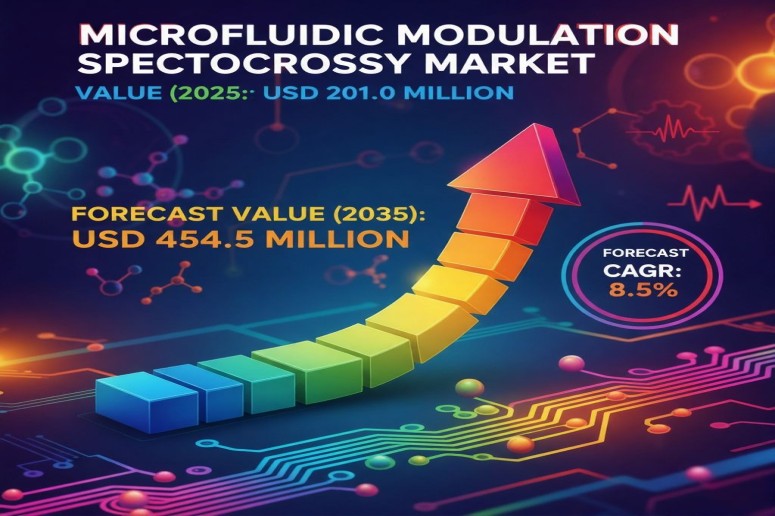
The global Microfluidic Modulation Spectroscopy (MMS) market is poised for remarkable expansion, projected to rise from USD 201.0 million in 2025 to an impressive USD 454.5 million by 2035, growing at a compound annual growth rate (CAGR) of 8.5%. This rapid market growth reflects an era of transformation in biopharmaceutical analysis, drug design, and protein characterization, driven by precision-based research and the emergence of advanced analytical technologies.
As both established industry leaders and emerging innovators seek to strengthen their market positions, microfluidic modulation spectroscopy is gaining recognition as a cornerstone technology for accelerating drug discovery, protein engineering, and biologics development.
A Rapidly Evolving Analytical Landscape
Microfluidic modulation spectroscopy represents a paradigm shift in molecular analysis, offering the precision, scalability, and reproducibility required in modern drug development and protein stability testing. The technology, pioneered by companies like RedShift BioAnalytics, Inc., combines mid-infrared laser spectroscopy with a microfluidic environment to enable real-time, high-resolution monitoring of biomolecular structures.
This innovation delivers a crucial advantage—reducing sample consumption while providing deep structural insights into proteins, peptides, and complex biological formulations. As research organizations and biopharmaceutical manufacturers navigate rising regulatory pressures for higher product quality and safety, MMS emerges as a transformative solution ensuring both speed and scientific accuracy.
Market Dynamics and Growth Drivers
The growing reliance on high-throughput analytical platforms is one of the strongest forces behind market expansion. With increasing investments in drug discovery, biologics, and personalized medicine, demand for efficient and reproducible molecular characterization methods continues to surge.
Moreover, the technology’s ability to integrate seamlessly with computational modeling and AI-based predictive analysis enhances its adoption in early-stage research. By combining precise molecular data with automated decision-making systems, companies are now capable of optimizing formulations and detecting potential instabilities much earlier in the R&D cycle.
Segmental Analysis: Applications and End Users
Drug Designing Leads the Market
Among application segments, Drug Designing dominates, expected to account for 42.6% of global MMS revenues in 2025. This segment’s leadership is driven by its role in enabling precise molecular understanding and the assessment of protein-ligand interactions, which are essential for rational drug design.
The adoption of MMS in this space is reinforced by its efficiency—delivering rapid, reproducible data with minimal sample consumption. Integration with computational modeling tools further enhances accuracy in evaluating binding kinetics, protein folding, and formulation stability.
Pharmaceutical researchers increasingly view microfluidic modulation spectroscopy as indispensable for reducing time-to-market, minimizing experimental variability, and supporting regulatory compliance in drug development pipelines.
Biopharmaceutical Companies as Key End Users
On the end-user front, Biopharmaceutical Companies represent the largest segment, holding an estimated 45.8% share of market revenue in 2025. The sector’s rapid adoption stems from the rising complexity of protein-based drugs, vaccines, and cell therapies, which require highly precise analytical validation throughout their life cycles.
For manufacturers, the technology offers distinct operational advantages—real-time analysis, enhanced reproducibility, and minimized experimental waste—while ensuring adherence to stringent quality and safety standards. Moreover, the global shift toward continuous biomanufacturing and high-throughput screening further amplifies the demand for MMS solutions.
Emerging players are particularly focusing on scalable, cost-effective platforms that integrate automation, digital monitoring, and modular design to make MMS more accessible across medium-sized research organizations and contract research facilities.
Regional Insights: Growth Patterns and Opportunities
- China leads with an exceptional CAGR of 11.5%, driven by increasing R&D funding and a flourishing biologics manufacturing sector.
- India follows with a CAGR of 10.6%, supported by expanding pharmaceutical exports and rapid infrastructure development in research institutions.
- Germany, France, and the UK continue to demonstrate steady growth rates of 9.8%, 8.9%, and 8.1%, respectively, supported by strong innovation ecosystems and regulatory harmonization within the EU.
- In North America, particularly the United States, the market is expected to expand from USD 69.9 million in 2025 to USD 140.4 million by 2035, at a CAGR of 7.2%, reflecting mature adoption of advanced analytical technologies across leading biopharmaceutical enterprises.
- Meanwhile, Brazil shows promising but moderate growth (6.4% CAGR), indicating untapped opportunities for new entrants and technology partnerships in Latin America.
Technology Advancements and Industry Developments
Innovations in laser-based detection systems, integrated microfluidic chip design, and machine learning-assisted data interpretation are redefining the MMS landscape. Companies like RedShift BioAnalytics have pioneered instruments such as the AQS³pro, which utilizes proprietary microfluidic modulation spectroscopy for precise secondary structure analysis of proteins.
Similarly, Lumedica Inc. and Spectradyne LLC are enhancing real-time molecular measurement capabilities, while Insplorion AB and Fluidion SAS are exploring next-generation sensor integration and microfluidic chip miniaturization for scalable deployment.
Opportunities for Emerging Manufacturers
The MMS market is increasingly open to new entrants and mid-scale manufacturers seeking to differentiate themselves through innovation and agility. Opportunities exist in:
- Developing modular MMS instruments tailored to academic and small-scale research environments.
- Integrating AI and cloud analytics for real-time data monitoring and predictive modeling.
- Partnering with biopharma and CROs for co-innovation in drug development workflows.
- Expanding into emerging regions such as Southeast Asia, Eastern Europe, and Latin America, where infrastructure modernization and government incentives are accelerating technology adoption.
Get this Report at $5,000 Only | Exclusive Discount Inside!
https://www.futuremarketinsights.com/reports/sample/rep-gb-7841
Checkout Now to Access Industry Insights:
https://www.futuremarketinsights.com/checkout/7841
About Future Market Insights (FMI)
Future Market Insights, Inc. (ESOMAR certified, recipient of the Stevie Award, and a member of the Greater New York Chamber of Commerce) offers profound insights into the driving factors that are boosting demand in the market. FMI stands as the leading global provider of market intelligence, advisory services, consulting, and events for the Packaging, Food and Beverage, Consumer Technology, Healthcare, Industrial, and Chemicals markets. With a vast team of over 400 analysts worldwide, FMI provides global, regional, and local expertise on diverse domains and industry trends across more than 110 countries.
Contact Us:
Future Market Insights Inc.
Christiana Corporate, 200 Continental Drive,
Suite 401, Newark, Delaware – 19713, USA
T: +1-347-918-3531
For Sales Enquiries: sales@futuremarketinsights.com
Website: https://www.futuremarketinsights.com
LinkedIn| Twitter| Blogs | YouTube