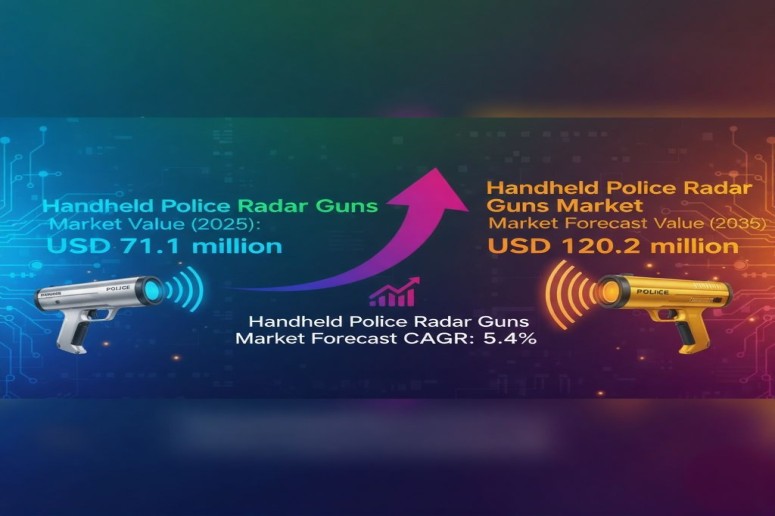
The global handheld police radar guns market is set for a decade of robust expansion, forecasted to grow from USD 71.1 million in 2025 to approximately USD 120.2 million by 2035, registering an absolute gain of USD 49.1 million and a healthy compound annual growth rate (CAGR) of 5.4%. The market’s value is expected to increase nearly 1.7 times during the forecast period, underpinned by accelerating traffic enforcement modernization, regulatory mandates for speed monitoring accuracy, and technological integration in law enforcement equipment.
Market Overview: Rising Adoption of Advanced Speed Detection Tools
As cities worldwide pursue safer, smarter, and more efficient traffic management systems, handheld police radar guns are emerging as essential tools in ensuring compliance and improving road safety outcomes. These compact, portable devices are increasingly favored for their accuracy, operational flexibility, and ability to seamlessly integrate with broader digital enforcement systems.
By 2025, stationary traffic law enforcement applications are anticipated to command a dominant 62% market share, reflecting their critical role in fixed-point monitoring at high-risk traffic zones. From highway patrols to urban enforcement, handheld radar guns provide rapid and precise speed readings vital for effective law enforcement and accident prevention programs.
Growth Catalysts and Industry Drivers
- Technological Advancements – Modern radar systems now incorporate Doppler and LIDAR technologies, digital integration, and enhanced target discrimination capabilities. These improvements enable officers to perform accurate detections across multiple lanes and varying traffic conditions with minimized false alarms.
- Regulatory and Safety Mandates – Government-backed road safety programs and smart city initiatives emphasize accurate speed detection and enforcement accountability, driving the widespread procurement of certified radar systems.
- Urbanization and Vehicle Growth – Expanding metropolitan infrastructure and surging vehicle density, particularly across Asia-Pacific and Latin America, continue to fuel adoption of handheld radar guns as part of traffic modernization efforts.
- Operational Efficiency – The evolution of lightweight, ergonomic, and battery-efficient radar designs enhances officer comfort and supports longer field deployment without performance degradation.
Regional Growth Hotspots: Asia-Pacific and Europe Lead Expansion
- China leads globally with a projected 7.3% CAGR through 2035, driven by rapid expansion of traffic enforcement infrastructure and national road safety initiatives. Law enforcement agencies are adopting advanced radar systems integrated with digital monitoring and automated ticketing platforms.
- India, growing at 6.8% CAGR, is undergoing a transformative phase in traffic enforcement through technology adoption and professional training programs. Expanding expressways and national highway systems are generating significant demand for high-accuracy radar solutions.
- Germany maintains leadership within Europe with a 6.2% CAGR, reflecting its strong focus on traffic safety, precision technology, and regulatory compliance. German agencies prioritize calibration-certified radar systems with robust accuracy and reliability standards.
- Brazil, growing at 5.7% CAGR, is modernizing its extensive highway patrol network, while the United States (5.1%) and the United Kingdom (4.6%) continue to emphasize technology upgrades, professional training, and operational standardization across enforcement departments.
Opportunity Pathways: AI, Connectivity, and Precision Engineering
The industry is entering a transformative phase as radar gun technologies evolve beyond traditional speed measurement toward integrated, intelligent enforcement solutions. Key growth pathways identified in the market include:
- AI-Integrated Smart Detection Systems (USD 15–25 Million Opportunity) – Emerging radar guns incorporate artificial intelligence and machine learning algorithms for enhanced target discrimination, automatic number plate recognition, and predictive analytics—boosting detection precision and evidentiary reliability.
- Multi-Function & Connected Devices (USD 20–30 Million Opportunity) – Integration of speed detection with GPS, wireless data transfer, real-time reporting, and video recording capabilities supports holistic enforcement workflows, reducing equipment redundancy.
- Enhanced Accuracy & Range Technologies (USD 12–20 Million Opportunity) – Advanced signal processing and antenna designs enable multi-lane detection, extended range, and reduced false alarm rates—features increasingly demanded by global law enforcement agencies.
- Emerging Market Penetration (USD 25–40 Million Opportunity) – Manufacturers focusing on regional localization and strategic partnerships across APAC, Latin America, and the Middle East & Africa stand to capture significant volume growth as these regions expand their enforcement infrastructure.
Segmental Highlights: Technology and Application Insights
By technology type, the Doppler radar segment is expected to maintain its leadership position with 58% market share in 2025, benefiting from proven performance and cost-effectiveness. This segment’s reliability across both stationary and mobile enforcement applications positions it as the preferred solution among global police agencies.
By application, stationary traffic law enforcement remains the largest segment at 62% share, underscoring growing investment in fixed-position speed enforcement and highway safety programs. These applications demand high-precision detection tools capable of continuous operation under varying traffic conditions—an area where handheld radar guns excel due to their balance of accuracy, mobility, and ease of deployment.
Competitive Landscape: Innovation and Performance Define Market Leadership
The handheld police radar guns market is characterized by a blend of established manufacturers and emerging innovators, all competing to enhance detection performance, product ergonomics, and integrated system capabilities.
Leading players include:
- Stalker Radar (Applied Concepts) – recognized for precision-engineered, professional-grade radar solutions with proven operational reliability.
- MPD (Kustom Signals, MPH Industries) – delivering specialized detection systems emphasizing accuracy, ruggedness, and field efficiency.
- Decatur Electronics and Laser Technology Inc. – advancing the frontier of digital radar innovation and LIDAR integration.
- Pocket Radar and Bushnell – offering compact, user-friendly radar solutions designed for both law enforcement and sports applications.
- Pacecat-Photoelectric Technology, Qingdao Yizhuo Optoelectronic Technology, and Xi’an Lei Tong Science & Technology – expanding global and regional manufacturing footprints with advanced product portfolios tailored to localized enforcement needs.
Get this Report at $2,000 Only | Exclusive Discount Inside!
https://www.futuremarketinsights.com/reports/sample/rep-gb-26758
Checkout Now to Access Industry Insights:
https://www.futuremarketinsights.com/checkout/26758
About Future Market Insights (FMI)
Future Market Insights, Inc. (ESOMAR certified, recipient of the Stevie Award, and a member of the Greater New York Chamber of Commerce) offers profound insights into the driving factors that are boosting demand in the market. FMI stands as the leading global provider of market intelligence, advisory services, consulting, and events for the Packaging, Food and Beverage, Consumer Technology, Healthcare, Industrial, and Chemicals markets. With a vast team of over 400 analysts worldwide, FMI provides global, regional, and local expertise on diverse domains and industry trends across more than 110 countries.
Contact Us:
Future Market Insights Inc.
Christiana Corporate, 200 Continental Drive,
Suite 401, Newark, Delaware – 19713, USA
T: +1-347-918-3531
For Sales Enquiries: sales@futuremarketinsights.com
Website: https://www.futuremarketinsights.com
LinkedIn| Twitter| Blogs | YouTube