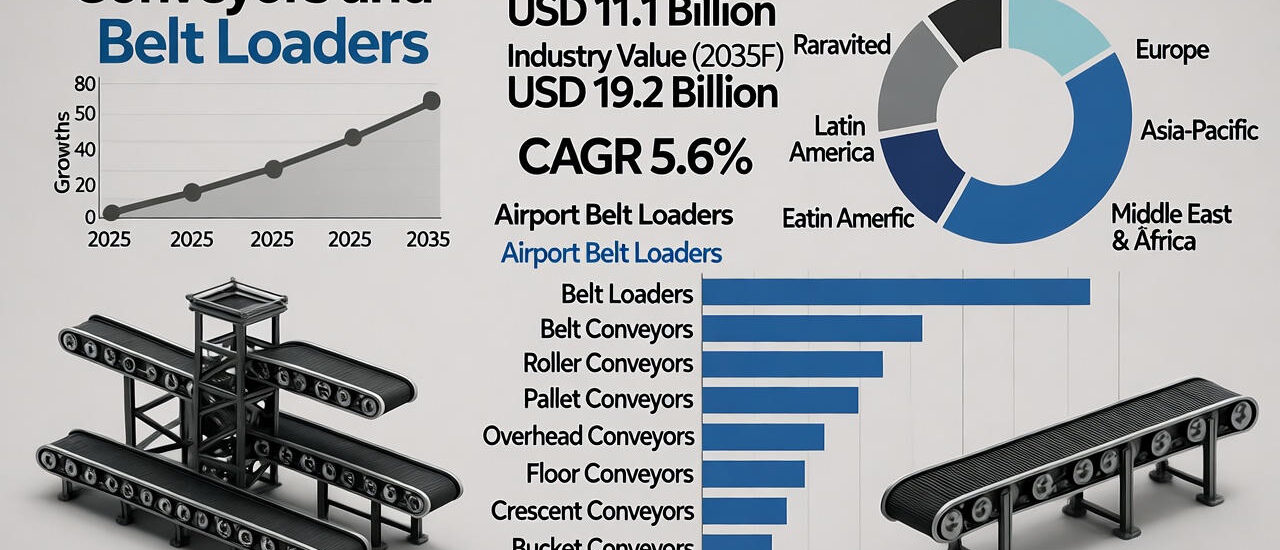
The worldwide conveyors and belt loaders market is poised for steady growth between 2025 and 2035, fueled by rising demand across warehousing, logistics, and material handling industries. These systems streamline the flow of goods and materials, reducing manual labor while enhancing operational efficiency. Today, conveyors and belt loaders have become indispensable from airport baggage handling to large distribution centers underpinning modern supply chain operations.
The global market, valued at approximately USD 11.1 billion in 2025, is expected to reach USD 19.2 billion by 2035, reflecting a CAGR of 5.6%. Key drivers include the push toward automation, AI-based monitoring, and energy-efficient operations, all of which are helping businesses optimize workflow, cut costs, and reduce operational risks.
Get this Report at $5000 Only (Report price) | Exclusive Discount Inside!: https://www.futuremarketinsights.com/reports/sample/rep-gb-2872
Regional Market Trends
North America stands out as a mature and expanding market, driven by strong e-commerce growth and logistics demand. Leading players are investing heavily in automated solutions to maintain cost competitiveness and ensure timely deliveries. Major airports in the U.S. and Canada are replacing outdated baggage handling systems, boosting the adoption of high-efficiency conveyors and belt loaders.
In Europe, automation adoption across automotive, food and beverage, and pharmaceutical sectors is a key driver. Regulatory standards and efficiency requirements encourage businesses to deploy automated material handling systems. Technological innovations such as smart sensors and energy-saving motors are shaping the market, alongside airport infrastructure and cargo handling improvements.
Asia-Pacific is experiencing rapid growth due to industrialization, infrastructure expansion, and the rise of e-commerce distribution centers. Countries like China, India, and Japan are investing in logistics parks and smart manufacturing hubs. Labor cost increases are further pushing the adoption of conveyor and belt loader solutions for efficient operations, supported by government initiatives in trade and automation.
Emerging Technologies and Market Opportunities
The conveyors and belt loaders market faces challenges such as high maintenance costs, energy consumption, and compliance with safety standards. However, opportunities abound in AI-driven predictive maintenance, IoT-enabled monitoring, and energy-efficient motors. Intelligent, modular conveyor designs are being widely adopted to optimize productivity and sustainability.
Automation continues to be a major growth driver. From AI-powered sorting mechanisms to robotic belt loaders, these solutions are enhancing operational efficiency in warehouses, airports, and industrial plants. Lightweight, modular materials, and low-friction belts are improving energy efficiency, while autonomous systems promise greater scalability and reduced labor dependency.
Competitive Landscape and Key Players
The market features both established leaders and emerging innovators. Daifuku Co., Ltd., Siemens Logistics, JBT Corporation, Toyota Material Handling (Bastian Solutions), and Fives Group dominate the global scene, offering solutions from AI-based conveyor tracking to autonomous material handling. Other notable players include Vanderlande, BEUMER Group, Alstef Group, Scharf Automation, and Transnorm Group, all contributing with next-generation, energy-efficient, and automated conveyor technologies.
These companies are focusing on integrating AI, robotics, and predictive analytics into their systems, catering to e-commerce fulfillment centers, automotive assembly lines, and airport baggage handling operations. Investments in sustainable materials, modular designs, and smart logistics solutions are setting the stage for future market expansion.
Buy Now Report Here: https://www.futuremarketinsights.com/checkout/2872
Future Outlook
From 2025 to 2035, the conveyor and belt loader market will continue its upward trajectory, driven by automation, digital integration, and sustainability. AI-assisted monitoring, modular designs, and autonomous material handling systems will define the next decade of innovation. As smart cities emerge and transportation hubs modernize, the adoption of intelligent conveyor solutions is expected to become a central pillar of efficient, automated, and eco-friendly supply chain management.
Related Reports:
About Future Market Insights (FMI)
Future Market Insights, Inc. (ESOMAR certified, recipient of the Stevie Award, and a member of the Greater New York Chamber of Commerce) offers profound insights into the driving factors that are boosting demand in the market. FMI stands as the leading global provider of market intelligence, advisory services, consulting, and events for the Packaging, Food and Beverage, Consumer Technology, Healthcare, Industrial, and Chemicals markets. With a vast team of over 400 analysts worldwide, FMI provides global, regional, and local expertise on diverse domains and industry trends across more than 110 countries.
Join us as we commemorate 10 years of delivering trusted market insights. Reflecting on a decade of achievements, we continue to lead with integrity, innovation, and expertise.
Contact Us:
Future Market Insights Inc.
Christiana Corporate, 200 Continental Drive,
Suite 401, Newark, Delaware – 19713, USA
T: +1-347-918-3531
For Sales Enquiries: sales@futuremarketinsights.com
Website: https://www.futuremarketinsights.com
LinkedIn| Twitter| Blogs | YouTube