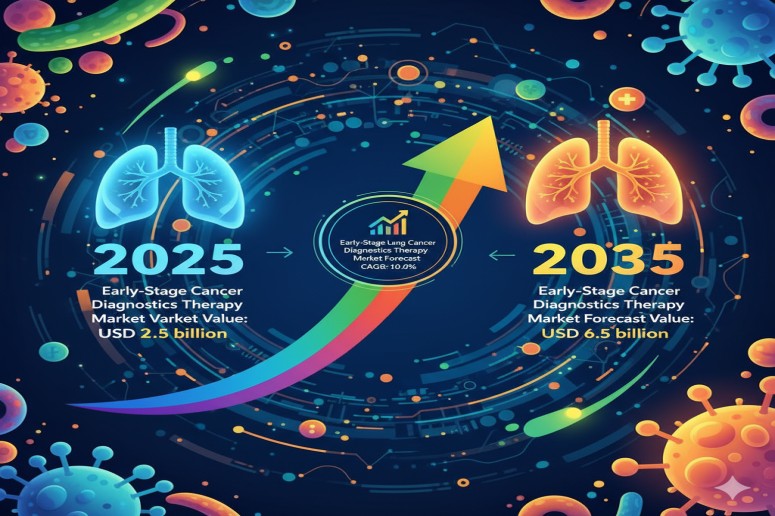
The global Early-Stage Lung Cancer Diagnostics Therapy Market is entering a transformative decade. With its valuation projected to rise from USD 2.5 billion in 2025 to USD 6.5 billion by 2035, the market is set to grow at an impressive CAGR of 10.0%. This surge reflects a critical shift in global oncology — moving from late-stage reactive treatments to early-stage, precision-driven interventions that significantly enhance survival rates and quality of life.
As cancer continues to be one of the leading causes of death worldwide, early diagnosis and intervention are now at the forefront of healthcare innovation. The integration of biomarker-based diagnostics, molecular profiling, and AI-enabled screening is revolutionizing how clinicians identify and treat lung cancer in its earliest and most treatable forms.
Meaning and Importance: Why Early Detection Matters
Early-stage lung cancer diagnostics therapy refers to medical and technological approaches used to detect lung cancer before it progresses into advanced stages. Early identification not only increases survival rates but also reduces treatment costs, hospital stays, and the likelihood of metastasis.
According to the National Cancer Institute, in 2025 alone, over 14 million new cancer cases were recorded globally, resulting in 8.2 million deaths. Lung cancer remains the deadliest among them, largely due to late detection. Only 18% of lung cancer cases are diagnosed at an early stage, underscoring the urgent need for advanced screening and diagnostic solutions.
Market Overview: A Global Perspective
Lung cancer remains a global healthcare challenge. While developed economies have established early screening systems, emerging economies are rapidly catching up, driven by increasing access to diagnostics and government-supported cancer care programs.
Advanced molecular testing methods, such as EGFR and BRAF mutation assays, are enhancing diagnostic accuracy, while non-invasive liquid biopsies are expanding patient accessibility. The market’s trajectory is also being influenced by companion diagnostics that enable personalized therapies — ensuring that treatments are tailored to a patient’s unique genetic profile.
Countries such as China and India are experiencing rapid adoption of these technologies, with CAGRs of 13.5% and 12.5%, respectively, outpacing mature markets like the USA (8.5%) and Germany (11.5%). These trends suggest that Asia-Pacific is emerging as the next growth frontier in the global diagnostics landscape.
Segmental Analysis: Understanding Market Dynamics
By Cell Type: Non Small-Cell Lung Cancer Leads the Charge
The Non Small-Cell Lung Cancer (NSCLC) segment dominates the market, accounting for 72.6% of total revenue in 2025. NSCLC represents the majority of global lung cancer cases and is now the prime focus of early-stage diagnostic programs.
Advancements in biomarker identification, molecular characterization, and AI-based image analysis have made early NSCLC detection more accurate and efficient. Clinicians increasingly rely on these diagnostics to personalize treatments, improving patient survival rates and reducing disease recurrence.
By Test Type: EGFR Tests Powering Personalized Medicine
The EGFR test segment is projected to capture 27.4% of the market in 2025. These tests are pivotal for identifying EGFR mutations, which play a major role in determining eligibility for targeted therapies.
The segment’s strength lies in the expanding availability of high-sensitivity, non-invasive molecular assays, which allow clinicians to detect mutations using minimal samples — accelerating treatment decisions and improving patient outcomes. As awareness of biomarker-driven care rises, the EGFR segment is expected to maintain steady momentum throughout the forecast period.
By End User: Hospital-Associated Laboratories Dominate
Hospital-associated laboratories account for approximately 49.8% of total revenue in 2025. Hospitals are at the center of early cancer diagnosis, supported by advanced molecular diagnostic infrastructure and multidisciplinary oncology teams.
These laboratories are equipped with high-throughput platforms, ensuring precision testing and faster results. The trend toward integrated hospital-based diagnostics is expected to strengthen further, as hospitals continue to consolidate testing services for enhanced efficiency and clinical accuracy.
Regional Insights: Asia-Pacific Takes the Lead
The Asia-Pacific region is anticipated to experience the most dynamic growth, fueled by government-led screening programs, expanding healthcare access, and increasing adoption of genomic diagnostics. China and India, leading with CAGRs of 13.5% and 12.5%, respectively, are positioning themselves as innovation hubs for cancer care.
In contrast, North America remains the most mature market, driven by established healthcare infrastructure and technological leadership. The U.S. market, valued at USD 863.3 million in 2025, is projected to reach USD 2.0 billion by 2035, supported by ongoing R&D investments and widespread use of precision oncology.
Europe continues to hold a strong share, with Germany emerging as a regional leader (CAGR 11.5%), while France and the U.K. maintain steady expansion through integrated national cancer strategies.
Competitive Landscape: Innovation at the Core
The competitive environment in the Early-Stage Lung Cancer Diagnostics Therapy Market is characterized by rapid innovation, strategic collaborations, and technological diversification. Leading players are leveraging AI, molecular analytics, and next-generation sequencing to enhance diagnostic precision and speed.
Key Players include:
- Abbott Laboratories
- Danaher Corporation
- Thermo Fisher Scientific
- QIAGEN N.V.
- Illumina, Inc.
- Quest Diagnostics Incorporated
- NanoString Technologies
- NeoGenomics Laboratories
Future Trends: The Path Toward Predictive Oncology
As healthcare moves toward precision and personalization, the next decade will witness a stronger focus on predictive diagnostics, AI-enabled pathology, and integrated data ecosystems that unify genomic, imaging, and clinical insights.
Emerging technologies such as liquid biopsy, circulating tumor DNA (ctDNA) analysis, and machine learning–based screening tools are set to redefine how early lung cancer is diagnosed and managed. Furthermore, collaboration between biotechnology firms and healthcare providers will accelerate the transition from reactive to preventive oncology.
Get Instant Access for Only $5,000 | Don’t Miss This Exclusive Offer!
https://www.futuremarketinsights.com/reports/sample/rep-gb-2837
Checkout Now to Access Data Insights:
https://www.futuremarketinsights.com/checkout/2837
About Future Market Insights (FMI)
Future Market Insights, Inc. (ESOMAR certified, recipient of the Stevie Award, and a member of the Greater New York Chamber of Commerce) offers profound insights into the driving factors that are boosting demand in the market. FMI stands as the leading global provider of market intelligence, advisory services, consulting, and events for the Packaging, Food and Beverage, Consumer Technology, Healthcare, Industrial, and Chemicals markets. With a vast team of over 400 analysts worldwide, FMI provides global, regional, and local expertise on diverse domains and industry trends across more than 110 countries.
Contact Us:
Future Market Insights Inc.
Christiana Corporate, 200 Continental Drive,
Suite 401, Newark, Delaware – 19713, USA
T: +1-347-918-3531
For Sales Enquiries: sales@futuremarketinsights.com
Website: https://www.futuremarketinsights.com
LinkedIn| Twitter| Blogs | YouTube