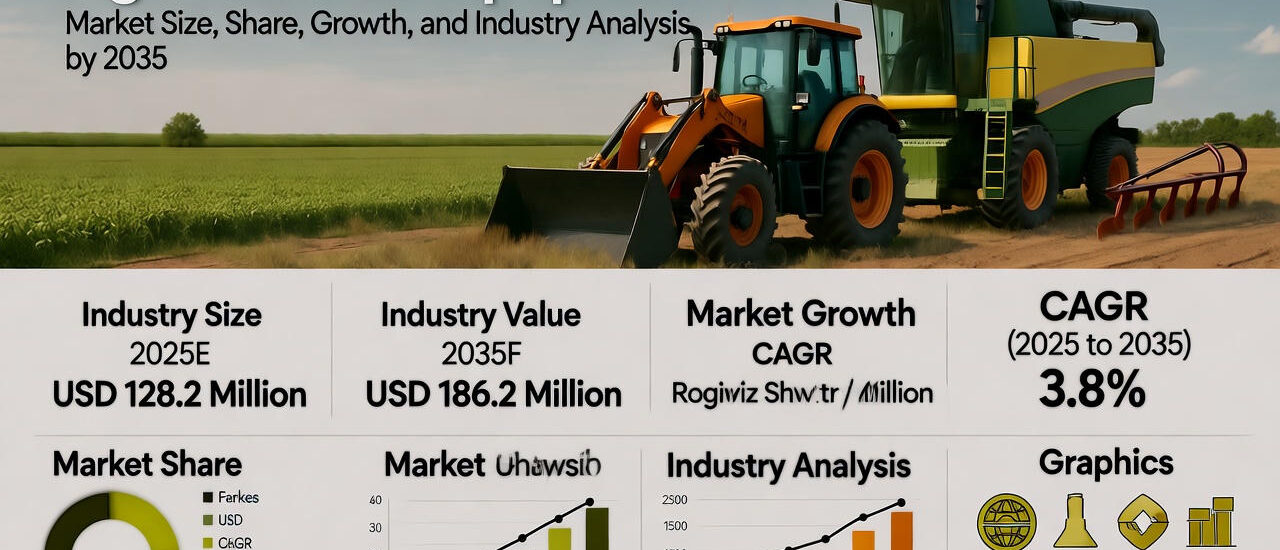
The Agricultural Equipment Market heralds a decade of accelerated transformation in the farming machinery sector, as both established manufacturers and ambitious newcomers vie to shape the future. Fueled by soaring demand for high-performance, efficient machinery, the market is expected to grow from USD 128.2 million in 2025 to USD 186.2 million by 2035 at a CAGR of 3.8%. Driving this surge are global population pressures, agricultural productivity mandates, and the uptake of advanced technologies.
Get this Report at $5000 Only (Report price) | Exclusive Discount Inside!: https://www.futuremarketinsights.com/reports/sample/rep-gb-523
Growth Drivers and Technological Trends
In the evolving agricultural landscape, precision farming is no longer optional it is imperative. Farmers and agro-enterprises are increasingly deploying GPS-guided implements, satellite-controlled tools, self-driving tractors, and data-driven crop management systems. These shifts have raised demand for premium tractors, harvesters, planters, and smart irrigation systems. At the same time, sustainability demands have motivated the development of greener machinery, stricter emissions compliance, and alternative-fuel technologies.
Government stimulus programs in emerging economies via subsidies, training, and financial incentives are smoothing the path for new and incumbent manufacturers to expand their presence. Meanwhile, investments in research & development are enabling equipment that is more durable, efficient, and climate-resilient. This dual momentum ensures the agricultural equipment industry is poised for remarkable growth over the next decade.
Segment Outlook: Tractors and Power Tillers
Tractors and power tillers command the lion’s share of the market, thanks to mechanization’s increasing penetration across farm scales. Modern tractors offer unmatched power, fuel efficiency, and multifunctionality as they replace manual and animal labor. Farmers now demand high-horsepower units for deep plowing and high-speed seeding, paired with automatic steering, variable rate controls, telematics, and AI-based systems. The adoption of low-emission engines, hybrid drives, and next-generation fuel systems reflects the pressure to align farming with environmental goals.
New players entering the market are exploring modular attachments, AI-enhanced drives, and smart sensors to compete with incumbents. Compact tractors aimed at smaller plots, orchards, and vineyards are opening fresh markets for emerging manufacturers. The challenges of upfront cost, fuel volatility, and maintenance complexity persist, but innovations in AI, engine design, and subsidy support are helping to lower barriers and drive broader adoption.
Tractor-Pulled vs. Self-Propelled Equipment
Mechanization in agriculture divides into two major paths: tractor-pulled attachments and self-propelled machines. Tractor-pulled equipment is favored for multi-functional flexibility from heavy tillage tools and seeding devices to harvesting attachments. The rise of AI-powered, sensor-equipped implements enables real-time soil analysis, precise depth control, and resource-efficient operations.
Self-propelled machines, on the other hand, appeal to large commercial operations. Autonomous harvesters, sprayers, and irrigation systems now incorporate real-time yield mapping, GPS navigation, and nutrient analysis. Although their higher capital costs and maintenance demands pose hurdles, firms whether legacy manufacturers or tech entrants are relentlessly innovating to reduce costs and improve usability through augmented autonomy and modular designs.
Regional Trends
In North America, the presence of global OEMs and strong adoption of precision practices support continued growth, with renewable energy integration emerging as a key differentiator. In Europe, sustainability and strict regulations drive demand for electric and hybrid machinery, aided by generous agricultural incentives. Asia-Pacific is one of the fastest-growing markets, especially in China and India, where subsidy programs and government initiatives fuel adoption of modern tractors, irrigation, and post-harvest equipment. Precision farming in Japan and South Korea is spurring uptake of GPS tractors, drone technologies, and automated monitoring.
Challenges and Opportunities
Rising equipment prices, supply chain bottlenecks, and raw material volatility pose significant headwinds. Delays in semiconductors or steel shipments and logistical uncertainties challenge manufacturers’ ability to scale. To counter these pressures, both established and new firms must refine sourcing strategies, embrace lean manufacturing, and focus on cost-efficient innovations.
On the flip side, automation, AI, robotics, 3D printing, sustainability, and precision technologies stand as massive opportunities. Companies that offer data-driven decision support, alternative fuel machines, and advanced connectivity services will be best positioned to lead in this dynamic period of transformation.
Buy Now Report Here: https://www.futuremarketinsights.com/checkout/523
Competitive Landscape and New Entrants
Legacy names such as Deere & Company, CNH Industrial, AGCO, Kubota, and CLAAS continue to dominate market share, investing heavily in autonomy, AI, and analytics. Deere maintains ~18-22 %, CNH ~14-18 %, and AGCO ~10-14 %. Yet the “Other Companies” segment accounts for a 40–50 % share a testament to the growing influence of agri-tech startups and regional manufacturers.
Emerging players such as Mahindra & Mahindra, Yanmar, SDF Group, Lemken, and TAFE are carving out niches by focusing on cost-optimized designs, smart attachments, and localized innovations. They are well positioned to capture demand in underserved markets and offer compelling alternatives to global giants.
Looking Ahead
From 2025 to 2035, the agricultural equipment market is set to witness a pronounced shift: from conventional mechanization to integrated, autonomous, and sustainable systems. Electric and hydrogen vehicles, fully autonomous tractors, AI seeding machines, and cloud-based IoT analytics will reshape farming operations. The winners will be those manufacturers — established or new — that invest early in green manufacturing, digital agriculture, and machine learning–based automation. The next decade will not just expand the market; it will redefine farming’s relationship to technology, sustainability, and global food security.
Related Reports:
Gas Insulated Substation Market- https://www.futuremarketinsights.com/reports/gas-insulated-substation-market
Soil Testing Market- https://www.futuremarketinsights.com/reports/soil-testing-equipment-market
Fine Bubble Diffuser Market- https://www.futuremarketinsights.com/reports/fine-bubble-diffuser-market
About Future Market Insights (FMI)
Future Market Insights, Inc. (ESOMAR certified, recipient of the Stevie Award, and a member of the Greater New York Chamber of Commerce) offers profound insights into the driving factors that are boosting demand in the market. FMI stands as the leading global provider of market intelligence, advisory services, consulting, and events for the Packaging, Food and Beverage, Consumer Technology, Healthcare, Industrial, and Chemicals markets. With a vast team of over 400 analysts worldwide, FMI provides global, regional, and local expertise on diverse domains and industry trends across more than 110 countries.
Join us as we commemorate 10 years of delivering trusted market insights. Reflecting on a decade of achievements, we continue to lead with integrity, innovation, and expertise.
Contact Us:
Future Market Insights Inc.
Christiana Corporate, 200 Continental Drive,
Suite 401, Newark, Delaware – 19713, USA
T: +1-347-918-3531
For Sales Enquiries: sales@futuremarketinsights.com
Website: https://www.futuremarketinsights.com
LinkedIn| Twitter| Blogs | YouTube