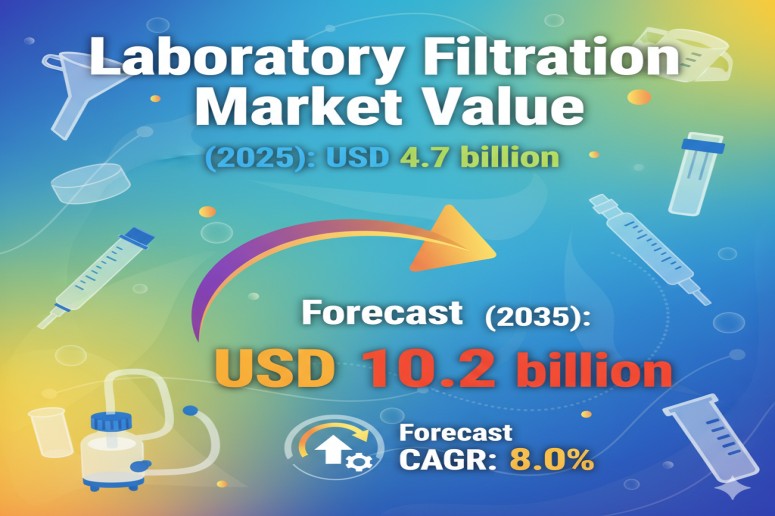
The global Laboratory Filtration Devices Market is poised for sustained expansion, projected to grow from USD 4.7 billion in 2025 to USD 10.2 billion by 2035, marking a strong compound annual growth rate (CAGR) of 8.0%, according to the latest market analysis. This growth reflects increasing investments in drug discovery, biologics development, and advanced diagnostic workflows, which are amplifying demand for high-performance, contamination-free laboratory environments.
Filtration has long been an essential component of laboratory operations, ensuring sterility, reproducibility, and precision in research and production. As laboratories face mounting regulatory requirements and pressure for faster, cleaner testing methods, filtration technologies are becoming indispensable across pharmaceutical, biotechnology, and food testing industries.
Rising Demand for Precision, Sterility, and Safety
The adoption of laboratory filtration devices is accelerating as research institutions and manufacturers prioritize reliability and safety in sample preparation, sterilization, and separation processes. These devices ensure consistent removal of particulates, microorganisms, and other contaminants from liquids and gases—critical to ensuring data integrity and product quality.
“Filtration technology now plays a pivotal role in enabling scientific innovation,” the report notes. “With the growth of biopharmaceuticals, cell-based research, and genomics, laboratories require advanced filtration systems that meet stringent regulatory and operational standards.”
Technological innovations, particularly in polymeric membrane filters and automation-integrated filtration systems, are propelling the market forward. The emphasis is shifting from traditional reusable equipment to disposable, contamination-free solutions, aligning with the global trend toward safer and more efficient laboratory practices.
Segmental Insights: Membrane Filters Lead the Market
Among product categories, Membrane Filters are set to dominate the global market, capturing 25.3% of total revenue in 2025. Their precision, reliability, and versatility make them indispensable for applications such as protein purification, water testing, and sterilization. Laboratories benefit from their ability to offer customizable pore sizes and materials, ensuring compatibility with diverse scientific needs.
The continued evolution of polymeric membranes is enhancing durability, flow rates, and chemical resistance, driving adoption across pharmaceutical and biotechnology workflows. As laboratories worldwide pursue contamination-free environments and reproducible outcomes, membrane filters are expected to retain their market leadership throughout the forecast period.
Disposable Filtration Systems Transform Laboratory Workflows
The Disposable Utility Segment, projected to account for 61.2% of market share in 2025, underscores the growing shift toward single-use filtration solutions. Disposable systems significantly reduce the risks of cross-contamination and eliminate time-intensive cleaning and sterilization procedures, offering laboratories greater efficiency and cost-effectiveness.
These systems have become particularly vital in cell culture, sterility testing, and diagnostic sample preparation, where precision and cleanliness are paramount. As regulatory bodies tighten quality assurance standards, disposable filtration technologies are gaining traction as the preferred choice for laboratories seeking scalability, compliance, and operational safety.
Microfiltration Technology Dominates Technological Adoption
On the technology front, Microfiltration continues to hold the largest market share, expected to account for 40.3% of total revenue in 2025. This technology’s versatility—spanning sterilization, clarification, and water purification—makes it integral to laboratories worldwide.
Microfiltration serves as a frontline defense against bacterial contamination while maintaining high throughput, essential for research-intensive and industrial settings. With the surge in biologics and vaccine development, the demand for microfiltration systems designed for sterile production environments is set to rise sharply. Ongoing innovations in membrane design and material science are expected to reduce operational costs and improve filtration efficiency.
Regional Outlook: Asia-Pacific and Europe Drive Global Expansion
Regionally, the Asia-Pacific (APAC) market is emerging as a powerhouse, led by China and India, which are forecast to register CAGRs of 10.8% and 10.0%, respectively. These countries are witnessing rapid growth in biopharmaceutical production, academic research, and clinical diagnostics, supported by favorable government funding and expanding R&D infrastructure.
In Europe, markets such as Germany (9.2% CAGR) and France (8.4% CAGR) are showing consistent growth, buoyed by investments in advanced laboratory technologies and sustainable manufacturing practices. The United States, valued at USD 1.6 billion in 2025, is projected to reach USD 3.1 billion by 2035, maintaining a steady CAGR of 6.8%—reflecting strong institutional research funding and biopharma innovation.
While Brazil trails with a 6.0% CAGR, its positive trajectory underscores the global nature of demand for laboratory filtration solutions, even in emerging markets.
Competitive Landscape: Innovation and Expansion Define Strategy
The market remains moderately consolidated, with leading players focusing on innovation, automation, and regional expansion. Key participants include 3M, Merck KGaA, Danaher Corporation, Sartorius AG, and Thermo Fisher Scientific Inc., all of which continue to expand their product portfolios and strengthen global distribution networks.
Other notable players such as GVS SpA, Cole-Parmer Instrument LLC, Agilent Technologies Inc., Repligen Corp., and Ahlstrom-Munksjö are emphasizing advancements in membrane technologies, smart filtration devices, and integration-ready systems for laboratory automation platforms. Strategic collaborations between equipment manufacturers and biopharmaceutical companies are expected to further accelerate technology adoption and market penetration.
Get this Report at $5,000 Only | Exclusive Discount Inside!
https://www.futuremarketinsights.com/reports/sample/rep-gb-2835
Checkout Now to Access Industry Insights:
https://www.futuremarketinsights.com/checkout/2835
About Future Market Insights (FMI)
Future Market Insights, Inc. (ESOMAR certified, recipient of the Stevie Award, and a member of the Greater New York Chamber of Commerce) offers profound insights into the driving factors that are boosting demand in the market. FMI stands as the leading global provider of market intelligence, advisory services, consulting, and events for the Packaging, Food and Beverage, Consumer Technology, Healthcare, Industrial, and Chemicals markets. With a vast team of over 400 analysts worldwide, FMI provides global, regional, and local expertise on diverse domains and industry trends across more than 110 countries.
Contact Us:
Future Market Insights Inc.
Christiana Corporate, 200 Continental Drive,
Suite 401, Newark, Delaware – 19713, USA
T: +1-347-918-3531
For Sales Enquiries: sales@futuremarketinsights.com
Website: https://www.futuremarketinsights.com
LinkedIn| Twitter| Blogs | YouTube