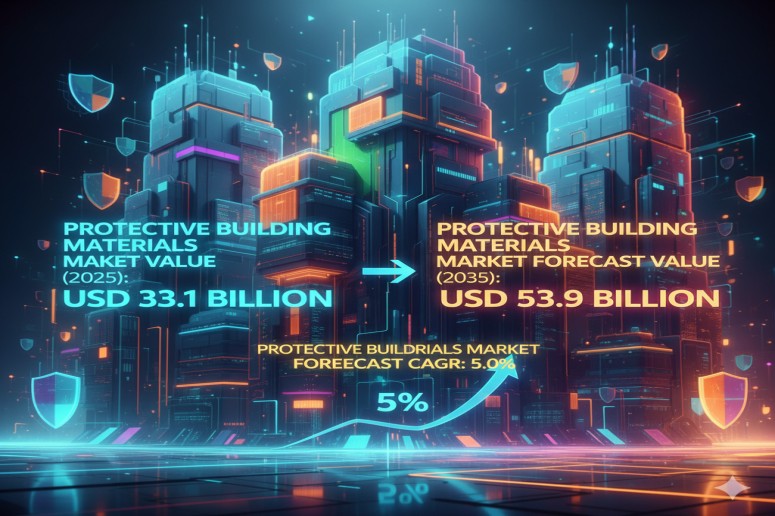
The global Protective Building Materials Market is on a strong growth trajectory, projected to rise from USD 33.1 billion in 2025 to USD 53.9 billion by 2035, registering a compound annual growth rate (CAGR) of 5.0%. This steady expansion reflects the global construction industry’s increasing emphasis on safety, durability, and environmental responsibility.
A Market Built on Safety, Strength, and Sustainability
Protective building materials are the cornerstone of modern construction, providing the resilience structures need to withstand extreme environmental conditions, physical stress, and long-term wear. From fire-resistant claddings and impact-resistant flooring to energy-efficient insulation, these materials enhance both the performance and lifespan of buildings across sectors.
As global urbanization accelerates and infrastructure investments surge, the demand for advanced, sustainable, and high-performance materials continues to grow. Governments and private developers alike are prioritizing fire resistance, acoustic insulation, waterproofing, and thermal efficiency, driving market adoption across residential, commercial, and industrial applications.
Regulatory standards emphasizing energy conservation and safety compliance are compelling construction companies to invest in next-generation materials. This shift is reshaping competitive dynamics, attracting both established manufacturers and emerging innovators to expand their portfolios and develop breakthrough technologies that redefine building protection.
Market Overview and Regional Outlook
The Protective Building Materials Market is expanding globally, led by strong growth in North America, Asia-Pacific, and Europe. Emerging economies such as China and India are posting some of the fastest growth rates, at 6.8% and 6.3% CAGR respectively, reflecting rapid urbanization and public infrastructure development.
Meanwhile, developed regions like Germany (5.8%), France (5.3%), and the United Kingdom (4.8%) are maintaining steady expansion through building renovation and green construction initiatives. The U.S. market is valued at USD 12.4 billion in 2025 and is anticipated to reach USD 18.8 billion by 2035, growing at 4.3% CAGR, supported by stringent safety regulations and adoption of smart construction materials.
The Asia-Pacific region, however, remains the epicenter of growth, propelled by government-driven infrastructure projects and industrialization. Japan and South Korea, valued at USD 1.7 billion and USD 939.5 million respectively in 2025, are emerging as technology hubs for material innovation and sustainable manufacturing.
Segmental Insights: Flooring Dominates Application Share
By application, the flooring segment is expected to account for 36.2% of total market revenue in 2025, maintaining its leadership throughout the forecast period. Flooring materials are central to building protection, offering resistance against mechanical stress, moisture, and chemicals, while also enhancing safety through slip and fire-resistant properties.
Metallic Materials: The Backbone of Modern Protection
In terms of material type, metallic protective materials hold the dominant share of 40.1% in 2025, underscoring their indispensable role in construction and infrastructure. Metals such as aluminum, steel, and specialized alloys offer unmatched strength, corrosion resistance, and recyclability, making them essential in both load-bearing and cladding applications.
Thermal Insulators Lead in Energy-Efficient Construction
The thermal insulators segment is projected to account for 29.3% of the market share in 2025, driven by the global shift toward energy-efficient and climate-responsive architecture. Insulating materials reduce energy consumption by maintaining optimal indoor temperatures, directly supporting carbon reduction goals and green building certifications.
Sustainability and Technological Innovation at the Core
The future of the protective building materials market lies at the intersection of technology and sustainability. Leading players are prioritizing recyclable inputs, low-emission manufacturing, and nanotechnology-driven material development. This transformation aligns with the broader global trend toward eco-friendly construction practices, supported by corporate environmental goals and consumer awareness.
Established manufacturers such as BASF SE, 3M, Owens Corning, DuPont, and Sika AG continue to invest heavily in R&D to expand their material portfolios and improve performance efficiency. Knauf Insulation and Trelleborg AB are focusing on advanced insulation and sealing systems designed for high-efficiency buildings, while Cymat Building Materials and K. Wah Group represent emerging innovators developing lightweight metal foams and composite reinforcements for specialized applications.
CBC Group is leveraging partnerships to enhance distribution networks and integrate smart materials technology into traditional construction segments. This wave of innovation is not only transforming product quality but also encouraging cross-industry collaboration between construction firms, material scientists, and sustainability experts.
Global Market Dynamics: Emerging Economies Drive Future Growth
Emerging economies are at the forefront of the market’s next growth phase. With rapid industrialization and urban development, countries such as China, India, and Southeast Asian nations are investing in resilient infrastructure to withstand climate and environmental challenges. Government initiatives promoting energy-efficient and disaster-resilient buildings are fueling investments in protective materials across residential, commercial, and public projects.
At the same time, developed regions are focusing on building retrofitting and modernization, particularly in Europe, where regulatory frameworks are advancing green renovation incentives. The integration of digital construction technologies—such as Building Information Modeling (BIM)—is further supporting the effective use and tracking of protective materials throughout a building’s lifecycle.
A Competitive Market with Expanding Horizons
The global competitive landscape is evolving rapidly as both established and new entrants aim to expand their presence. Traditional industry leaders are strengthening their market share through acquisitions, partnerships, and technological advancements, while startups are introducing innovative eco-materials and smart protection systems tailored to future building needs.
With the ongoing convergence of AI-driven material design, nanotechnology, and circular economy principles, the next decade promises a transformative era for protective building materials. Companies investing in sustainability, adaptability, and digital integration will be best positioned to capture emerging opportunities in the global construction boom.
Get this Report at $5,000 Only | Exclusive Discount Inside!
https://www.futuremarketinsights.com/reports/sample/rep-gb-1963
Checkout Now to Access Industry Insights:
https://www.futuremarketinsights.com/checkout/1963
About Future Market Insights (FMI)
Future Market Insights, Inc. (ESOMAR certified, recipient of the Stevie Award, and a member of the Greater New York Chamber of Commerce) offers profound insights into the driving factors that are boosting demand in the market. FMI stands as the leading global provider of market intelligence, advisory services, consulting, and events for the Packaging, Food and Beverage, Consumer Technology, Healthcare, Industrial, and Chemicals markets. With a vast team of over 400 analysts worldwide, FMI provides global, regional, and local expertise on diverse domains and industry trends across more than 110 countries.
Contact Us:
Future Market Insights Inc.
Christiana Corporate, 200 Continental Drive,
Suite 401, Newark, Delaware – 19713, USA
T: +1-347-918-3531
For Sales Enquiries: sales@futuremarketinsights.com
Website: https://www.futuremarketinsights.com
LinkedIn| Twitter| Blogs | YouTube