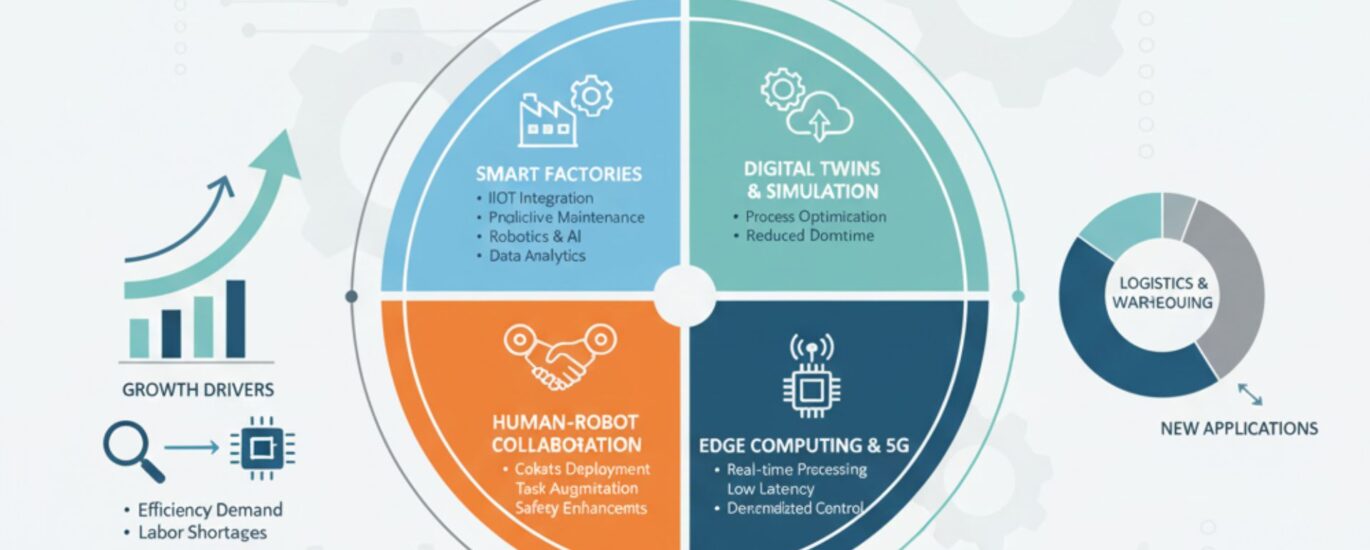
The palletizing systems market is entering a decade of transformative growth, driven by rapid industrialization, e-commerce expansion, and advancements in robotics and IoT technologies. Global sales of palletizing systems are projected to reach USD 2,456.4 million in 2025 and are expected to surge to USD 3,925.6 million by 2035, achieving a CAGR of 4.8% during the forecast period. This growth reflects both the rising demand for automation and manufacturers’ focus on operational efficiency, safety, and productivity.
Rising Demand for Automated Palletizing Systems
Manufacturers worldwide are increasingly seeking solutions that address labor cost reductions, workplace safety, and faster supply chain operations. Automated palletizing systems, which integrate high-speed robotics, IoT, and AI-driven sensors, offer precise and efficient product handling. Industries such as food & beverages, pharmaceuticals, and e-commerce are leading the adoption curve, relying on these systems to maintain high hygiene standards, handle perishable goods, and meet growing consumer demands.
The automation of palletizing tasks not only accelerates production but also ensures quality control, making these systems indispensable for modern warehouse and manufacturing operations.
Buy Now & Save: Premium Market Report at $5,000 | Discount Details Inside:- https://www.futuremarketinsights.com/reports/sample/rep-gb-1195
Industry Value and Market Growth
The palletizing systems industry is projected to provide an incremental opportunity of USD 1,469.3 million by 2035, growing 1.6X over the decade. Semi-annual analysis indicates a steady upward trajectory: the CAGR from H1 2025 to H2 2035 is expected to be 4.6% in the first half of each year and 5% in the second half. These figures highlight the consistent demand and ongoing technological advancements that drive market performance.
Tier 1 companies dominate the market, capturing 55–60% of the share, with global leaders such as ABB Flexible Automation Inc, KUKA Roboto GmbH, Intelligrated Inc, and Cermex group spearheading innovation. Tier 2 players serve niche markets locally, focusing on tailored solutions for smaller industrial needs.
Technological Advancements Driving Efficiency
The integration of robotics and IoT into palletizing systems has transformed logistics and warehouse management. Robotic palletizers can handle multiple product types and sizes, while sensor-enabled IoT systems allow real-time monitoring and diagnostics. Collaborative robots (cobots) are increasingly working alongside human operators to execute repetitive palletizing tasks, boosting productivity without compromising safety.
Energy efficiency and sustainability are also key trends. Manufacturers are adopting eco-friendly materials and designing energy-conscious systems, supported by grants and regulatory incentives. These innovations not only reduce operational costs but also help companies achieve sustainability targets while maintaining high-speed operations.
Regional Insights: USA, China, and India
The USA remains a leading market for palletizing systems, particularly in food & beverage, e-commerce, and pharmaceuticals. Automated solutions like FANUC’s 2024 robotic palletizing systems enhance precision and operational speed, allowing manufacturers to reduce labor costs while increasing output. The growth of online retail—projected to reach USD 1.72 trillion by 2027—further emphasizes the need for high-speed, reliable palletizing systems.
China is experiencing rapid market expansion, driven by industrialization, e-commerce, and government initiatives like “Made in China 2025.” Cities such as Shanghai, Guangzhou, and Shenzhen are embracing robotics and automation, while emerging industrial hubs like Chengdu, Xi’an, and Hangzhou are expected to increase automated palletizer adoption by 30% over the next five years.
India’s palletizing systems market is growing alongside its industrial sector, e-commerce expansion, and government programs such as “Make in India” and PLI schemes for pharmaceutical and medical device manufacturing. Increased investments in automation solutions are enabling businesses to enhance operational efficiency and meet global standards.
Segment Analysis: Robotic Palletizers and Industry Applications
By 2035, robotic palletizers are expected to account for 44.6% of the palletizing systems market. These systems provide flexibility, speed, and precision, making them ideal for industries with high variability in product types and packaging formats.
- Food & Beverage: Leading end-use segment with 22.6% share. Automated palletizers ensure hygiene, rapid handling, and minimal defects.
- Pharmaceuticals: Precision and regulatory compliance are key, driving adoption of robotic systems.
- E-Commerce & Retail: Speed and customization in packaging are essential for efficient order fulfillment.
Floor-level and high-level palletizers remain suitable for high-volume, static environments, but robotic solutions are preferred where flexibility and adaptability are critical.
Competitive Landscape and Recent Developments
The palletizing systems market is witnessing a wave of innovation as established players and new entrants push technological boundaries. Premier Tech’s 2024 introduction of collaborative robots enhanced packaging and palletizing flexibility. Estun Automation launched high-payload robots for automotive and metal processing, leveraging proprietary servo systems for improved precision.
Market leaders such as ABB Robotics, FANUC Corporation, and KUKA AG are integrating AI and IoT into their systems, extending their reach into emerging industrial automation markets. Continuous R&D and innovative offerings ensure sustained growth for the palletizing systems sector.
Click Here to Purchase the Report:- https://www.futuremarketinsights.com/checkout/1195
Future Outlook
The global palletizing systems market is poised for sustained growth from 2025 to 2035, driven by industrial automation, robotics integration, e-commerce demands, and energy-efficient innovations. Manufacturers adopting these systems will achieve higher operational efficiency, enhanced safety, and improved supply chain performance. With global sales projected to reach nearly USD 4 billion by 2035, palletizing systems will remain a cornerstone of modern manufacturing and logistics strategy.
About Future Market Insights (FMI)
Future Market Insights, Inc. (ESOMAR certified, recipient of the Stevie Award, and a member of the Greater New York Chamber of Commerce) offers profound insights into the driving factors that are boosting demand in the market. FMI stands as the leading global provider of market intelligence, advisory services, consulting, and events for the Packaging, Food and Beverage, Consumer Technology, Healthcare, Industrial, and Chemicals markets. With a vast team of over 400 analysts worldwide, FMI provides global, regional, and local expertise on diverse domains and industry trends across more than 110 countries.
Contact Us:
Future Market Insights Inc.
Christiana Corporate, 200 Continental Drive,
Suite 401, Newark, Delaware – 19713, USA
T: +1-347-918-3531
For Sales Enquiries: sales@futuremarketinsights.com
Website: https://www.futuremarketinsights.com
LinkedIn| Twitter| Blogs | YouTube