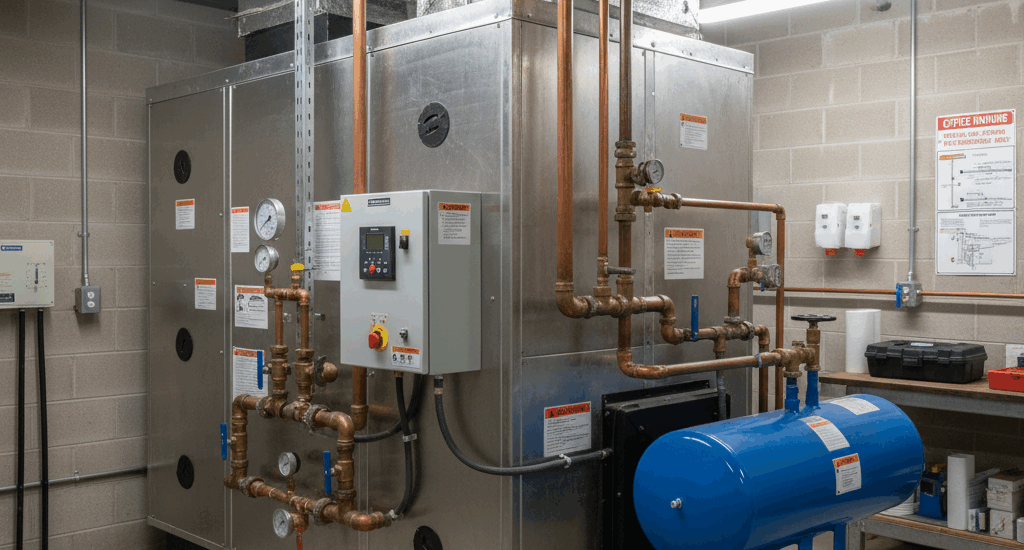
The global Office Boiler Market is poised for substantial expansion, growing from USD 3.3 billion in 2025 to USD 6.2 billion by 2035, reflecting a 6.5% CAGR. This growth underscores the increasing need for energy-efficient heating and hot water systems across office complexes, corporate campuses, and shared workspaces worldwide.
Between 2020 and 2024, the market matured from its early adoption phase, where pilot installations and safety assessments laid the foundation for broad commercial acceptance. By 2025, office boilers became integral to mid- and large-scale commercial projects, signaling the transition toward standardized procurement, installation, and maintenance practices.
Get this Report at $5000 | Grab Your Market Insights Today: https://www.futuremarketinsights.com/reports/sample/rep-gb-25530
Energy Efficiency and Sustainability Drive Market Growth
The demand for energy-efficient office heating solutions is a primary force propelling the market forward. With rising fuel prices, stricter emission regulations, and the global drive toward low-carbon infrastructure, businesses are turning to advanced boiler technologies that reduce operating costs while improving workplace comfort.
Modern office boilers are no longer just heat sources—they are smart, connected systems capable of optimizing energy distribution and maintaining consistent performance. These systems integrate seamlessly with building management systems (BMS), allowing real-time monitoring, predictive maintenance, and enhanced safety.
Natural gas-fueled boilers, which account for 57.6% of the market share in 2025, remain the preferred choice for commercial applications due to their efficiency, reliability, and cleaner combustion profiles. Meanwhile, the shift toward hybrid and modular boilers, capable of operating on multiple fuels or renewable energy inputs, reflects the industry’s long-term sustainability ambitions.
Technological Innovation Fuels Competitive Advantage
Established leaders and new entrants alike are investing heavily in research and development to deliver high-performance and eco-friendly systems. Innovations in condensing boiler technology, advanced heat exchangers, and intelligent control systems are transforming the competitive landscape.
Companies such as Bosch Industriekessel, Cleaver-Brooks, VIESSMANN, and Vaillant Group are pioneering low-NOx, high-efficiency boilers with digital control integration. These systems cater to both standalone office facilities and large, multi-zone commercial properties.
Emerging players and regional manufacturers, including FERROLI, FONDITAL, and WOLF, are expanding their portfolios with compact, cost-effective models suitable for mid-sized offices, offering greater flexibility and scalability. This diversity of offerings allows businesses of all sizes to access efficient heating technologies that align with their budget and sustainability goals.
Key Market Segments: Natural Gas and Hot Water Systems Lead Adoption
The hot water product segment, projected to capture 61.3% of market revenue in 2025, dominates the office boiler landscape. Its popularity stems from versatility—hot water systems cater not only to space heating but also to various office utilities, offering precise temperature control and consistent performance.
By capacity, boilers in the >2.5–10 MMBTU/hr range represent the largest market share (44.1% in 2025), driven by their suitability for medium to large office complexes. These systems balance power and efficiency, ensuring stable heating performance across variable loads.
Regionally, North America, Asia-Pacific, and Europe are the most prominent markets. North America and Europe emphasize smart, condensing boilers to meet strict energy and emission standards, while the Asia-Pacific region is witnessing rapid adoption due to urbanization, corporate expansion, and modernization of commercial infrastructure.
Regional Outlook: Asia-Pacific Leads Global Expansion
Among the fastest-growing markets, China and India stand out with CAGRs of 8.8% and 8.1%, respectively.
- In China, government incentives and expanding commercial real estate are driving demand for low-emission and high-efficiency boilers, supported by active R&D in digital controls and compact designs.
- India’s office construction boom and energy cost concerns are pushing demand for cost-effective, durable systems, while public awareness campaigns promote sustainable heating practices.
In Europe, Germany (7.5%) continues to lead with strict emission standards and innovation in heat recovery and smart control technologies. The United Kingdom (6.2%) follows closely, with a focus on retrofit installations and energy efficiency initiatives in commercial offices.
The United States, growing at 5.5%, remains a mature yet resilient market. With an emphasis on smart building integration, American manufacturers and facility managers are investing in condensing boilers equipped with predictive maintenance and remote monitoring capabilities.
Market Dynamics: Efficiency, Design, and Regulation Shape Demand
Global growth is influenced by several converging factors:
- Efficiency and fuel flexibility: Condensing boilers compatible with multiple fuel types reduce both operational costs and emissions.
- Compact design and automation: Wall-mounted and modular units with digital control systems meet space and management constraints in modern office buildings.
- Regulatory compliance: Governments worldwide are tightening emission and efficiency regulations, rewarding suppliers offering certified low-NOx systems.
- Maintenance reliability: Lifecycle cost, ease of servicing, and predictive diagnostics are now core purchasing criteria for commercial building operators.
Access Premium Reports – Get Your Copy Today: https://www.futuremarketinsights.com/checkout/25530
Competitive Landscape: Innovation and Collaboration at the Core
The competitive field features both industry veterans and emerging manufacturers advancing new technologies to strengthen their market positions.
Key players include:
Bosch Industriekessel, A.O. Smith, Ariston Holding, Babcock & Wilcox, Bradford White Corporation, Cleaver-Brooks, Fulton, Hurst Boiler & Welding, VIESSMANN, Vaillant Group, and Miura America.
These companies are investing in digital automation, modular systems, and eco-friendly fuel innovations to meet evolving customer needs. Startups and regional manufacturers are also leveraging localized production, affordability, and quick service networks to penetrate high-growth markets across Asia-Pacific and Eastern Europe.
About Future Market Insights (FMI)
Future Market Insights, Inc. (ESOMAR certified, recipient of the Stevie Award, and a member of the Greater New York Chamber of Commerce) offers profound insights into the driving factors that are boosting demand in the market. FMI stands as the leading global provider of market intelligence, advisory services, consulting, and events for the Packaging, Food and Beverage, Consumer Technology, Healthcare, Industrial, and Chemicals markets. With a vast team of over 400 analysts worldwide, FMI provides global, regional, and local expertise on diverse domains and industry trends across more than 110 countries.
Contact Us:
Future Market Insights Inc.
Christiana Corporate, 200 Continental Drive,
Suite 401, Newark, Delaware – 19713, USA
T: +1-347-918-3531
For Sales Enquiries: sales@futuremarketinsights.com
Website: https://www.futuremarketinsights.com
LinkedIn| Twitter| Blogs | YouTube