The municipal sludge dewatering equipment market is poised for robust expansion, estimated at USD 4.5 billion in 2025 and projected to reach USD 11.1 billion by 2035, reflecting a remarkable CAGR of 9.5%. Driven by accelerating urbanization, stringent environmental regulations, and the rising need for efficient sludge management, municipalities and industrial wastewater treatment facilities are increasingly investing in advanced dewatering technologies to enhance water recovery, minimize sludge volume, and reduce operational costs.
Early market adoption, from 2025 to 2028, is strongest in North America and Europe, where aging infrastructure, compliance requirements, and investments in smart water management systems are prompting upgrades and retrofits. Between 2029 and 2032, growth accelerates in Asia-Pacific, Latin America, and the Middle East, fueled by urban population growth and industrial expansion. By 2033–2035, market growth stabilizes, with incremental revenues primarily arising from maintenance services, equipment upgrades, and technology integration, representing a cumulative USD 6.6 billion opportunity over the decade.
Driving Forces Behind Market Expansion
The market’s growth is anchored in increasing urban wastewater generation, rising sludge volumes, and regulatory pressure to reduce environmental impact. Municipal wastewater treatment plants dominate demand, contributing roughly 50% of the market, followed by industrial wastewater management at 20%, addressing chemical, food, and paper processing effluents. Environmental services and recycling account for 15%, while construction and infrastructure projects represent 10% of the market. Technology and research providers, making up the remaining 5%, continue to drive innovation, process optimization, and energy efficiency.
Advancements in centrifuges, belt presses, screw presses, and decanter systems are enhancing operational efficiency. Integration with anaerobic digestion and biogas recovery systems is transforming sludge into renewable energy, aligning the market with circular economy principles. Smart monitoring systems now allow real-time tracking of sludge feed, polymer dosing, and process optimization, enabling predictive maintenance and minimizing operational downtime.
Belt Filter Presses Lead the Market
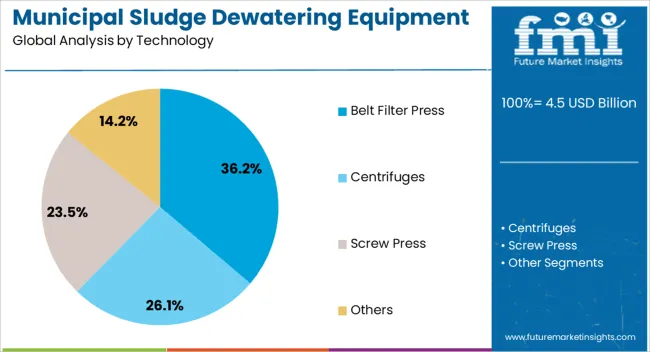
Among technologies, belt filter presses dominate with 36.2% market share in 2025, favored for medium-to-large-scale municipal operations due to continuous dewatering capability and moderate energy consumption. These systems are increasingly automated, with improved belt materials and polymer conditioning, offering enhanced cake dryness, durability, and lower lifecycle costs. Municipalities continue to rely on belt filter presses for both new installations and retrofits, emphasizing scalability, reliability, and cost-effectiveness.
Centrifuges and screw presses complement belt filter presses, providing higher throughput for high-solids sludge and industrial applications. Hybrid systems combining these technologies are emerging, offering operational flexibility, energy efficiency, and improved water recovery.
Technological Advancements Driving Market Innovation
The market is witnessing a technological transformation, with automation, IoT-enabled monitoring, and energy-efficient equipment becoming standard. Integration of SCADA systems, sensors, and predictive maintenance ensures optimized sludge handling while reducing operator errors. Modular, hybrid, and high-throughput systems are gaining traction, particularly in Asia-Pacific, where rapid urbanization demands scalable wastewater treatment solutions.
Energy efficiency improvements reduce operational costs by 10–12%, while regulatory compliance for emissions and nutrient recovery promotes adoption of sustainable dewatering systems. Manufacturers are increasingly designing equipment that aligns with circular economy initiatives, enabling reuse of treated sludge for agriculture, energy recovery, or composting.
Regional Growth Insights
Asia-Pacific is the fastest-growing market, led by China (CAGR 12.8%) and India (CAGR 11.9%), driven by massive infrastructure investments, urban wastewater management projects, and industrial expansion. Technological focus in these regions emphasizes automation, energy efficiency, and integration with anaerobic digestion systems, supported by regulatory policies promoting sustainability.
In Germany, the market grows at 10.9% CAGR, fueled by advanced wastewater treatment standards, high solids handling, and process automation. France (CAGR 10.0%) and the UK (CAGR 9.0%) see strong adoption due to regulatory emphasis on environmental compliance and energy-efficient operations. The United States (CAGR 8.1%) maintains steady growth, with demand concentrated in municipal and industrial wastewater plants, alongside investment in sustainable, high-throughput systems.
Emerging markets in Latin America, the Middle East, and Africa are increasingly adopting modular, automated dewatering equipment to address urbanization and industrial wastewater challenges, creating a diversified and growing global market landscape.
Competitive Landscape and Key Players
The municipal sludge dewatering market is highly competitive, with leading companies emphasizing efficiency, automation, and sustainability. Alfa Laval and Andritz are notable for their high-capacity centrifuges and decanter solutions. Aqseptence Group and Encon Evaporators focus on modular, flexible systems suited to urban wastewater plants.
Evoqua Water Technologies and Flotrend deliver compact automated solutions that integrate monitoring, filtration, and separation technologies. Hiller Separation & Process and Hitachi Zosen provide high-performance dewatering solutions for industrial and municipal applications. Huber and Keppel Seghers emphasize screw presses, belt presses, and filter presses optimized for variable sludge types and throughput rates.
Other prominent players include Komline-Sanderson, Kontek Ecology Systems, Phoenix Process Equipment, Sebright Products, and Veolia, all advancing automation, energy efficiency, and scalable solutions. These companies are targeting municipalities, industrial wastewater facilities, and infrastructure projects globally, leveraging technology to reduce operational costs and environmental impact.
Future Outlook and Opportunities
The municipal sludge dewatering equipment market is entering a decade defined by innovation, automation, and sustainability. Regulatory compliance, urban population growth, and industrial expansion continue to drive adoption. Opportunities lie in integrating dewatering with energy recovery, enhancing automation, and expanding into emerging markets with growing wastewater treatment needs.
For stakeholders, investors, and new manufacturers, this market represents a unique chance to combine operational efficiency with environmental responsibility. Companies investing in modular, IoT-enabled, and energy-efficient solutions are well-positioned to lead the sector. By 2035, municipal sludge dewatering equipment will not only manage waste efficiently but also contribute to renewable energy generation and sustainable urban infrastructure.
Key Players in the Municipal Sludge Dewatering Equipment Market:
Alfa Laval, Andritz, Aqseptence Group, Encon Evaporators, Evoqua Water Technologies, Flotrend, Hiller Separation & Process, Hitachi Zosen, Huber, Keppel Seghers, Komline-Sanderson, Kontek Ecology Systems, Phoenix Process Equipment, Sebright Products, Veolia.
Purchase this Report for USD 5,000 Only | Get an Exclusive Discount Instantly! https://www.futuremarketinsights.com/checkout/26029
Everything You Need—within Your Budget. Request a Special Price Now! https://www.futuremarketinsights.com/reports/sample/rep-gb-26029
About Future Market Insights (FMI)
Future Market Insights, Inc. (ESOMAR certified, recipient of the Stevie Award, and a member of the Greater New York Chamber of Commerce) offers profound insights into the driving factors that are boosting demand in the market. FMI stands as the leading global provider of market intelligence, advisory services, consulting, and events for the Packaging, Food and Beverage, Consumer Technology, Healthcare, Industrial, and Chemicals markets. With a vast team of over 400 analysts worldwide, FMI provides global, regional, and local expertise on diverse domains and industry trends across more than 110 countries.
Contact Us:
Future Market Insights Inc.
Christiana Corporate, 200 Continental Drive,
Suite 401, Newark, Delaware – 19713, USA
T: +1-347-918-3531
For Sales Enquiries: sales@futuremarketinsights.com
Website: https://www.futuremarketinsights.com
LinkedIn| Twitter| Blogs | YouTube