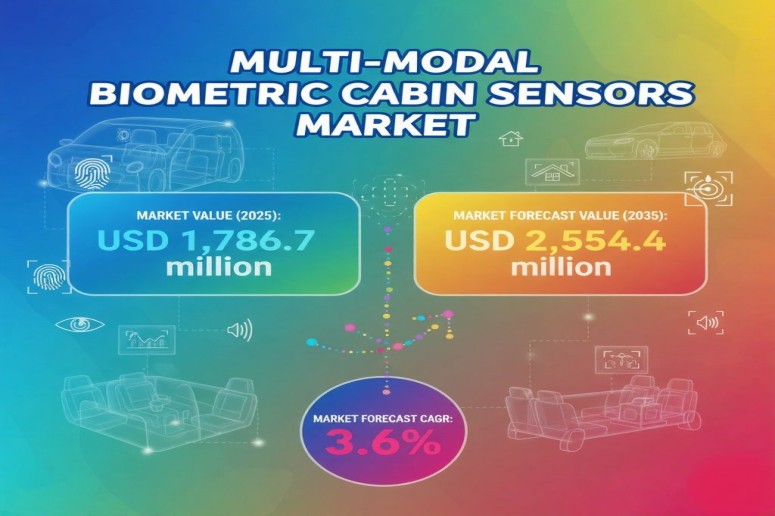
The global multi-modal biometric cabin sensors market is on track to grow from USD 1,786.7 million in 2025 to approximately USD 2,554.4 million by 2035, marking a 43.0% total increase and a steady CAGR of 3.6% over the decade. This upward trajectory underscores the expanding role of intelligent biometric systems across automotive and industrial security applications, as the world shifts toward advanced authentication and next-generation cabin monitoring technologies.
With optical/imaging sensors holding a commanding 35.0% market share, and key regions like Asia Pacific, North America, and Europe driving deployment, the multi-modal biometric sensor ecosystem is becoming central to modern safety and identity verification strategies.
Rising Security and Automotive Intelligence Fuel Market Expansion
The global push for improved automotive safety, cybersecurity, and identity protection is redefining the way vehicles and critical facilities manage authentication. Between 2025 and 2030, the market is projected to expand by USD 331.2 million, representing 43.1% of total forecasted growth. From 2030 to 2035, the momentum continues, adding another USD 436.5 million as biometric cabin systems become standard in next-generation vehicles.
This expansion is being shaped by rising demand for multi-factor identification, evolving regulatory frameworks for driver safety, and the integration of AI and machine learning into biometric recognition systems. Manufacturers are racing to design adaptive, intelligent sensors capable of reading multiple biometric traits—facial, iris, voice, and behavioral patterns—ensuring maximum accuracy and fraud prevention.
Established Leaders and Emerging Innovators Shape the Competitive Landscape
Industry giants such as Bosch, Continental, Denso, and Valeo continue to lead the way, leveraging decades of automotive expertise and precision engineering to create robust sensor solutions. Bosch, commanding a 6.5% market share, exemplifies excellence in precision manufacturing and AI-powered sensor design, while Continental and Denso are driving advancements in integrated electronic and safety components for connected vehicles.
Meanwhile, emerging innovators like Seeing Machines, Smart Eye, and OmniVision are capturing attention with their niche expertise in driver monitoring systems (DMS), facial recognition, and optical imaging technologies. Their emphasis on combining visual intelligence with real-time behavioral analytics positions them at the forefront of AI-driven security solutions.
Additionally, semiconductor leaders such as NXP, Infineon, and STMicroelectronics are supplying the essential processing infrastructure that powers these biometric platforms, enabling faster data analysis and enhanced system responsiveness across multiple cabin applications.
Regional Outlook: Asia Pacific Leads the Global Growth Curve
The Asia Pacific region, led by China (4.5% CAGR) and India (4.2% CAGR), remains the most dynamic market for multi-modal biometric cabin sensors.
In China, the surge in automotive manufacturing and the integration of security technologies are transforming both domestic production and export potential. Major sensor companies are expanding operations to cater to the growing demand for intelligent in-cabin systems in electric and connected vehicles.
India, supported by digital transformation and increased automotive investments, is rapidly adopting biometric authentication in vehicle manufacturing and public infrastructure. The combination of policy-driven innovation and private sector expansion is positioning India as an emerging hub for biometric research and production.
North America maintains a strong position, with the U.S. market (3.3% CAGR) focusing on automotive sophistication and advanced security integration. Major automakers are deploying multi-modal biometric solutions to enhance driver safety, reduce distraction, and meet upcoming safety compliance standards.
In Europe, countries like Germany, France, and the UK are emphasizing high-precision automotive engineering and safety innovation. Germany anchors the region with a 3.1% CAGR, supported by its leadership in precision sensor manufacturing and robust automotive R&D programs. France and the UK, with growth rates of 3.5% and 3.4% respectively, continue to prioritize security modernization and technological excellence in smart mobility systems.
Japan and South Korea: Innovation-Centric Growth Hubs
Japan continues to demonstrate leadership in precision sensor manufacturing, accounting for over 52.8% of domestic demand from automotive applications. Japanese automakers are integrating facial and voice recognition technologies into driver assistance systems, supporting intelligent transport and passenger monitoring. The country’s deep expertise in precision engineering ensures superior reliability and global competitiveness.
In South Korea, the market ecosystem revolves around powerful technology manufacturers such as semiconductor and electronics companies that supply biometric modules to major automotive and aviation OEMs. Collaborative innovation between local giants and international players like NEC, Thales, and IDEMIA is accelerating the development of AI-driven, multi-modal authentication systems. With a 13.0% CAGR, South Korea stands out as a technology powerhouse in biometric integration and system miniaturization.
Key Market Segments: Optical Imaging and Ethernet/Fieldbus Connectivity Lead
By measurement principle, optical/imaging sensors dominate with 35% market share in 2025, owing to their superior resolution, adaptability to varying lighting conditions, and efficiency in facial recognition applications. As AI-based image analysis becomes more advanced, optical systems will continue to set the benchmark for authentication accuracy and system reliability.
On the connectivity front, Ethernet/Fieldbus interfaces command a 40% market share, underscoring their importance in industrial communication and real-time data exchange. These systems are favored for their robustness, scalability, and ability to operate in high-demand environments—making them essential for both automotive and industrial automation ecosystems.
AI, Machine Learning, and Sensor Fusion: Defining the Next Frontier
The next phase of market evolution lies in AI-enhanced biometric intelligence. Manufacturers are embedding deep learning algorithms and behavioral analytics into sensor systems, allowing them to adapt dynamically to individual users, detect anomalies, and perform predictive safety actions.
Such advancements not only improve system reliability but also open new applications in smart mobility, industrial safety, and defense infrastructure. Companies investing in AI integration such as OmniVision and Seeing Machines—are positioning themselves as key contributors to the next generation of biometric innovation.
Order Now for $5,000 | Unlock Insights with a Special Discount!
https://www.futuremarketinsights.com/reports/sample/rep-gb-26716
Checkout Now to Access Industry Insights:
https://www.futuremarketinsights.com/checkout/26716
About Future Market Insights (FMI)
Future Market Insights, Inc. (ESOMAR certified, recipient of the Stevie Award, and a member of the Greater New York Chamber of Commerce) offers profound insights into the driving factors that are boosting demand in the market. FMI stands as the leading global provider of market intelligence, advisory services, consulting, and events for the Packaging, Food and Beverage, Consumer Technology, Healthcare, Industrial, and Chemicals markets. With a vast team of over 400 analysts worldwide, FMI provides global, regional, and local expertise on diverse domains and industry trends across more than 110 countries.
Contact Us:
Future Market Insights Inc.
Christiana Corporate, 200 Continental Drive,
Suite 401, Newark, Delaware – 19713, USA
T: +1-347-918-3531
For Sales Enquiries: sales@futuremarketinsights.com
Website: https://www.futuremarketinsights.com
LinkedIn| Twitter| Blogs | YouTube