The global medium duty truck market, valued at USD 57.8 billion in 2025, is forecasted to reach USD 99.6 billion by 2035, reflecting a CAGR of 5.6% over the forecast period. The market is entering a decade of transformative growth, supported by rising demand from logistics, e-commerce, and construction industries. As cities expand and last-mile delivery networks become increasingly critical, medium-duty trucks are solidifying their role as indispensable assets for efficient, mid-range transportation and utility operations.
Rising Demand from Logistics, Construction, and E-Commerce Sectors
Medium-duty trucks play a crucial role in linking long-haul freight systems to local delivery networks. Their balanced design, offering both payload capacity and maneuverability, makes them essential for last-mile and regional freight transport. The rise of e-commerce, rapid urbanization, and ongoing infrastructure development are major catalysts driving market growth worldwide.
The logistics and supply chain sector accounts for nearly 25–30% of global medium-duty truck demand, as e-commerce giants and retailers prioritize faster delivery models. The construction and building materials segment contributes around 15–18%, fueled by infrastructure expansion in emerging economies. Additionally, the food and beverage industry, requiring temperature-controlled transport for fresh and frozen goods, contributes nearly 10–12%.
Growing focus on waste management and urban sanitation has also elevated demand, with municipal fleets increasingly adopting medium-duty vehicles due to their adaptability and low operational cost. Together, these applications demonstrate how medium-duty trucks have evolved from simple transport tools to sophisticated, technology-driven fleet solutions.
Technological Innovation and Electrification Redefine the Market
A key trend transforming the medium-duty truck landscape is fleet electrification. As governments tighten emission standards and offer incentives for zero-emission vehicles, manufacturers are accelerating the development of electric and hybrid medium-duty trucks. These models offer lower operating costs, reduced environmental impact, and compliance with urban emission zones, making them especially viable for short-range, high-frequency delivery routes.
Meanwhile, autonomous driving and telematics technologies are reshaping operational efficiency. Advanced telematics systems allow fleet managers to track fuel use, monitor vehicle health, and predict maintenance schedules, while emerging autonomous driving capabilities promise improved safety and reduced labor costs. Manufacturers investing in automation, data connectivity, and AI-based logistics optimization are expected to gain a competitive edge in the coming years.
Segmental Overview: Class 4 Dominates the Market
By class, Class 4 trucks lead the global market with a 28.7% share in 2025. These vehicles strike a balance between payload capacity and cost efficiency, making them highly suitable for parcel delivery, food distribution, and municipal services.
Fleet operators favor Class 4 trucks for their affordability, fuel efficiency, and ability to navigate congested urban areas. With new regulations promoting low-emission transport, this segment is witnessing rising adoption of electric and hybrid models. Manufacturers such as Tata Motors, Ashok Leyland, and Hino Motors are increasingly offering Class 4 variants equipped with enhanced safety systems, ergonomic cabins, and smart connectivity features to cater to evolving customer demands.
Diesel Leads but Electric Gaining Ground
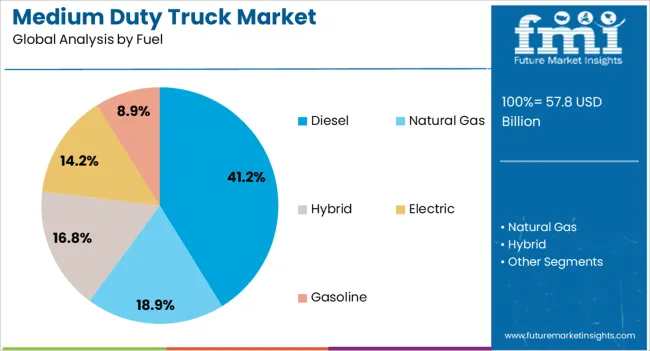
Despite the growing popularity of electric vehicles, diesel-powered medium-duty trucks continue to dominate with a 41.2% market share. Their high torque, durability, and fuel efficiency make them indispensable for heavy-duty applications and long operational hours. However, advancements in cleaner combustion technologies and after-treatment systems are helping diesel engines remain compliant with stricter emission norms.
In parallel, electric and hybrid trucks are steadily gaining momentum. Governments in Europe, North America, and Asia-Pacific are offering tax benefits and infrastructure support for EV adoption. Companies such as Mercedes-Benz Group AG, PACCAR Inc, and Traton Group are heavily investing in next-generation electric platforms, ensuring a gradual but consistent transition toward sustainable mobility.
Performance Insights by Horsepower and Application
The below 150 HP segment currently accounts for 33.5% of market share, favored for urban deliveries and short-distance logistics where efficiency and maneuverability matter most. As metropolitan areas introduce low-emission zones, lighter, more compact vehicles with lower horsepower are finding increased relevance.
By application, the freight and logistics segment dominates, driven by expanding retail and e-commerce networks. The construction and mining segment follows closely, supported by global infrastructure projects. These trucks are vital in transporting building materials such as cement, gravel, and steel, ensuring seamless project execution.
Regional Market Outlook: Asia-Pacific Leads Global Growth
The global medium-duty truck market’s regional expansion reflects the interplay of industrialization, infrastructure growth, and environmental policies. Asia-Pacific leads the global market, with China and India registering growth rates of 7.6% and 7.0%, respectively.
In China, rapid industrial expansion and government-led logistics modernization programs are accelerating truck adoption. The country’s vast e-commerce and construction sectors create consistent demand for medium-duty vehicles.
In India, infrastructure megaprojects, industrial growth, and rural development initiatives are fueling demand. Indian manufacturers such as Tata Motors, Eicher Motors, and BharatBenz are developing localized solutions focused on durability, cost efficiency, and electric transition.
In Europe, France and Germany remain key markets, driven by strict emission norms and growing demand for efficient urban transport. Both nations are advancing fleet electrification initiatives to reduce greenhouse gas emissions. Meanwhile, the United Kingdom is investing in smart transport networks, promoting electric truck adoption in logistics and retail sectors.
In North America, particularly the United States, the market is projected to grow at a 4.8% CAGR. Growth is anchored by strong construction, logistics, and last-mile delivery segments. U.S. manufacturers are focusing on electric and hybrid trucks to meet evolving regulatory standards and consumer preferences.
Competitive Landscape: Established Leaders and Emerging Innovators
The medium-duty truck market features a diverse mix of established global automakers and emerging regional manufacturers. Leading companies such as Ashok Leyland Limited, BharatBenz, Eicher Motor Limited, Ford Motor Company, General Motors, Hino Motors Ltd., ISUZU Motors, Mercedes-Benz Group AG, PACCAR Inc, Tata Motors Limited, and Traton Group dominate the landscape through innovation and regional expansion.
Established manufacturers continue to refine diesel technology while investing in electric platforms, connectivity, and autonomous driving systems. New entrants are leveraging niche capabilities, such as telematics integration and modular EV designs, to compete with global players. Strategic alliances between automakers, battery suppliers, and technology firms are further shaping the industry’s evolution.
Purchase this Report for USD 5,000 Only | Get an Exclusive Discount Instantly! https://www.futuremarketinsights.com/checkout/25868
Everything You Need—within Your Budget. Request a Special Price Now! https://www.futuremarketinsights.com/reports/sample/rep-gb-25868
About Future Market Insights (FMI)
Future Market Insights, Inc. (ESOMAR certified, recipient of the Stevie Award, and a member of the Greater New York Chamber of Commerce) offers profound insights into the driving factors that are boosting demand in the market. FMI stands as the leading global provider of market intelligence, advisory services, consulting, and events for the Packaging, Food and Beverage, Consumer Technology, Healthcare, Industrial, and Chemicals markets. With a vast team of over 400 analysts worldwide, FMI provides global, regional, and local expertise on diverse domains and industry trends across more than 110 countries.
Contact Us:
Future Market Insights Inc.
Christiana Corporate, 200 Continental Drive,
Suite 401, Newark, Delaware – 19713, USA
T: +1-347-918-3531
For Sales Enquiries: sales@futuremarketinsights.com
Website: https://www.futuremarketinsights.com
LinkedIn| Twitter| Blogs | YouTube