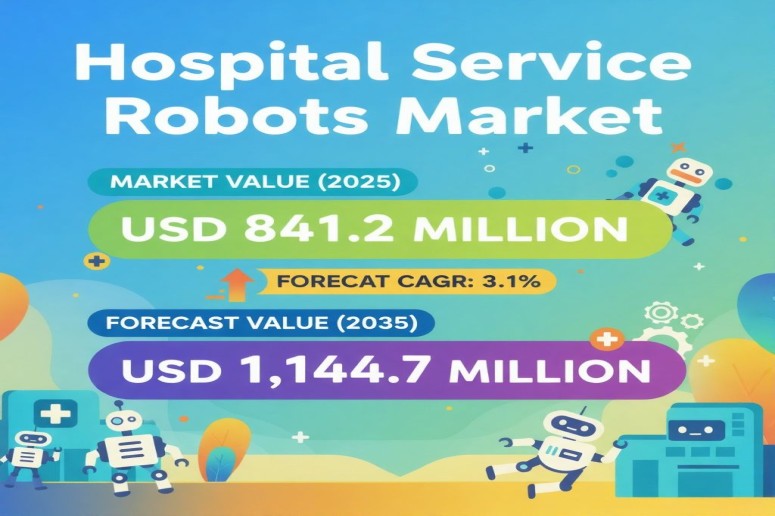
The global hospital service robots market is poised for substantial expansion, projected to rise from USD 841.2 million in 2025 to approximately USD 1,144.7 million by 2035, reflecting a total growth of 36.1% over the forecast period. This translates to a compound annual growth rate (CAGR) of 3.1%, underscoring the growing role of robotics in transforming hospital operations, enhancing patient safety, and enabling contactless healthcare services worldwide.
Why the Market Is Growing
The core driver behind this growth is the rising global demand for healthcare automation. Hospital administrators are prioritizing systems that ensure contactless operations, real-time responsiveness, and infection control reliability. Robots are increasingly performing logistics, cleaning, disinfection, and patient assistance tasks—reducing the physical burden on medical staff and improving the precision of hospital workflows.
Modern hospital robots are not only about efficiency but also about safety. Their ability to minimize human contact in critical environments and enhance operational reliability has positioned them as key enablers of the “smart hospital” vision. Moreover, the integration of AI, computer vision, and machine learning algorithms is empowering robots to predict maintenance needs, optimize routes, and adapt to dynamic hospital environments—making them smarter, safer, and more autonomous.
Segmental Insights: Logistics AMRs Lead the Way
By product type, Logistics AMRs dominate the market, accounting for 45% of global revenue in 2025. These robots are designed for material transport, supply delivery, and waste management in complex healthcare environments. Their superior navigation systems, load-handling capabilities, and safety protocols make them the backbone of hospital automation initiatives.
In terms of use cases, materials and medical transport applications lead with 40% of market share. Hospitals are investing heavily in robotic transport systems that streamline internal logistics, medication delivery, and equipment handling—freeing up clinical staff for patient-focused activities.
Regional Performance: Asia Pacific and North America Take the Lead
Among key regions, Asia Pacific is emerging as the fastest-growing market, supported by robust healthcare modernization and automation programs. China, in particular, leads the global trajectory with a 3.7% CAGR, driven by rapid hospital expansion and government investment in healthcare robotics. Brazil follows closely at 3.6%, propelled by its accelerating healthcare infrastructure development.
In North America, the United States maintains strong market momentum with a 2.8% CAGR, leveraging its advanced medical ecosystem and early adoption of robotic technologies for critical operations. Across Europe, countries such as France (3.1%), the UK (2.9%), and Germany (2.3%) continue to integrate precision robotics into hospital settings, emphasizing innovation, patient safety, and operational efficiency.
Europe: A Diverse Market Landscape
The European market for hospital service robots is expected to grow from USD 206.9 million in 2025 to USD 272.7 million by 2035, achieving a 2.8% CAGR. Germany remains a powerhouse with a 23.1% market share in 2025, supported by its precision engineering and medical device expertise. The United Kingdom is forecast to increase its share to 17.6% by 2035, driven by strong healthcare digitization programs, while France continues to invest in innovation-driven medical technologies.
Meanwhile, Italy, Spain, and the BENELUX countries are emerging as competitive players, each expanding their hospital automation capabilities through collaborations between healthcare institutions, robotics firms, and technology providers.
Country Spotlights: Emerging Markets Drive Next-Phase Growth
In Japan, hospitals account for 58.4% of all service robot deployments in 2025. The market’s growth is tied closely to Japan’s aging population and the increasing need for robotics-assisted eldercare. Delivery and disinfection robots dominate demand, with rehabilitation-focused solutions steadily gaining traction through partnerships between technology manufacturers and care providers.
In South Korea, healthcare providers and technology companies are jointly shaping the robotics landscape through co-development initiatives. With 45.8% of adoption led by hospitals, the market is shifting toward telepresence and rehabilitation robotics, integrating digital platforms for seamless care delivery and workflow automation.
Competitive Landscape: Innovation Defines Market Leaders
The competitive environment is evolving rapidly, blending established global players with agile new entrants. Aethon, a recognized leader in healthcare logistics automation, continues to dominate through its TUG robots known for reliability and efficiency. Diligent Robotics has earned acclaim for its AI-powered service robots, such as “Moxi,” designed to support nursing teams in clinical environments.
Swisslog Healthcare and Omron Mobile Robots are focusing on autonomous transport and workflow integration, while Xenex Disinfection Services leads in UV-based infection control robotics. Emerging companies like Geckō Healthcare, Relay Robotics, and Keenon Robotics are expanding aggressively, introducing modular, cost-efficient robotic systems tailored for small and mid-sized healthcare facilities.
Government and Industry Collaboration to Accelerate Innovation
The next decade of growth in the hospital service robots market depends on collaborative initiatives among governments, manufacturers, and healthcare providers. Policymakers can stimulate innovation by investing in medical technology zones, R&D hubs, and AI testing centers, enabling faster product validation and workforce development.
Creating robust regulatory frameworks and safety certification protocols will also be essential to streamline hospital adoption. Countries like China and France are already developing healthcare robotics standards that ensure both patient safety and operational reliability.
Get this Report at $5,000 Only | Exclusive Discount Inside!
https://www.futuremarketinsights.com/reports/sample/rep-gb-26709
Checkout Now to Access Data Insights:
https://www.futuremarketinsights.com/checkout/26709
About Future Market Insights (FMI)
Future Market Insights, Inc. (ESOMAR certified, recipient of the Stevie Award, and a member of the Greater New York Chamber of Commerce) offers profound insights into the driving factors that are boosting demand in the market. FMI stands as the leading global provider of market intelligence, advisory services, consulting, and events for the Packaging, Food and Beverage, Consumer Technology, Healthcare, Industrial, and Chemicals markets. With a vast team of over 400 analysts worldwide, FMI provides global, regional, and local expertise on diverse domains and industry trends across more than 110 countries.
Contact Us:
Future Market Insights Inc.
Christiana Corporate, 200 Continental Drive,
Suite 401, Newark, Delaware – 19713, USA
T: +1-347-918-3531
For Sales Enquiries: sales@futuremarketinsights.com
Website: https://www.futuremarketinsights.com
LinkedIn| Twitter| Blogs | YouTube