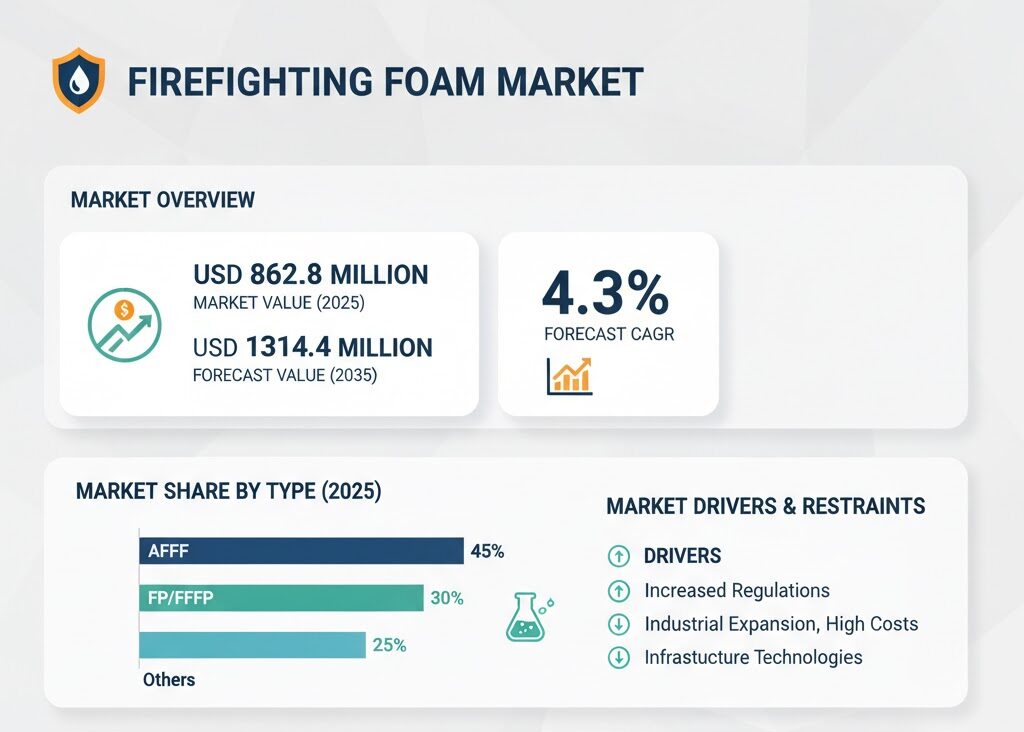
The firefighting foam market is set to grow from USD 862.8 million in 2025 to USD 1,314.4 million by 2035, registering a compound annual growth rate (CAGR) of 4.3%. The market is witnessing increasing adoption due to stringent safety regulations, expanding industrial operations, and the emergence of environmentally sustainable foam formulations. Technological innovations such as fluorine-free and biodegradable foams, coupled with automated and mobile dispensing systems, are driving widespread adoption across both developed and emerging economies.
Market Trends Highlighted
- Sustainable Transition: The industry is rapidly shifting toward fluorine-free and low-toxicity foams, replacing traditional PFAS-based variants amid rising environmental regulations.
- Automation and Mobility: Growing integration of automated dispensing systems and portable delivery units is enhancing operational efficiency.
- Technological Integration: Compatibility with modern fire suppression infrastructure and simulation-based training programs are boosting market readiness.
- Evolving End-Use Landscape: Industrial sectors—particularly oil & gas, aviation, and marine—continue to be the primary consumers, accounting for nearly 70% of total demand.
Recent Developments
- Formulation Advancements: Leading manufacturers are developing next-generation foams with faster spread rates, better vapor suppression, and improved environmental compliance.
- Strategic Collaborations: Partnerships between foam producers and firefighting equipment manufacturers are expanding product integration and market access.
- Regional Manufacturing Expansion: Domestic producers in China and India have scaled up fluorine-free foam production to meet industrial and municipal demand.
- R&D Investments: Global players such as 3M, Johnson Controls International, and Angus Fire are allocating resources toward improving foam biodegradability and compatibility with automated systems.
Market Drivers
- Industrial Safety Regulations: Enforcement of strict safety standards in oil & gas, chemical, and aviation sectors is expanding foam usage.
- Rising Fire Hazards: Increasing industrial fire incidents and growing awareness of fire preparedness are reinforcing market demand.
- Environmental Compliance: Transition to fluorine-free formulations is supported by regulatory bodies in Europe and North America.
- Urbanization and Infrastructure Growth: Rapid development in Asia Pacific and Middle East regions is driving large-scale installations of firefighting systems.
- Technological Advancements: Improved foam chemistry, including high-expansion and water-efficient solutions, enhances performance and reduces ecological impact.
Regional Insights
- Asia Pacific (36% Market Share): Led by China (18%), Japan (10%), and India (8%), the region dominates due to industrial expansion and safety modernization programs.
- Europe (32%): Strong focus on environmental compliance, led by Germany, France, and the UK, with growing adoption of fluorine-free foams.
- North America (28%): The U.S. remains a key contributor, with emphasis on industrial, aviation, and municipal firefighting applications.
- Latin America & Middle East (4%): Emerging markets with increasing infrastructure investments and safety regulation adoption.
Country-wise CAGR Analysis
- The global firefighting foam market is projected to expand at a CAGR of 4.3% from 2025 to 2035, with growth dynamics varying across major economies. China leads the market with a 8% CAGR, outpacing the global average by 1.35×, driven by industrial expansion, urban infrastructure development, and robust government-led fire safety programs. India follows closely with a 5.4% CAGR, reflecting rising investments in oil & gas, chemical industries, and municipal fire departments.
- In Europe, Germany maintains a steady 9% CAGR, supported by strict regulatory standards and technological innovation in eco-friendly formulations. France and the United Kingdom post growth rates of 4.5% and 4.1%, respectively, underpinned by modernization of industrial facilities and adoption of fluorine-free foams.
- The United States records a moderate 7% CAGR, characterized by consistent demand across industrial, aviation, and municipal firefighting sectors. Meanwhile, Brazil shows a 3.2% CAGR, supported by expanding industrial zones and gradual adoption of advanced fire suppression technologies.
- Overall, BRICS economies (China, India, Brazil) are driving volume-based growth through infrastructure expansion and regulatory upgrades, while OECD countries (Germany, France, UK, USA) emphasize technological advancement, sustainability, and performance optimization in firefighting foam deployment.
Competition Outlook
The firefighting foam market is moderately consolidated, with key players focusing on innovation, sustainability, and global expansion.
Leading companies include:
3M, Johnson Controls International PLC, Angus Fire, The Solberg Company, Dr. Sthamer, National Foam, Tyco Fire Products LP, Chemguard, Kerr Fire, Buckeye Fire Equipment, Dafo Fomtec AB, ICL Group, Eau&Feu, Kidde-Fenwal Inc., and SFFECO Global.
Competitive Strategies:
- Development of eco-friendly foam concentrates compliant with international safety standards.
- Expansion of global supply networks for faster delivery and deployment.
- Enhanced R&D focus on foam stability, biodegradability, and high expansion ratios.
- Strategic collaborations with industrial and municipal fire departments to support training and simulation-based deployment.
Key Segments of the Market Report
- By Type: Aqueous Film Forming Foam (AFFF), Alcohol-Resistant AFFF, Protein Foam, Synthetic Detergent Foam, and Others.
- By End Use: Oil & Gas, Aviation, Marine, Mining, Chemical, and Others.
- By Fire Class: Class B, Class A, and Class C.
- By Region: North America, Europe, Asia-Pacific, Latin America, Middle East & Africa.
- Key Markets Covered: United States, Canada, Germany, France, United Kingdom, China, Japan, India, Brazil, and South Africa.
Grab This Report Now at Just $5000| Limited-Time Discount Offer! https://www.futuremarketinsights.com/reports/sample/rep-gb-25558
Checkout Now to Access Industry Insights: https://www.futuremarketinsights.com/checkout/25558
About Future Market Insights (FMI)
Future Market Insights, Inc. (ESOMAR certified, recipient of the Stevie Award, and a member of the Greater New York Chamber of Commerce) offers profound insights into the driving factors that are boosting demand in the market. FMI stands as the leading global provider of market intelligence, advisory services, consulting, and events for the Packaging, Food and Beverage, Consumer Technology, Healthcare, Industrial, and Chemicals markets. With a vast team of over 400 analysts worldwide, FMI provides global, regional, and local expertise on diverse domains and industry trends across more than 110 countries.
Contact Us:
Future Market Insights Inc.
Christiana Corporate, 200 Continental Drive,
Suite 401, Newark, Delaware – 19713, USA
T: +1-347-918-3531
For Sales Enquiries: sales@futuremarketinsights.com
Website: https://www.futuremarketinsights.com
LinkedIn| Twitter| Blogs | YouTube