The fire stopping materials market, valued at USD 1.9 billion in 2025, is poised to more than double to USD 4.3 billion by 2035, registering a CAGR of 8.9%. This growth is propelled by increasing emphasis on fire safety regulations, urbanization, and complex building designs requiring robust passive fire protection solutions. Both established manufacturers and emerging technology players are positioned to leverage opportunities in new construction, retrofit projects, and advanced material innovations to meet the rising demand across residential, commercial, and industrial sectors.
In the initial phase, from 2025 to 2026, growth is driven by the growing focus on fire safety regulations in construction and infrastructure projects. Awareness of fire hazards in commercial buildings, industrial facilities, and residential properties has spurred adoption of fire stopping solutions, as architects, contractors, and building owners seek compliance and safety assurance. By 2030, the market is projected to reach USD 2.8 billion, supported by increasing implementation of fire prevention technologies in both new builds and retrofits.
Market Dynamics: Construction, Safety, and Industrial Needs
The construction sector is the largest contributor, representing 35–40% of demand, due to its integral role in ensuring safety in residential, commercial, and industrial projects. Stringent fire safety regulations, particularly for high-rise buildings and public infrastructure, are driving continuous adoption of fire stopping materials. The building safety and fire protection market accounts for roughly 25–30%, reflecting the critical role of these materials in maintaining safe occupancy conditions and structural integrity.
The insurance sector contributes around 10–12%, as insurers increasingly mandate compliance with fire safety standards to mitigate risk exposure. Meanwhile, the renovation and retrofit market, at 12–15%, is becoming a significant driver as older buildings are upgraded to meet modern fire codes. Industrial manufacturing facilities, including oil and gas, power plants, and chemical industries, account for 8–10% of the market, highlighting the critical need for fire protection in high-risk environments.
Technological Advancements and Product Segmentation
Fire stopping materials are increasingly recognized as essential for passive fire protection, offering barriers that contain flames, smoke, and heat during fire events. Coatings, the leading type segment at 16.2% share, are commonly applied to steel structures, cables, and ductwork, with innovations such as intumescent and low-VOC formulations enhancing performance and environmental compliance. Coatings are gaining traction particularly in high-rise and industrial construction, providing cost-effective and adaptable solutions for modern building designs.
By product type, passive fire protection systems dominate with a 58.5% market share, reflecting their foundational role in modern safety strategies. These systems are designed to contain fire without requiring external activation, ensuring reliability across commercial buildings, hospitals, and data centers. Manufacturers are developing modular, pre-tested solutions that simplify installation while meeting regional and international fire codes.
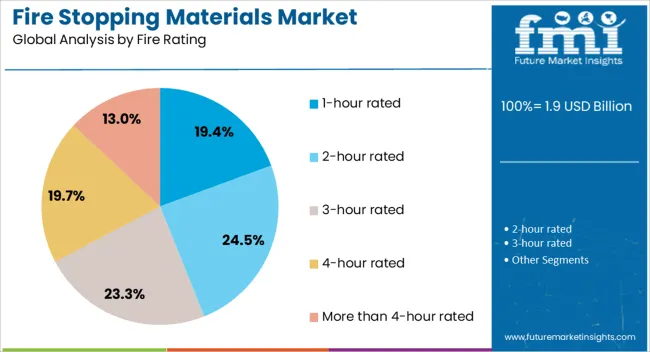
In terms of fire rating, 1-hour rated materials hold a 19.4% share, widely used in office complexes, residential buildings, and light commercial properties. Their balanced performance, regulatory compliance, and cost efficiency make them an attractive choice for developers and architects seeking reliable fire protection in moderately risky areas.
Key Drivers, Trends, and Challenges
Urbanization and the proliferation of high-rise buildings are significant growth drivers, alongside stricter fire safety regulations and evolving building codes. Fire stopping materials prevent the spread of fire and smoke through wall and floor penetrations, becoming essential in both new constructions and retrofit projects.
Technological innovation is enhancing market appeal. Multi-functional solutions, including thermal insulation, soundproofing, water resistance, and eco-friendly formulations, are gaining popularity. Spray-on and easy-to-apply products simplify installation and reduce labor costs, supporting faster adoption in large-scale projects.
However, challenges persist. Raw material cost fluctuations, regulatory complexity, and technical constraints in extreme conditions such as high heat or moisture can impact production and performance. Manufacturers must innovate to ensure durability, compliance, and affordability while meeting diverse architectural and industrial needs.
Regional Insights: China, India, France, UK, and USA Lead Growth
China leads the market with a CAGR of 12.0%, driven by urbanization, infrastructure expansion, and the rapid construction of high-rise residential and commercial buildings. Demand is also bolstered by government regulations promoting fire safety in both public and industrial facilities.
India follows at 11.1% CAGR, fueled by a booming construction sector, urban infrastructure projects, and heightened awareness of fire safety in public spaces, commercial complexes, and industrial facilities. Government regulations and enforcement are strong catalysts for adoption in both new and existing buildings.
In Europe, France is projected to grow at 9.3% CAGR, supported by commercial construction projects, large-scale infrastructure like airports and hospitals, and stringent fire safety codes. The UK anticipates 8.5% CAGR, with demand driven by high-rise office spaces, public facilities, and increasing awareness in residential and industrial spaces.
The USA market, with a CAGR of 7.6%, is shaped by robust safety regulations, high-rise commercial buildings, industrial complexes, and residential properties. Compliance with fire codes, expansion in infrastructure development, and growing awareness of fire risks in dense urban areas are key growth factors.
Competitive Landscape: Innovation, Compliance, and Market Leadership
The fire stopping materials market is highly competitive, led by global and regional players emphasizing innovation, regulatory compliance, and multi-functional solutions. 3M, Bostik, Emseal Joint Systems, Everkem, Flame Stop, Fosroc, H. B. Fuller, Hilti, Promat, RectorSeal, Rockwool, Sika, Specified Technologies, Tremco, and Unique Fire Stop Products are at the forefront.
These companies are differentiating themselves through product versatility, eco-friendly formulations, modular and pre-tested systems, and solutions that streamline installation. Established brands leverage global presence and technical expertise, while smaller firms and innovators emphasize agility, niche applications, and rapid deployment for retrofit projects.
The competitive focus is on developing fire stopping solutions that address increasingly complex building designs, comply with evolving fire codes, and deliver multi-functional benefits. Brochures and technical literature now highlight environmental compliance, thermal performance, sound insulation, and ease of installation alongside fire ratings, reflecting the market’s shift toward holistic building safety solutions.
Purchase this Report for USD 5,000 Only | Get an Exclusive Discount Instantly! https://www.futuremarketinsights.com/checkout/25858
Everything You Need—within Your Budget. Request a Special Price Now! https://www.futuremarketinsights.com/reports/sample/rep-gb-25858
About Future Market Insights (FMI)
Future Market Insights, Inc. (ESOMAR certified, recipient of the Stevie Award, and a member of the Greater New York Chamber of Commerce) offers profound insights into the driving factors that are boosting demand in the market. FMI stands as the leading global provider of market intelligence, advisory services, consulting, and events for the Packaging, Food and Beverage, Consumer Technology, Healthcare, Industrial, and Chemicals markets. With a vast team of over 400 analysts worldwide, FMI provides global, regional, and local expertise on diverse domains and industry trends across more than 110 countries.
Contact Us:
Future Market Insights Inc.
Christiana Corporate, 200 Continental Drive,
Suite 401, Newark, Delaware – 19713, USA
T: +1-347-918-3531
For Sales Enquiries: sales@futuremarketinsights.com
Website: https://www.futuremarketinsights.com
LinkedIn| Twitter| Blogs | YouTube