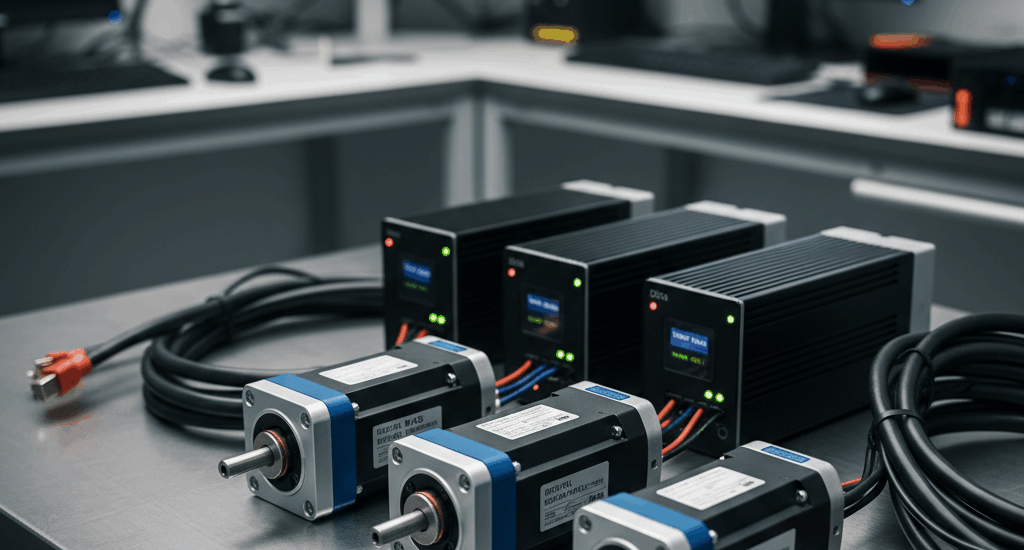
The Digital Servo Motors and Drives Market is on a transformative growth path, projected to expand from USD 9.7 billion in 2025 to USD 18.5 billion by 2035, advancing at a CAGR of 6.7%. This sustained rise underscores the pivotal role of digital servo systems in powering industrial automation, robotics, packaging, and precision manufacturing worldwide.
Between 2020 and 2024, the market evolved from its early adoption phase, as industries experimented with pilot implementations across automated lines, robotic arms, and CNC machinery. By 2025, digital servo systems became an integral part of mainstream operations, particularly in sectors demanding accuracy, reliability, and energy efficiency.
Get this Report at $5000 | Grab Your Market Insights Today: https://www.futuremarketinsights.com/reports/sample/rep-gb-25506
Industry Expansion Through Smart Automation
The decade ahead (2025–2035) marks a period of large-scale adoption and consolidation. During the first half, industries are expected to ramp up installations of servo motors and drives to improve production flexibility, throughput, and control precision. By 2030, market value is estimated to exceed USD 12.5 billion, propelled by demand from industrial automation, material handling, and packaging lines.
As manufacturing transitions into the era of smart factories and Industry 4.0, servo systems will serve as the backbone for intelligent motion control. In the consolidation phase (2030–2035), larger players are likely to solidify their dominance through acquisitions and technology collaborations, while smaller firms innovate in niche areas such as compact servo drives and affordable retrofit systems.
What’s Driving the Growth?
The expansion of the digital servo motors and drives market is strongly influenced by rising automation investments, increasing deployment of robotics, and the need for high-speed, high-precision motion control. Digital servo systems provide real-time feedback, improved energy efficiency, and reduced downtime, enabling smarter and more efficient industrial operations.
Moreover, as industries shift toward energy-efficient and IoT-integrated machinery, digital servo drives offer enhanced connectivity and predictive diagnostics, reinforcing their role in next-generation production environments.
Segmental Overview
By Drive Type:
The AC Drive segment dominates with a projected 57.6% market share in 2025, owing to its superior torque control, energy efficiency, and flexibility across applications. Its integration into smart manufacturing ecosystems allows for reduced maintenance costs and higher compatibility with automation software platforms.
By Application:
The Robotics segment leads with a 44.8% share in 2025. The demand for robotic precision, repeatability, and adaptability in logistics, assembly, and warehousing applications continues to fuel servo drive adoption. Advancements in sensor feedback and control algorithms have further enhanced servo system performance in automated environments.
Regional and Country-Level Growth
Asia-Pacific leads the market surge, driven by industrial automation initiatives in China and India.
- China (CAGR 9.0%): Rapid adoption of servo technology in electronics, automotive, and robotics production, supported by government-backed manufacturing modernization.
- India (CAGR 8.4%): Expanding automation in textiles, electronics, and packaging sectors, with manufacturers developing durable, cost-efficient servo systems and training SMEs in modern automation practices.
Europe demonstrates strong technological advancement:
- Germany (CAGR 7.7%): Leveraging Industry 4.0 frameworks and R&D in smart drive systems to maintain leadership in precision machinery.
- United Kingdom (CAGR 6.4%): Growth in flexible automation and packaging industries, supported by technical training and integration initiatives.
North America, particularly the United States (CAGR 5.7%), maintains steady growth with robust investments in robotics, CNC systems, and smart manufacturing solutions backed by strict energy and safety standards.
Competitive Landscape
The competitive ecosystem includes a blend of established automation leaders and emerging technology innovators.
Siemens, ABB, and Yaskawa dominate large-scale industrial automation deployments, while Mitsubishi Electric, Schneider Electric, and Rockwell Automation focus on integrated motion control and smart factory solutions.
Innovators such as Beckhoff Automation and Bosch Rexroth are enhancing system flexibility through modular servo drives and compact designs, catering to high-performance and space-constrained applications. Meanwhile, Delta Electronics, Danfoss, Fuji Electric, and WEG are targeting emerging economies with cost-effective and energy-efficient systems that balance affordability and performance.
New manufacturers and mid-scale enterprises are also entering the field, exploring AI-driven control algorithms, predictive maintenance, and cloud-based monitoring to differentiate their solutions and attract industrial automation clients seeking smart, scalable systems.
Technology Trends Shaping the Future
- Precision and High Performance: Continuous improvement in torque accuracy and dynamic load handling enhances performance in CNC machining, automotive assembly, and aerospace applications.
- Compact and Energy-Efficient Designs: Demand for lightweight, power-optimized systems supports growth in robotics, medical devices, and electronics manufacturing.
- IoT and Smart Integration: Servo drives with Ethernet/IP connectivity and predictive diagnostics are revolutionizing maintenance and uptime management.
- Safety and Compliance: Growing adherence to global safety and efficiency standards ensures reliable, certified systems across regions.
Access Premium Reports – Get Your Copy Today: https://www.futuremarketinsights.com/checkout/25506
Outlook: Toward a Smarter Motion Future
The digital servo motors and drives market is transitioning from mechanical efficiency to intelligent motion control. As automation deepens across industries, both established leaders and emerging innovators are poised to redefine industrial motion with connected, energy-conscious, and data-driven servo systems.
By 2035, digital servo technology will be a cornerstone of the global automation landscape—enabling manufacturers to achieve precision, sustainability, and productivity at unprecedented levels.
About Future Market Insights (FMI)
Future Market Insights, Inc. (ESOMAR certified, recipient of the Stevie Award, and a member of the Greater New York Chamber of Commerce) offers profound insights into the driving factors that are boosting demand in the market. FMI stands as the leading global provider of market intelligence, advisory services, consulting, and events for the Packaging, Food and Beverage, Consumer Technology, Healthcare, Industrial, and Chemicals markets. With a vast team of over 400 analysts worldwide, FMI provides global, regional, and local expertise on diverse domains and industry trends across more than 110 countries.
Contact Us:
Future Market Insights Inc.
Christiana Corporate, 200 Continental Drive,
Suite 401, Newark, Delaware – 19713, USA
T: +1-347-918-3531
For Sales Enquiries: sales@futuremarketinsights.com
Website: https://www.futuremarketinsights.com
LinkedIn| Twitter| Blogs | YouTube