The bicycle gear shifter market is set for a dynamic decade, valued at USD 1.4 billion in 2025 and projected to reach USD 3.1 billion by 2035, marking a CAGR of 8.2%. Growth is being driven by the rising popularity of cycling as a recreational and fitness activity, along with the increasing adoption of electric bicycles (e-bikes), which require specialized, high-performance gear shifters. Modern cyclists are demanding smoother, more precise gear changes, pushing manufacturers to innovate across mechanical, electronic, and hydraulic systems.
Urbanization and investments in cycling infrastructure globally are creating favorable conditions for both traditional bicycles and e-bikes. Recreational cycling, competitive sports, and commuting trends have converged to expand demand, while innovations in smart and automated gear systems continue to elevate consumer expectations.
Market Dynamics and Growth Drivers
The bicycle gear shifter market is shaped by multiple parent markets. The bicycle components market, contributing 40–45%, drives product development across gear, shifter, pedal, and brake systems. The sports and recreation sector accounts for 15–20%, reflecting growing participation in cycling for fitness and leisure. The e-bike segment contributes 12–18%, as the rising popularity of electric-assisted bikes fuels demand for precise and reliable gear systems. Additional demand comes from automotive-influenced innovations, urban cycling accessories, and professional competition equipment.
Rising health awareness, environmental concerns, and urban traffic challenges are motivating consumers to choose bicycles, increasing demand for gear shifters that offer reliability, lightweight design, and ergonomic operation. The market is further supported by investments in cycling trails, bike parks, and urban mobility programs.
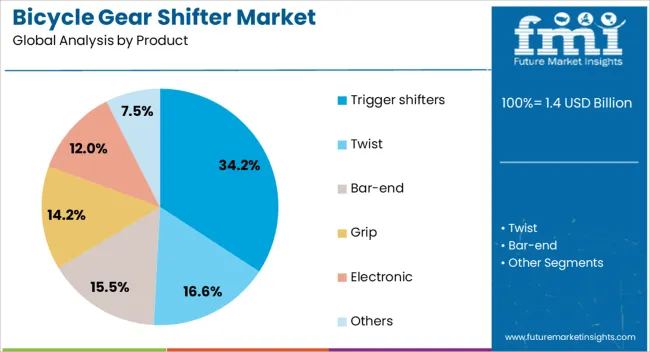
Trigger Shifters Lead the Product Segment
Among gear types, trigger shifters dominate with 34.2% market share, favored for their ease of use, reliability, and seamless performance across diverse terrain. Widely adopted in mountain bikes and off-road applications, trigger shifters offer compact designs compatible with flat handlebars and modern drivetrains. Manufacturers continue to refine tactile feedback, lightweight materials, and ergonomic layouts, ensuring these systems remain a market staple for both casual and performance riders.
Other product types, including twist, bar-end, grip, and electronic shifters, are gaining traction, particularly as e-bikes and high-performance road bicycles demand smoother, more automated gear engagement.
Mechanical Technology Dominates
Mechanical gear shifters account for 47.9% of the market, valued for reliability, cost-efficiency, and ease of maintenance. Cable-based systems remain popular among budget-conscious consumers and in emerging markets, where simplicity and repairability are key. Innovations in cable routing, friction reduction, and material strength continue to enhance mechanical systems without sacrificing performance.
Electronic and hydraulic alternatives are expanding, particularly in premium and e-bike segments, offering wireless integration, precision, and smart-bike connectivity. These technologies are opening opportunities for manufacturers to deliver customizable solutions tailored to various cycling disciplines.
Mountain Bikes Drive Application Demand
Mountain bikes represent 41.6% of market demand, requiring robust and precise gear systems for off-road trails, enduro, and downhill cycling. The increasing popularity of trail riding and adventure cycling, combined with investments in recreational infrastructure, is fueling demand for durable, responsive shifters. Innovations in lightweight materials, extended gear ranges, and terrain-specific designs are directly addressing rider expectations in this segment.
Road bikes, urban commuting, and touring bicycles also contribute to market growth, with consumers seeking precision, efficiency, and reliability across diverse cycling applications.
Regional Insights
China leads with a projected CAGR of 11.1%, fueled by urbanization, e-bike adoption, and government investment in cycling infrastructure. Domestic manufacturers are scaling production, while international players expand distribution to meet rising demand for high-performance gear systems.
India follows with a CAGR of 10.3%, driven by increased cycling participation, growing disposable incomes, and government support for urban cycling initiatives. Recreational and competitive cycling events further enhance demand for quality gear shifters.
Germany shows a CAGR of 9.4%, benefiting from a strong cycling culture, well-developed infrastructure, and e-bike growth. France (8.6%), UK (7.8%), and USA (7.0%) demonstrate moderate growth, underpinned by urban mobility programs and the rising popularity of high-end bicycles and e-bikes.
Opportunities and Emerging Trends
Wireless electronic shifting systems, smart-bike integration, and lightweight, durable materials are key trends shaping the market. Manufacturers are focusing on smooth, quiet, and precise shifting, often integrated with digital monitoring for performance tracking. The rise of e-bikes provides an especially lucrative opportunity for innovative shifters tailored for electric drive systems.
Customization is becoming a differentiator, with gear shifters designed for specific cycling styles—mountain biking, road racing, touring, and urban commuting. As cycling continues to gain popularity for both transportation and leisure, companies offering user-friendly, technologically advanced, and adaptable solutions will capture significant market share.
Competitive Landscape
Shimano remains the market leader, offering mechanical and electronic systems across road, mountain, and gravel bikes, with Di2 electronic shifting particularly favored by professionals. SRAM is pushing wireless eTap systems and technological innovations for high-end road and mountain bikes. Campagnolo focuses on premium road cycling with precision mechanical and electronic systems.
Mid-tier players such as microSHIFT, L-TWOO, and Sensah provide affordable yet reliable alternatives, catering to recreational and semi-professional riders. New entrants like Box Components are gaining traction in the mountain bike segment, balancing performance and cost. SunRace and Sturmey Archer emphasize internal hub gear systems, ideal for urban commuting and touring bicycles. Additional key competitors include Tektro and Wolf Tooth, all innovating in lightweight materials, smart integration, and durable designs.
Purchase this Report for USD 5,000 Only | Get an Exclusive Discount Instantly! https://www.futuremarketinsights.com/checkout/25846
Everything You Need—within Your Budget. Request a Special Price Now! https://www.futuremarketinsights.com/reports/sample/rep-gb-25846
About Future Market Insights (FMI)
Future Market Insights, Inc. (ESOMAR certified, recipient of the Stevie Award, and a member of the Greater New York Chamber of Commerce) offers profound insights into the driving factors that are boosting demand in the market. FMI stands as the leading global provider of market intelligence, advisory services, consulting, and events for the Packaging, Food and Beverage, Consumer Technology, Healthcare, Industrial, and Chemicals markets. With a vast team of over 400 analysts worldwide, FMI provides global, regional, and local expertise on diverse domains and industry trends across more than 110 countries.
Contact Us:
Future Market Insights Inc.
Christiana Corporate, 200 Continental Drive,
Suite 401, Newark, Delaware – 19713, USA
T: +1-347-918-3531
For Sales Enquiries: sales@futuremarketinsights.com
Website: https://www.futuremarketinsights.com
LinkedIn| Twitter| Blogs | YouTube