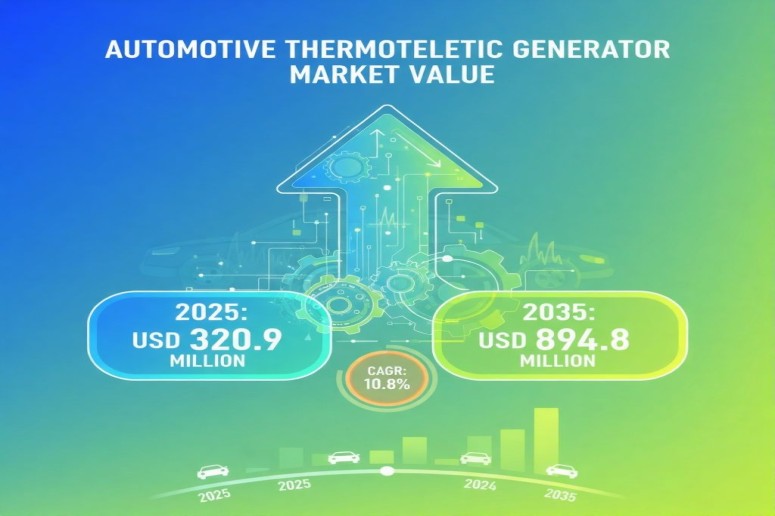
The global automotive thermoelectric generator (ATEG) market is entering a period of remarkable growth, projected to expand from USD 320.9 million in 2025 to USD 894.8 million by 2035, representing a robust CAGR of 10.8%.
This growth signals the transition of thermoelectric technology from early experimental adoption to widespread integration across passenger cars, commercial vehicles, and hybrid platforms. Manufacturers, both established and emerging, are increasingly investing in research, production capabilities, and new technologies to capture the potential of this evolving market.
During the early adoption phase from 2020 to 2024, growth was moderate, rising from USD 192.1 million to USD 320.9 million as automotive companies explored waste heat recovery systems and tested prototype installations. This period focused on demonstrating efficiency gains, reducing fuel consumption, and validating feasibility across various vehicle models. By 2025, the market has achieved a critical size, marking readiness for broader deployment and growing interest from automotive OEMs seeking complementary power solutions for both internal combustion and hybrid vehicles.
Between 2025 and 2030, the ATEG market is expected to enter a scaling phase, surpassing USD 483.6 million by 2030. Growth during this period is being driven by wider integration across passenger and commercial vehicles, technological advancements in thermoelectric materials, and improved production efficiencies.
The subsequent consolidation phase, spanning 2030 to 2035, will see market leaders strengthening their positions, while smaller players align with established networks, further driving the market toward USD 894.8 million by 2035. The projected 10.8% CAGR underscores long-term, structured growth as thermoelectric technology becomes an integral component of modern vehicles.
Key Market Insights and Drivers
The ATEG market is fueled by a combination of automotive, energy, and technological sectors. The global automotive industry alone contributes approximately 35% to the market, with vehicle production directly influencing adoption potential. Powertrain systems account for 20%, forming the foundation for integrating thermoelectric solutions. Vehicle energy management and battery systems contribute 15%, enabling efficient use of recovered heat.
Other segments such as automotive component manufacturing (10%), aftermarket services (7%), transportation and logistics (5%), electronics and semiconductors (5%), and software and monitoring platforms (3%) collectively support the growth ecosystem. This multi-dimensional foundation allows stakeholders to prioritize investments, form strategic partnerships, and scale deployment effectively.
The market’s expansion is being accelerated by rising demand for energy-efficient and environmentally friendly vehicles. Regulatory pressures on emission reduction, consumer preference for eco-friendly vehicles, and advances in thermal management systems are driving adoption. Automotive OEMs are strategically investing in thermoelectric generators to enhance fuel efficiency, reduce emissions, and support auxiliary systems, positioning ATEGs as key enablers of sustainable mobility.
Segmental Highlights of the Automotive Thermoelectric Generator Market
By material, Bismuth Telluride leads the market, projected to account for 47.6% of revenue in 2025. Its high thermoelectric efficiency, stability under automotive operating conditions, and cost-effective manufacturing make it the preferred choice for both passenger and commercial vehicles. Continuous advancements in material processing and modular designs further strengthen its dominance, allowing reliable power generation across diverse temperature ranges without compromising safety.
In terms of vehicle types, passenger cars are anticipated to represent 51.3% of market revenue in 2025, driven by standardized engine layouts, exhaust heat availability, and ease of module installation. The ability to retrofit thermoelectric generators into existing vehicles without major modifications has facilitated adoption. This trend reflects consumer demand for eco-friendly vehicles and regulatory initiatives targeting urban emissions reduction.
Among applications, waste heat recovery emerges as the largest segment, projected to account for 44.8% of market revenue in 2025. By capturing otherwise lost energy from vehicle exhaust systems and converting it into usable electricity, thermoelectric generators provide dual benefits of fuel efficiency improvement and emission reduction. Advancements in module efficiency, lightweight designs, and integration with vehicle electronic systems are further enhancing adoption.
Regional Growth Trends
North America and Europe are driving high-efficiency TEG adoption in hybrid and luxury vehicles, focusing on maximum energy recovery and thermal stability. In contrast, Asia-Pacific markets are prioritizing cost-effective solutions for conventional and mid-range hybrid vehicles, balancing performance with affordability. Differences in integration complexity, regulatory standards, and vehicle types shape market strategies and adoption timelines globally.
Among countries, China leads with a CAGR of 14.6%, fueled by increasing hybrid and fuel-efficient vehicle adoption, lightweight module production, and government incentives for energy-efficient technologies. India follows at 13.5% CAGR, supported by rising demand for emission control technologies and clean energy vehicle initiatives.
Germany, with a CAGR of 12.4%, benefits from a strong automotive sector, stringent emissions standards, and early adoption of energy recovery solutions. The United Kingdom and the United States grow at CAGRs of 10.3% and 9.2%, respectively, driven by clean energy initiatives, regulatory mandates, and hybrid vehicle adoption.
Competitive Landscape and Key Players
The ATEG market is competitive, with established players and new entrants striving to innovate. Leading companies include Gentherm Incorporated, Alphabet Energy, European Thermodynamics, Faurecia, II-VI Marlow, KELK Ltd., Laird Thermal Systems, and Valeo. These companies are pioneering technologies that convert waste heat from vehicle exhaust systems into electrical energy, enhancing overall energy efficiency.
Order Now for $5,000 | Unlock Insights with a Special Discount!
https://www.futuremarketinsights.com/reports/sample/rep-gb-25444
Checkout Now to Access Industry Insights:
https://www.futuremarketinsights.com/checkout/25444
About Future Market Insights (FMI)
Future Market Insights, Inc. (ESOMAR certified, recipient of the Stevie Award, and a member of the Greater New York Chamber of Commerce) offers profound insights into the driving factors that are boosting demand in the market. FMI stands as the leading global provider of market intelligence, advisory services, consulting, and events for the Packaging, Food and Beverage, Consumer Technology, Healthcare, Industrial, and Chemicals markets. With a vast team of over 400 analysts worldwide, FMI provides global, regional, and local expertise on diverse domains and industry trends across more than 110 countries.
Contact Us:
Future Market Insights Inc.
Christiana Corporate, 200 Continental Drive,
Suite 401, Newark, Delaware – 19713, USA
T: +1-347-918-3531
For Sales Enquiries: sales@futuremarketinsights.com
Website: https://www.futuremarketinsights.com
LinkedIn| Twitter| Blogs | YouTube