The global automated feeding systems market is on a remarkable growth trajectory, projected to climb from USD 6.8 billion in 2025 to approximately USD 33.5 billion by 2035, representing an astounding 393% increase and a CAGR of 17.3%. This surge underscores the global shift toward precision livestock farming and the rising demand for operational efficiency, feed management optimization, and automation in agricultural operations. Both established market leaders and emerging technology providers are actively investing in solutions that improve feed efficiency, reduce labor requirements, and enhance animal welfare.
The market’s first growth phase, from 2025 to 2030, anticipates an increase from USD 6.8 billion to USD 15.1 billion. This period is shaped by escalating labor costs in agriculture, the adoption of IoT-enabled feeding systems, and increased focus on feed conversion optimization. Livestock producers are recognizing that automated solutions allow for consistent feed delivery while lowering manual labor and improving productivity.
The subsequent phase, from 2030 to 2035, is forecast to account for the majority of market expansion, growing from USD 15.1 billion to USD 33.5 billion. During this period, integration of artificial intelligence, development of precision nutrition delivery systems, and deployment of autonomous mobile feeding robots are expected to transform feeding practices. These innovations allow systems to adapt to individual animal requirements, integrate with farm management software, and deliver comprehensive analytics for operational decision-making.
Market Dynamics: Efficiency, Technology, and Animal Welfare
The automated feeding systems market is expanding due to the growing need for operational efficiency in livestock operations. Labor shortages, rising feed costs, and stricter animal welfare regulations have made precision feeding essential. Automated systems deliver exact feed quantities at optimal times, improving feed conversion rates, reducing waste, and ensuring compliance with welfare standards.
The integration of IoT and smart sensor technologies enables real-time monitoring, remote control, and predictive maintenance, significantly enhancing system reliability and performance. Advanced sensor networks track feed levels, consumption patterns, and equipment status, providing actionable insights that inform farm management decisions.
Moreover, the development of precision nutrition systems allows producers to tailor feed delivery to individual animals, production stages, or performance objectives. By optimizing nutrition and minimizing waste, these systems help farmers achieve high efficiency while supporting sustainable farming practices.
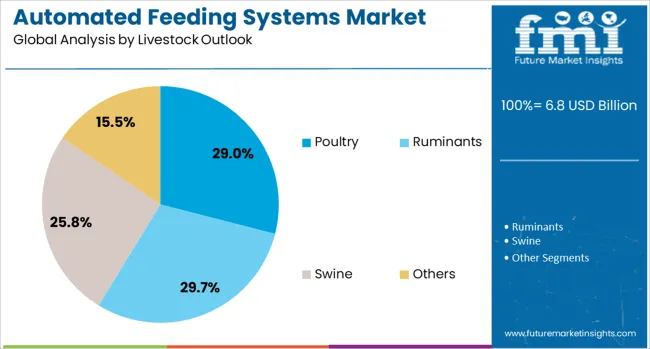
Segmental Insights: Hardware, Conveyor Systems, and Poultry
By component, hardware dominates with 61.6% market share in 2025, reflecting the essential role of feeding mechanisms, conveyors, storage units, and control devices in automated feeding installations. Hardware investments are critical for system reliability and are continuously enhanced to integrate with farm infrastructure and improve performance.
Within system categories, conveyor feeding systems lead with a 50% share, providing reliable, consistent feed delivery with straightforward installation and maintenance. Their proven operational reliability makes them the preferred choice for both small and large-scale livestock operations.
By livestock type, poultry accounts for 29% of market share, driven by high-density facilities and standardized feeding needs. Automated systems support biosecurity, feed consistency, and high production volumes, complementing the rapid global growth in poultry consumption.
Drivers, Trends, and Challenges
Market growth is fueled by rising labor costs, the demand for feed efficiency, and increasing adoption of data-driven livestock management practices. AI-powered systems, capable of predictive modeling and adaptive learning, optimize feeding schedules and formulations, while autonomous mobile feeders provide flexible solutions for complex farm layouts.
Challenges include high initial capital requirements, integration complexity, and variable adoption rates across farm sizes and regions. Nevertheless, financing solutions, technical support, and ongoing innovation are enabling broader adoption and market penetration.
Regional Market Insights: China, India, Germany, France, UK, USA, Brazil
China leads the market with a 23.4% CAGR, driven by livestock modernization, commercial farm expansion, and government support for agricultural automation. India follows at 21.6% CAGR, fueled by mechanization initiatives, dairy sector investment, and technology adoption programs.
Germany, with 19.9% CAGR, emphasizes precision farming and advanced agricultural technology integration. France, at 18.2% CAGR, integrates feeding automation with existing livestock management systems, supported by cooperative purchasing programs. The UK grows at 16.4% CAGR, with a focus on green farming practices and operational efficiency, while the USA achieves 14.7% CAGR, driven by large-scale commercial operations and technology integration. Brazil expands at 13% CAGR, fueled by modernization and livestock production growth.
These regional trends reflect the global push toward automation, efficiency, and sustainable livestock management practices, providing opportunities for both multinational providers and innovative startups.
Competitive Landscape: Innovation, Integration, and Expansion
The automated feeding systems market is highly competitive, with players emphasizing innovation, precision feeding, and integrated farm management solutions. Leading companies include GEA Group, DeLaval, BouMatic, DAIRYMASTER, FarmFeeder, Fullwood JOZ, HETWIN – FÜTTERUNGSTECHNIK, Lely, RNA Automation Limited, Rovibec Agrisolutions, Schauer Agrotronic GmbH, and Trioliet.
These companies are differentiating themselves through technology-driven solutions, AI integration, autonomous feeding systems, and multi-functional hardware. Established firms leverage global presence and engineering expertise, while emerging players focus on agility, customization, and innovative product offerings. Strategic partnerships and research initiatives are further enhancing capabilities and market reach.
Purchase this Report for USD 5,000 Only | Get an Exclusive Discount Instantly! https://www.futuremarketinsights.com/checkout/26067
Everything You Need—within Your Budget. Request a Special Price Now! https://www.futuremarketinsights.com/reports/sample/rep-gb-26067
About Future Market Insights (FMI)
Future Market Insights, Inc. (ESOMAR certified, recipient of the Stevie Award, and a member of the Greater New York Chamber of Commerce) offers profound insights into the driving factors that are boosting demand in the market. FMI stands as the leading global provider of market intelligence, advisory services, consulting, and events for the Packaging, Food and Beverage, Consumer Technology, Healthcare, Industrial, and Chemicals markets. With a vast team of over 400 analysts worldwide, FMI provides global, regional, and local expertise on diverse domains and industry trends across more than 110 countries.
Contact Us:
Future Market Insights Inc.
Christiana Corporate, 200 Continental Drive,
Suite 401, Newark, Delaware – 19713, USA
T: +1-347-918-3531
For Sales Enquiries: sales@futuremarketinsights.com
Website: https://www.futuremarketinsights.com
LinkedIn| Twitter| Blogs | YouTube