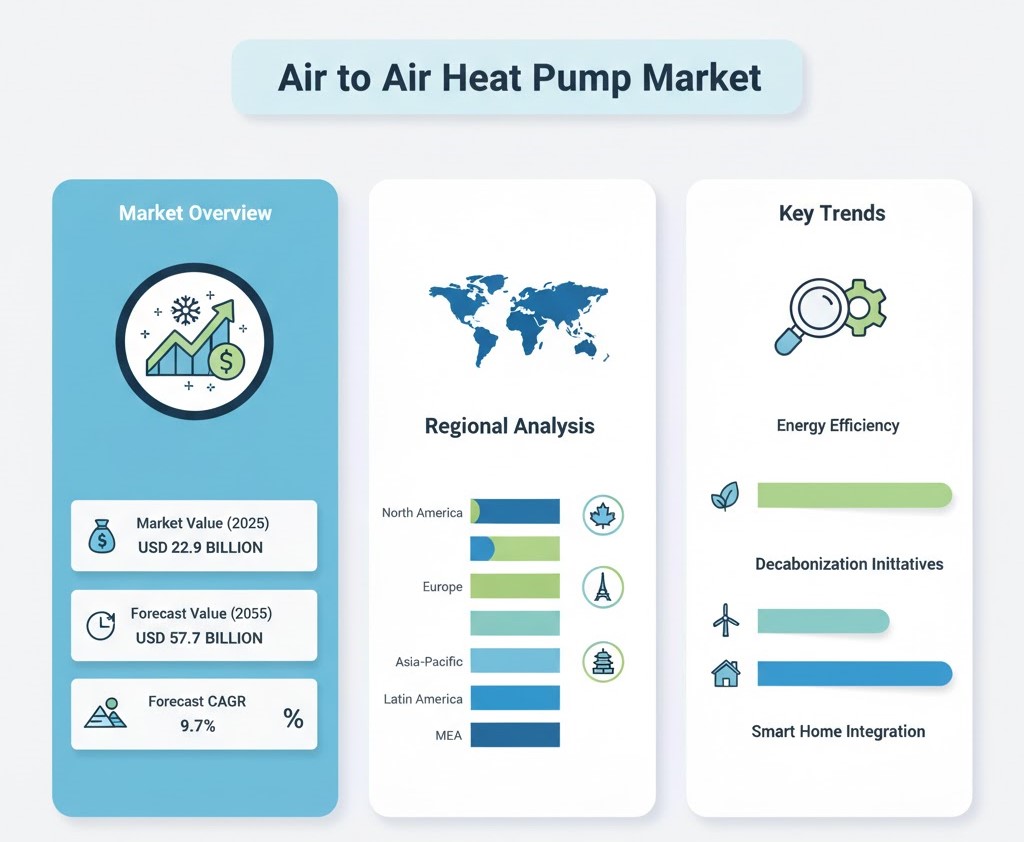
The global Air to Air Heat Pump Market is set to experience remarkable growth over the next decade, expanding from USD 22.9 billion in 2025 to USD 57.7 billion by 2035, at a CAGR of 9.7%. This steady rise is fueled by rising environmental awareness, stringent energy-efficiency standards, and the widespread transition toward eco-friendly heating and cooling solutions. Supported by policy incentives, technology advancements, and growing retrofitting activities, the market is evolving into a core component of the sustainable HVAC landscape.
Report Coverage & Deliverable
The comprehensive market report offers in-depth quantitative and qualitative insights across key segments, including:
- Market Size and Growth Forecasts (2025–2035)
- Product Segmentation: Ductless and Ducted
- Application Segmentation: Residential and Commercial
- Regional Insights: North America, Europe, Asia-Pacific, Latin America, Middle East & Africa
- Key Players Profiled: Daikin, Carrier, LG Electronics, Trane, Panasonic, Bosch Thermotechnology, Samsung, Lennox, Rheem, Stiebel Eltron, and others
- Analytical Coverage: Competitive landscape, pricing dynamics, regulatory influence, technology integration, and consumer adoption trends.
This report provides strategic guidance for stakeholders seeking to understand evolving market dynamics, regional growth hotspots, and emerging investment opportunities in the HVAC industry.
Key Factors Shaping Market Dynamics
- Rising Energy Efficiency Regulations
Governments across developed and emerging economies are enforcing stricter building codes and performance standards. These initiatives are driving the integration of energy-efficient HVAC systems, with heat pumps gaining preference due to their low emissions and operational efficiency. Tax credits, rebates, and subsidy programs in the U.S., U.K., Germany, China, and India are accelerating adoption.
- Expanding Retrofitting and New Construction Projects
Retrofitting of existing buildings and new housing developments are both fueling market growth. In mature markets like North America and Western Europe, retrofits dominate, while Asia-Pacific and Eastern Europe lead in new installations driven by urbanization and infrastructure expansion.
- Technological Advancements and Hybrid Integration
Manufacturers are increasingly adopting inverter-based and variable refrigerant flow (VRF) technologies. Hybrid integration with ventilation and smart control systems enhances energy optimization and user comfort, establishing a new benchmark for modern HVAC systems.
- Growing Consumer Awareness
With rising energy costs and climate consciousness, consumers are seeking long-term savings and reduced carbon footprints. Air to air heat pumps provide dual functionality—heating and cooling—while offering superior energy performance and compatibility with smart home platforms.
- Policy and Incentive Support
National sustainability programs and climate action plans are critical to demand expansion. Policy-driven adoption ensures predictable demand cycles, encouraging OEMs to invest in local manufacturing, supply chain development, and aftersales infrastructure.
Key Takeaways
- Market Valuation: USD 22.9 billion (2025) → USD 57.7 billion (2035)
- Forecast CAGR: 9.7% over 2025–2035
- Leading Product Segment (2025): Ductless systems – 57.8% share
- Leading Application Segment (2025): Residential – 46.3% share
- Top Growth Regions: North America, Asia-Pacific, and Europe
- Major Market Players: Daikin, Carrier, Trane, LG Electronics, Panasonic, Bosch Thermotechnology, and Samsung
Weighted Growth Outlook
Between 2025 and 2030, the market is projected to rise from USD 22.9 billion to USD 33.1 billion, a 44.5% increase. From 2030 to 2035, it will surge by nearly 74.4%, reflecting stronger momentum in the latter half of the decade due to broader adoption across residential and commercial installations.
Sectoral Distribution
- Residential: ~38% share, driven by retrofits and efficiency mandates
- Commercial: ~26% share, with high adoption in offices and retail spaces
- Utilities and Energy Management: ~14% share, boosted by smart grid integration
- Industrial and Others: ~22% share, including logistics, healthcare, and education
Regional Analysis
Asia-Pacific
Asia-Pacific leads the market, driven by China (13.1% CAGR) and India (12.1% CAGR). Government incentives, rapid urban development, and large-scale housing projects are boosting adoption.
- China: Expanding public housing, VRF adoption, and localized manufacturing.
- India: Smart city initiatives and HVAC efficiency codes accelerating growth.
Europe
Europe remains a critical hub with strong policy support and high retrofit activity.
- Germany (11.2% CAGR): Driven by strict building performance standards and energy service contracts.
- France (10.2% CAGR): Focus on modernization and low-noise units.
- UK (9.2% CAGR): Supported by grants, EPC rating pressures, and retrofit programs.
North America
The U.S. market (8.2% CAGR) benefits from federal and state incentives, with regional adoption varying by climate. Demand is concentrated in residential retrofits and small commercial facilities, with an increasing shift to cold-climate models and smart control integration.
Latin America & Middle East
These regions are gradually emerging as growth frontiers due to rising energy costs, climate challenges, and government-backed efficiency mandates. Brazil (7.3% CAGR) stands out for its rapid adoption of inverter-based systems.
Key Segments of the Market Report
By Product Type
- Ductless Systems: Dominant segment with 57.8% market share in 2025 due to cost-effective installation, zoned control, and adaptability in retrofits.
- Ducted Systems: Preferred in large commercial and institutional settings for centralized climate control.
By Application
- Residential: Largest application segment, driven by energy-conscious consumers and supportive government policies.
- Commercial: Gaining traction in office spaces, educational institutions, and hospitality sectors seeking operational efficiency and regulatory compliance.
Competitive Landscape
The market is moderately consolidated, led by Daikin, Carrier, LG Electronics, Trane, Panasonic, and Bosch Thermotechnology, with strong regional presence and diverse product portfolios.
- Daikin dominates through innovation and service networks.
- Carrier, Lennox, and Trane leverage North American dealer strength.
- Fujitsu, Panasonic, and Samsung expand through smart system integration.
- Bosch and Stiebel Eltron target premium European markets with engineering excellence.
- Emerging players like MRCOOL, Napoleon, and GREE Comfort are capturing price-sensitive markets with hybrid and inverter solutions.
Grab This Report Now at Just $5000| Limited-Time Discount Offer! https://www.futuremarketinsights.com/reports/sample/rep-gb-25348
Checkout Now to Access Industry Insights: https://www.futuremarketinsights.com/checkout/25348
About Future Market Insights (FMI)
Future Market Insights, Inc. (ESOMAR certified, recipient of the Stevie Award, and a member of the Greater New York Chamber of Commerce) offers profound insights into the driving factors that are boosting demand in the market. FMI stands as the leading global provider of market intelligence, advisory services, consulting, and events for the Packaging, Food and Beverage, Consumer Technology, Healthcare, Industrial, and Chemicals markets. With a vast team of over 400 analysts worldwide, FMI provides global, regional, and local expertise on diverse domains and industry trends across more than 110 countries.
Contact Us:
Future Market Insights Inc.
Christiana Corporate, 200 Continental Drive,
Suite 401, Newark, Delaware – 19713, USA
T: +1-347-918-3531
For Sales Enquiries: sales@futuremarketinsights.com
Website: https://www.futuremarketinsights.com
LinkedIn| Twitter| Blogs | YouTube