The global maritime cybersecurity market is set to experience a transformative decade, expanding from USD 3.5 billion in 2025 to nearly USD 11.4 billion by 2035. This remarkable growth, representing a 225.7% increase and a 12.5% CAGR, is driven by the accelerating digitalization of maritime operations and the escalating frequency of cyberattacks targeting critical shipping infrastructure and port systems. As maritime operations become increasingly interconnected, the demand for robust cybersecurity frameworks has evolved from a compliance necessity to a strategic business priority.
Rising Digitalization and the Growing Need for Cyber Resilience
Between 2025 and 2030, the maritime cybersecurity market will witness its first major phase of expansion, reaching USD 6.3 billion, accounting for over one-third of the decade’s total growth. This acceleration is fueled by the increasing adoption of smart shipping technologies, the integration of IoT devices, and the growing complexity of operational technology systems onboard vessels and within port environments. Maritime organizations are rapidly investing in digital transformation, yet each advancement exposes them to heightened cybersecurity vulnerabilities.
From 2030 to 2035, the market’s momentum will intensify further, adding another USD 5.1 billion in value. Artificial intelligence and advanced data analytics are expected to dominate this period, as autonomous vessels and smart port ecosystems rely on predictive cybersecurity models to detect and neutralize sophisticated digital threats. The proliferation of maritime data networks, coupled with evolving regulatory mandates, will push organizations toward more comprehensive and adaptive cybersecurity solutions.
A Decade Defined by Awareness, Regulation, and Innovation
The years leading up to 2025 marked the awakening of the maritime sector to cyber risks. Following multiple high-profile cyber incidents targeting global shipping lines, the industry began adopting a proactive stance on digital defense. International maritime regulators introduced new cybersecurity compliance standards, prompting organizations to integrate security into every layer of maritime operations. This cultural and technological shift laid the groundwork for the robust growth forecasted for the next decade.
Market Structure and Segmental Insights
The maritime cybersecurity market is broadly segmented by component, security type, deployment, organization size, end-user, and region. Among these, solutions dominate the component outlook, capturing an estimated 68.7% share in 2025. These integrated platforms offer real-time threat detection, automated incident response, and specialized protection for vessel and port systems. The continued innovation in operational technology (OT) protection and maritime-specific software development is reinforcing the strength of this segment.
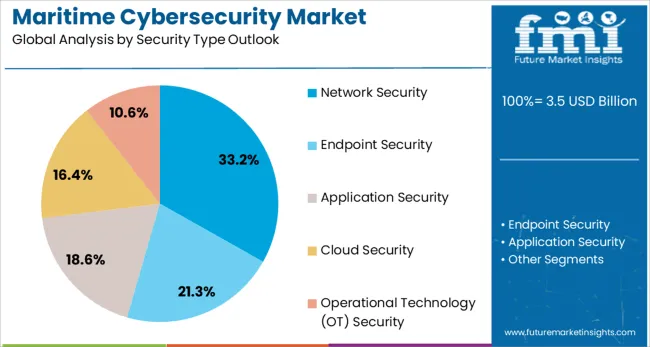
By security type, network security remains a cornerstone, accounting for 33.2% of the total market share. The need to safeguard communication links between ships, satellites, and ports has become essential as vessels rely on seamless connectivity for navigation and logistics. The protection of this interconnected ecosystem is critical to prevent disruptions in global trade.
In terms of deployment, on-premise solutions are expected to hold 65% of the market in 2025. Given the autonomous nature of maritime operations, vessels require localized, immediate cybersecurity control. These systems ensure uninterrupted security even in environments with limited connectivity—an indispensable feature for deep-sea operations.
When analyzed by organization size, large enterprises dominate with a 70.8% market share, reflecting the sophisticated digital ecosystems of major shipping companies and global port authorities. Smaller maritime operators, however, are increasingly adopting scalable cloud-based solutions to strengthen their defenses.
The commercial shipping segment, representing 42.1% of the total market, highlights the vast scope of cybersecurity applications—from navigation systems to cargo logistics. As global trade volumes grow, this segment will remain at the forefront of cybersecurity innovation and investment.
Drivers and Emerging Trends
The maritime cybersecurity landscape is shaped by a convergence of technological, regulatory, and operational factors. The expansion of connected vessel systems, automated navigation, and digital port logistics has amplified the attack surface, prompting maritime stakeholders to integrate AI-driven threat detection, machine learning analytics, and predictive security monitoring.
Artificial intelligence plays a critical role in identifying abnormal patterns in data traffic, while machine learning enhances incident response accuracy. These intelligent systems not only mitigate risk but also optimize security resources for complex, distributed maritime infrastructures.
Another significant trend is the emergence of maritime-specific cybersecurity standards. Modern platforms now embed compliance protocols aligned with the International Maritime Organization (IMO) guidelines and other regional mandates. This shift toward regulatory convergence ensures a uniform security posture across international maritime operations.
Regional Dynamics and Growth Leaders
The maritime cybersecurity market displays strong regional momentum, with Asia Pacific emerging as the fastest-growing hub. China, leading with a 16.9% CAGR, benefits from its ambitious smart port projects, the Belt and Road Initiative, and government-backed mandates for cybersecurity modernization. The nation’s rapid port automation and shipping digitalization have created fertile ground for advanced cybersecurity investments.
India follows closely with a 15.6% CAGR, supported by extensive port modernization under the Sagarmala program and the rise of digital maritime ecosystems across major ports like Mumbai, Chennai, and Kolkata. The country’s push for international-standard security compliance is stimulating demand for professional cybersecurity services and infrastructure upgrades.
In Europe, Germany (14.4% CAGR) leads innovation through its integration of maritime Industry 4.0 technologies, emphasizing operational resilience in key ports such as Hamburg and Bremen. France (13.1%) and the United Kingdom (11.9%) are reinforcing cybersecurity across naval, defense, and commercial operations, ensuring adherence to EU directives and international shipping protocols.
In the United States, growth at 10.6% CAGR reflects the strategic importance of cybersecurity in critical maritime infrastructure and naval defense. Federal initiatives aimed at protecting national shipping and port operations from cyber threats are bolstering market maturity. Meanwhile, Brazil (9.4%) demonstrates steady progress, focusing on port modernization and digitalization in key trade hubs such as Santos and Rio de Janeiro.
Competitive Landscape: Collaboration and Innovation Define the Future
The maritime cybersecurity market is a vibrant ecosystem of global leaders, specialized firms, and emerging innovators. Established players such as Marlink SAS, Fortinet Inc., Naval Dome Ltd., Cydome Security Ltd., CyberOwl Ltd., and ABS Group are driving product innovation through AI integration, OT security enhancement, and real-time threat intelligence.
Multinational giants including Cisco Systems Inc., Thales Group, BAE Systems plc, Raytheon Technologies Corporation, Northrop Grumman Corporation, Honeywell International Inc., and Wärtsilä Corporation are expanding their maritime cybersecurity portfolios to address the increasing convergence of IT and OT systems in global shipping.
Emerging companies are also finding opportunities to collaborate with port authorities, shipbuilders, and logistics providers, introducing cost-effective, scalable cybersecurity frameworks tailored for small and medium-sized maritime enterprises.
Purchase this Report for USD 5,000 Only | Get an Exclusive Discount Instantly! https://www.futuremarketinsights.com/checkout/26135
Everything You Need—within Your Budget. Request a Special Price Now! https://www.futuremarketinsights.com/reports/sample/rep-gb-26135
About Future Market Insights (FMI)
Future Market Insights, Inc. (ESOMAR certified, recipient of the Stevie Award, and a member of the Greater New York Chamber of Commerce) offers profound insights into the driving factors that are boosting demand in the market. FMI stands as the leading global provider of market intelligence, advisory services, consulting, and events for the Packaging, Food and Beverage, Consumer Technology, Healthcare, Industrial, and Chemicals markets. With a vast team of over 400 analysts worldwide, FMI provides global, regional, and local expertise on diverse domains and industry trends across more than 110 countries.
Contact Us:
Future Market Insights Inc.
Christiana Corporate, 200 Continental Drive,
Suite 401, Newark, Delaware – 19713, USA
T: +1-347-918-3531
For Sales Enquiries: sales@futuremarketinsights.com
Website: https://www.futuremarketinsights.com
LinkedIn| Twitter| Blogs | YouTube