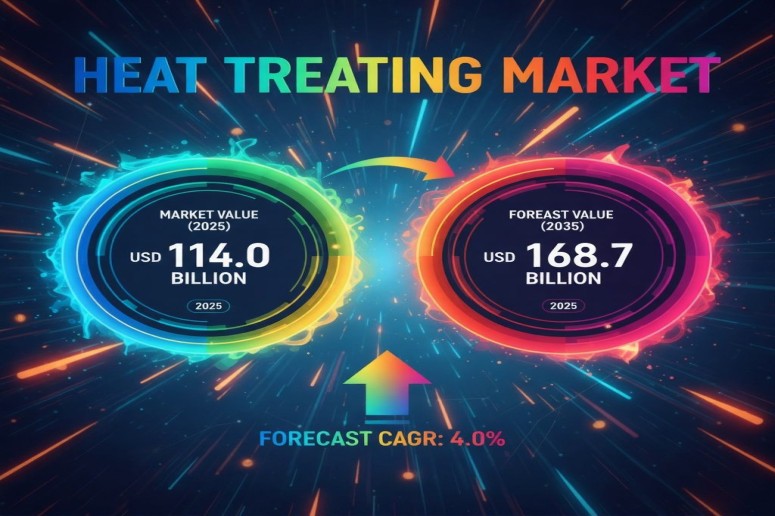
The global heat treating market, currently valued at USD 114.0 billion in 2025, is poised for significant expansion, projected to reach USD 168.7 billion by 2035, representing a robust CAGR of 4.0%. The market’s growth trajectory reflects increasing industrial demand, technological innovation, and the strategic adoption of advanced heat treatment processes across automotive, aerospace, heavy machinery, and metallurgical sectors.
Key Market Dynamics and Drivers
The heat treating market is fundamentally supported by the metal and alloy manufacturing sector, contributing approximately 28-32% of overall demand. Processes such as annealing, quenching, and tempering enhance the mechanical properties, hardness, and wear resistance of steel, aluminum, and other alloys. Automotive and transportation industries account for another 20-24%, with gears, engine parts, shafts, and suspension components undergoing heat treatment to withstand high operational stress.
Aerospace and defense applications contribute 15-18%, where critical components like turbine blades and landing gear require precise thermal processing to maintain safety, reliability, and performance. Meanwhile, industrial machinery and heavy equipment sectors make up roughly 12-15% of market demand, leveraging heat treatment for tools, dies, molds, and production machinery.
The growing emphasis on high-strength, durable materials across industries has fueled steady market growth. Technological advancements, particularly in furnace design, temperature control systems, and automation, are enhancing process efficiency and precision. Concurrently, environmental regulations and sustainability initiatives have accelerated the adoption of energy-efficient equipment and cleaner processes. The rise of advanced alloys and specialized steel grades further supports the demand for customized heat treatment solutions.
Material and Process Insights
Among materials, steel remains dominant, accounting for 54.6% of market revenue in 2025. Its widespread use in automotive parts, industrial tools, and construction machinery makes heat treatment indispensable for enhancing hardness, fatigue resistance, and durability. Alloy steel, in particular, offers adaptability to multiple heat treatment processes at a competitive cost, making it the preferred choice for large-scale manufacturing.
In terms of processes, carburizing stands out as a critical category, expected to capture 22.8% of the market revenue in 2025. This process imparts a hard, wear-resistant surface while maintaining a ductile core, essential for components such as automotive gears, bearings, and transmission parts. Innovations in low-pressure carburizing, improved atmosphere control, and case depth uniformity are enhancing efficiency, reducing cycle times, and improving energy consumption.
Equipment Trends: Electrically Heated Furnaces Leading Adoption
Electrically heated furnaces dominate the equipment segment, projected to hold 59.3% of market revenue in 2025. Their precision, clean operation, and compatibility with both batch and continuous applications make them a preferred choice for manufacturers seeking energy efficiency and environmental compliance. Technological advancements in heating elements, insulation, and digital controls have enhanced their performance, while integration with automation and Industry 4.0 systems supports real-time process monitoring and quality assurance.
Regional Market Outlook
Asia-Pacific, North America, and Europe are the key growth regions driving market expansion. China and India are the fastest-growing markets, with CAGRs of 5.4% and 5.0% respectively, fueled by industrial modernization, automotive production, and heavy machinery demand. France’s heat treating market is growing at a CAGR of 4.2%, driven by aerospace, automotive, and machinery sectors with high regulatory compliance. The UK (3.8%) and USA (3.4%) continue to show steady adoption in automotive, aerospace, and industrial machinery, supported by modernization initiatives, automation, and process monitoring systems.
Opportunities in Key Sectors
The automotive, aerospace, and energy sectors provide significant opportunities for growth. Aerospace and defense industries increasingly rely on advanced heat-treated alloys for critical components. Automotive manufacturers are leveraging heat treatment to enhance engine parts, gears, and suspension systems, while the energy sector applies heat-treated materials in turbines, pipelines, and drilling equipment.
Manufacturers offering process optimization, customized heat treatment cycles, and technical support gain a competitive edge, particularly when integrating retrofitted furnaces and digital monitoring systems to improve operational efficiency.
Technological Advancements and Market Trends
Automation, process innovation, and digital monitoring are shaping the market’s future. IoT-enabled sensors, predictive maintenance, and real-time quality control are enabling more reliable and energy-efficient operations.
Modular, energy-efficient equipment is increasingly adopted, allowing manufacturers to meet diverse industrial needs while reducing operational costs. Industry 4.0 integration facilitates continuous monitoring, optimization, and traceability, positioning manufacturers that embrace these technologies for sustained market growth.
Competitive Landscape and Key Players
The heat treating market is highly competitive, featuring established global players and emerging manufacturers striving for technological leadership. Key players include Bodycote plc, Aalberts N.V., Advanced Heat Treat Corp (AHT), Aichelin Group, ALD Vacuum Technologies, Bluewater Thermal Solutions, BMI Fours Industrials, ECM Technologies, Furnace and Industrial Services BV (FIS), Harterei Gerster, Heat Treatment Services (HTS), Huisman Group, Parker Trutec Group, Paulo, and ThermTech.
These companies are investing in advanced furnaces, induction heating, surface hardening, and IoT-enabled monitoring solutions to capture market share. New entrants and expanding manufacturers are focusing on automation, process standardization, energy efficiency, and service integration to differentiate themselves and support global industrial demand.
Grab This Report Now at Just $5,000 | Limited-Time Discount Offer!
https://www.futuremarketinsights.com/reports/sample/rep-gb-24963
Checkout Now to Access Industry Insights:
https://www.futuremarketinsights.com/checkout/24963
About Future Market Insights (FMI)
Future Market Insights, Inc. (ESOMAR certified, recipient of the Stevie Award, and a member of the Greater New York Chamber of Commerce) offers profound insights into the driving factors that are boosting demand in the market. FMI stands as the leading global provider of market intelligence, advisory services, consulting, and events for the Packaging, Food and Beverage, Consumer Technology, Healthcare, Industrial, and Chemicals markets. With a vast team of over 400 analysts worldwide, FMI provides global, regional, and local expertise on diverse domains and industry trends across more than 110 countries.
Contact Us:
Future Market Insights Inc.
Christiana Corporate, 200 Continental Drive,
Suite 401, Newark, Delaware – 19713, USA
T: +1-347-918-3531
For Sales Enquiries: sales@futuremarketinsights.com
Website: https://www.futuremarketinsights.com
LinkedIn| Twitter| Blogs | YouTube