The global ceramic matrix composites (CMC) market is entering a transformative growth phase, expected to rise from USD 15.9 billion in 2025 to an impressive USD 42.8 billion by 2035, achieving a robust compound annual growth rate (CAGR) of 10.4%. The market’s upward trajectory is underpinned by surging demand from aerospace, defense, and energy industries—sectors that increasingly rely on lightweight, heat-resistant, and high-strength materials to achieve operational excellence.
At its core, the CMC market reflects the growing convergence of materials science and engineering innovation. These composites, formed by embedding ceramic fibers in ceramic matrices, offer extraordinary mechanical properties, enabling applications that conventional alloys cannot sustain. From jet engines to industrial turbines and automotive braking systems, CMCs have become indispensable to modern high-performance design.
The Economics and Value Chain Behind CMC Growth
Behind every CMC component lies a complex and cost-intensive production process. Raw materials such as high-purity ceramics and reinforcing fibers form the foundation of the industry, representing a substantial share of total production costs. Manufacturing techniques including chemical vapor infiltration (CVI), melt infiltration, and polymer impregnation and pyrolysis require specialized infrastructure, significant energy input, and highly skilled labor.
The value chain extends beyond synthesis into precision machining, integration, and testing, particularly for aerospace and defense applications, where reliability and safety standards are uncompromising. Each stage of production adds incremental cost but ensures unparalleled durability and performance—allowing manufacturers to command premium pricing.
Complementary services such as maintenance and technical support have become integral to the business model, creating recurring revenue opportunities for leading companies and offering long-term value for clients seeking reliability over product lifecycles.
Technological Innovation Drives Market Leadership
Recent years have witnessed remarkable progress in CMC innovation. Fiber-reinforced matrices, hybrid composites, and oxidation-resistant coatings are now mainstream, enhancing both performance and longevity. The integration of additive manufacturing enables production of complex geometries with improved efficiency and reduced material waste.
Manufacturers like General Electric, Rolls-Royce, and Kyocera Corporation are at the forefront, developing CMC components for turbine engines and next-generation propulsion systems. These companies invest heavily in R&D to optimize strength-to-weight ratios and reduce fuel consumption. Applied Thin Films, Inc., CeramTec GmbH, and COI Ceramics, Inc. focus on precision manufacturing and high-temperature endurance, while Morgan Advanced Materials and CoorsTek, Inc. serve industrial clients with tailored composites for harsh environments.
Such technological momentum is fostering collaboration between OEMs and material suppliers, opening pathways for new manufacturers eager to expand into the high-value CMC domain.
Dominant Segments and Material Trends
Within the material spectrum, oxide-based CMCs account for nearly 57.4% of the market share in 2025, owing to their superior oxidation resistance and temperature stability. These materials are widely used in gas turbines, aerospace components, and heat-resistant structures, where environmental durability is vital. Their processing flexibility also enables scalability for mass production—a key factor driving cost efficiency.
By fiber type, continuous fiber CMCs lead with 62.8% market share, offering high crack resistance and mechanical strength across large structural components. They have become indispensable in aircraft engine parts, turbine blades, and braking systems, aligning with the industry’s ongoing shift toward lightweight and high-reliability materials.
Aerospace and Defense at the Forefront of Demand
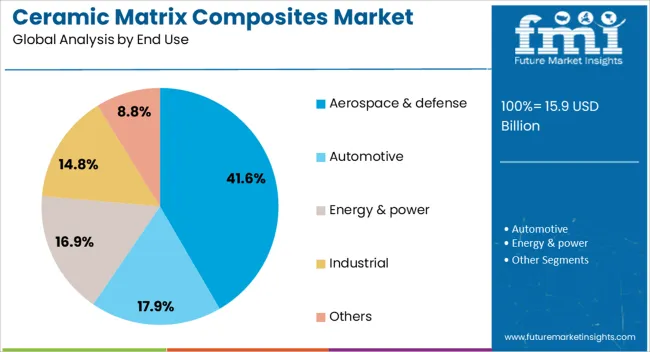
The aerospace and defense sector continues to dominate CMC consumption, accounting for 41.6% of total demand. These industries require materials that withstand extreme conditions while improving performance and reducing emissions. In aircraft engines, CMCs deliver significant weight savings and higher thermal tolerance, resulting in lower fuel consumption and extended service life.
Defense applications—from missile structures to advanced armor systems—benefit from CMCs’ unmatched resistance to thermal shock and corrosion. The surge in space exploration and hypersonic vehicle programs further amplifies the need for next-generation ceramic composites capable of sustaining high-velocity, high-temperature operations.
For manufacturers seeking entry into this space, collaboration with aerospace OEMs and defense contractors presents an enormous growth avenue.
Regional Growth Dynamics: Asia Leads the Charge
Regionally, Asia-Pacific is emerging as the powerhouse of CMC adoption. China leads with an extraordinary 14.0% CAGR, bolstered by state-driven investments in aerospace and high-temperature industrial applications. Domestic firms like AVIC Composite and SinoComposites are rapidly expanding their R&D capabilities, bridging the gap with Western technology leaders.
India, following closely at 13.0% CAGR, is channeling investments into aerospace propulsion systems, energy turbines, and defense programs. Partnerships between Indian manufacturers and global players such as Bharat Forge and Godrej Aerospace are accelerating commercialization and export potential.
In Europe, Germany (12.0%) and France (10.9%) continue to dominate, leveraging precision engineering and close integration with the automotive and aerospace sectors. The United Kingdom, growing at 9.9%, benefits from established industry leaders like Rolls-Royce and GKN, while the United States, at 8.8%, remains a hub of technological innovation with pioneers such as General Electric and Renegade Materials Corporation advancing high-temperature composites.
Manufacturing Breakthroughs and Sustainability Trends
Advancements in process automation, hybrid CMC design, and quality inspection systems are driving scalability and cost optimization. Additive manufacturing and digital simulation have allowed manufacturers to reduce cycle times and improve consistency, enhancing commercial viability.
Sustainability also plays a central role in shaping industry direction. As global industries seek lightweight, recyclable, and energy-efficient solutions, CMCs align perfectly with the green manufacturing agenda. Their longer lifespan and fuel-saving potential contribute directly to lower carbon footprints in aviation and industrial power generation.
Research into eco-friendly precursors and solvent-free processes further reinforces the material’s role as a sustainable alternative to traditional alloys and metals.
Opportunities for Stakeholders and New Entrants
The CMC industry is inherently capital- and technology-intensive, but this complexity also creates significant entry barriers—ensuring long-term profitability for innovators. As economies of scale improve and process costs decline, new manufacturers have the opportunity to carve out niche markets in automotive performance parts, industrial turbines, and energy equipment.
Emerging players focusing on hybrid formulations, thermal coatings, and automated fabrication systems can partner with aerospace and defense OEMs to gain early traction. Meanwhile, established leaders continue to strengthen their portfolios through strategic acquisitions, R&D alliances, and expansion into high-growth regions.
For investors and stakeholders, the market represents not only a high-return opportunity but also a crucial enabler of next-generation mobility, energy efficiency, and defense readiness.
Purchase this Report for USD 5,000 Only | Get an Exclusive Discount Instantly! https://www.futuremarketinsights.com/checkout/26066
Everything You Need—within Your Budget. Request a Special Price Now! https://www.futuremarketinsights.com/reports/sample/rep-gb-26066
About Future Market Insights (FMI)
Future Market Insights, Inc. (ESOMAR certified, recipient of the Stevie Award, and a member of the Greater New York Chamber of Commerce) offers profound insights into the driving factors that are boosting demand in the market. FMI stands as the leading global provider of market intelligence, advisory services, consulting, and events for the Packaging, Food and Beverage, Consumer Technology, Healthcare, Industrial, and Chemicals markets. With a vast team of over 400 analysts worldwide, FMI provides global, regional, and local expertise on diverse domains and industry trends across more than 110 countries.
Contact Us:
Future Market Insights Inc.
Christiana Corporate, 200 Continental Drive,
Suite 401, Newark, Delaware – 19713, USA
T: +1-347-918-3531
For Sales Enquiries: sales@futuremarketinsights.com
Website: https://www.futuremarketinsights.com
LinkedIn| Twitter| Blogs | YouTube