The global Building Information Modeling (BIM) market is on a transformative trajectory, projected to rise from USD 9.7 billion in 2025 to USD 29.6 billion by 2035, achieving a remarkable 205.2% growth and a CAGR of 11.8%. This rapid expansion underscores how the global construction industry is embracing digital transformation, sustainability, and collaboration at an unprecedented scale.
BIM has evolved from being a design tool to becoming the backbone of digital construction, enabling architects, engineers, and project managers to design, plan, and execute complex projects with precision. Between 2025 and 2030, the market is expected to grow from USD 9.7 billion to USD 16.9 billion, while the period from 2030 to 2035 will witness accelerated growth to USD 29.6 billion, driven by augmented reality (AR), virtual reality (VR), and predictive analytics integration.
Rising Digitalization and Sustainable Construction Drive Market Expansion
The accelerating pace of urbanization, infrastructure modernization, and the need for sustainable building practices are shaping the future of construction. Governments across the world are mandating BIM adoption for public projects, ensuring cost efficiency, transparency, and safety. This institutional backing, combined with industry-wide recognition of BIM’s efficiency in reducing design conflicts and cost overruns, is propelling demand globally.
As the world transitions toward carbon-neutral construction, BIM plays a vital role in modeling energy-efficient structures and supporting green certification. The integration of digital twins, AI, and cloud-based platforms is transforming how projects are conceived, designed, and managed, creating opportunities for established players and new entrants alike.
Software Takes the Lead as Digital Collaboration Intensifies
In 2025, software will account for nearly 66% of the BIM market, underscoring its role as the core component of digital construction. With functionalities such as 3D modeling, clash detection, and visualization, BIM software enables multidisciplinary collaboration, ensuring that projects are executed on time and within budget.
Technology leaders such as Autodesk, Bentley Systems, Dassault Systèmes, and Trimble are revolutionizing BIM through AI-powered design automation, cloud connectivity, and machine learning analytics. These innovations are not only enhancing accuracy but also helping project teams simulate and optimize building performance before ground is broken.
On-Premises Deployment Retains Dominance Amid Security and Performance Needs
Despite the rise of cloud solutions, on-premises deployments will command 57% of market share in 2025. The preference stems from the construction industry’s need for direct data control, high performance, and customization. Large engineering firms continue to invest in advanced IT infrastructure to handle the heavy computational requirements of BIM, ensuring data confidentiality and system reliability.
However, the cloud-based BIM segment is growing rapidly, enabling global teams to collaborate seamlessly through shared platforms, version control, and real-time updates. This transition toward hybrid systems highlights how the market is balancing security with scalability.
Pre-Construction and Design Phases Offer Maximum Value Creation
The pre-construction phase will account for 32% of BIM market activity in 2025, as organizations increasingly recognize its impact on reducing rework and improving cost forecasting. Early-stage BIM modeling helps identify design conflicts, optimize material use, and streamline planning processes—delivering measurable financial benefits.
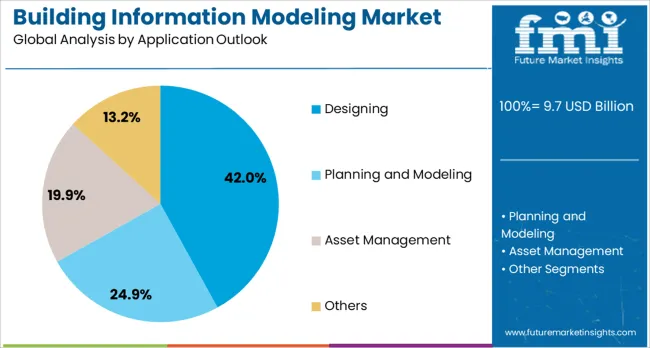
Meanwhile, the design segment, with a 42% market share, remains the cornerstone of BIM adoption. It drives collaboration across architectural, structural, and mechanical design disciplines, ensuring that all project stakeholders have a unified vision before construction begins.
Commercial Construction Leads Adoption
Among building types, the commercial segment represents 38% of BIM usage in 2025, reflecting the sector’s complexity and need for integrated project management. From high-rise buildings to large-scale retail and office spaces, commercial projects depend heavily on BIM for coordination and stakeholder alignment. The technology’s ability to simulate construction sequences and detect design conflicts delivers significant time and cost savings, making it indispensable for modern development projects.
Regional Analysis: Asia Pacific and Europe Emerge as Growth Powerhouses
Geographically, Asia Pacific, North America, and Europe are expected to dominate BIM adoption. Asia Pacific stands out, with China (15.9% CAGR) and India (14.8% CAGR) driving growth through government-led infrastructure projects and smart city initiatives. Both nations are rapidly digitizing construction workflows to support urban expansion, efficiency, and sustainability goals.
In Europe, Germany (13.6%) leads with precision engineering and Industry 4.0 integration, while France (12.4%) and the UK (11.2%) are leveraging BIM for sustainable architecture and infrastructure modernization. The United States, a pioneer in BIM adoption, continues to innovate with AI-driven construction analytics and digital twin ecosystems, maintaining a 10% CAGR through 2035.
Emerging economies like Brazil (8.9%) are also strengthening their BIM ecosystems, with national mandates and public-private collaborations promoting standardized digital construction frameworks.
Competitive Landscape: Innovation at the Core
The BIM market is witnessing intense competition among global leaders and emerging innovators. Autodesk Inc., the market frontrunner, continues to expand its portfolio with solutions like Revit and AutoCAD, now enhanced through AI and cloud connectivity. Bentley Systems focuses on infrastructure modeling, while Trimble combines software with field technologies to streamline on-site operations. Dassault Systèmes leverages its 3DEXPERIENCE platform to integrate collaboration and lifecycle management.
European firms like Nemetschek Group and Hexagon AB are advancing 3D modeling, measurement, and visualization technologies, while Topcon, AVEVA, Asite, and Beck Technology cater to specialized BIM applications across varied sectors. Emerging innovators such as Bimeye and ACCA Software are targeting niche market opportunities through modular, AI-enabled BIM solutions.
Strategic partnerships, acquisitions, and regional expansions remain central to growth strategies. Established firms are investing in startups to diversify capabilities and strengthen interoperability, while new entrants are leveraging cloud-first approaches to capture mid-market opportunities.
Purchase this Report for USD 5,000 Only | Get an Exclusive Discount Instantly! https://www.futuremarketinsights.com/checkout/26099
Everything You Need—within Your Budget. Request a Special Price Now! https://www.futuremarketinsights.com/reports/sample/rep-gb-26099
About Future Market Insights (FMI)
Future Market Insights, Inc. (ESOMAR certified, recipient of the Stevie Award, and a member of the Greater New York Chamber of Commerce) offers profound insights into the driving factors that are boosting demand in the market. FMI stands as the leading global provider of market intelligence, advisory services, consulting, and events for the Packaging, Food and Beverage, Consumer Technology, Healthcare, Industrial, and Chemicals markets. With a vast team of over 400 analysts worldwide, FMI provides global, regional, and local expertise on diverse domains and industry trends across more than 110 countries.
Contact Us:
Future Market Insights Inc.
Christiana Corporate, 200 Continental Drive,
Suite 401, Newark, Delaware – 19713, USA
T: +1-347-918-3531
For Sales Enquiries: sales@futuremarketinsights.com
Website: https://www.futuremarketinsights.com
LinkedIn| Twitter| Blogs | YouTube