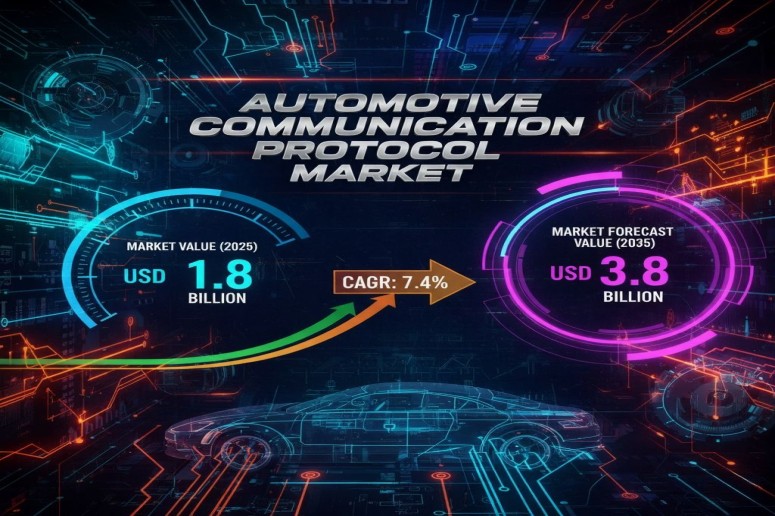
The global Automotive Communication Protocol Market is entering a transformative decade, projected to expand from USD 1.8 billion in 2025 to USD 3.8 billion by 2035, marking a compound annual growth rate (CAGR) of 7.4%. This surge represents an absolute dollar opportunity of USD 2.0 billion, driven by technological advancements in connected, autonomous, and electric vehicles (EVs) and the continuous evolution of vehicle communication systems.
From USD 1.3 billion in early-stage development, the market has demonstrated robust consistency, reaching USD 2.6 billion by 2030 and setting a clear path for sustained acceleration through 2035. As the automotive industry becomes increasingly software-defined, the demand for fast, secure, and standardized communication protocols continues to grow—creating a fertile environment for both established leaders and emerging innovators.
Steady Growth Paves Way for Strategic Expansion
Between 2025 and 2028, the market will grow from USD 1.8 billion to USD 2.1 billion, with annual increments of around USD 0.1–0.2 billion. This early growth phase offers a stable platform for new entrants to establish production bases, develop partnerships, and strengthen supply chain resilience.
The second phase from 2030 to 2035 marks accelerated expansion, climbing from USD 2.6 billion to USD 3.8 billion. During this period, annual revenue increments are projected to rise by USD 0.3–0.4 billion, driven by higher integration of digital technologies, data-heavy vehicle systems, and the growing demand for communication reliability in electric and self-driving vehicles.
Why the Market Is Accelerating
The automotive communication protocol market’s rapid expansion stems from the increasing complexity of in-vehicle electronics and the industry’s transition toward software-driven architectures. As modern vehicles integrate advanced driver assistance systems (ADAS), infotainment platforms, and connected powertrains, reliable, high-speed communication frameworks become indispensable.
Protocols such as Controller Area Network (CAN), Local Interconnect Network (LIN), FlexRay, and Automotive Ethernet serve as the backbone of these systems—enabling seamless data exchange across sensors, control units, and driver interfaces.
Moreover, regulatory mandates for safety, emissions, and cybersecurity have encouraged automakers to standardize network architectures, ensuring interoperability and simplifying diagnostics. Collaborative developments among automakers, semiconductor companies, and software developers are now leading to enhanced efficiency, scalability, and data protection across the automotive ecosystem.
Global and Regional Market Insights
The market’s geographic distribution reflects both industrial maturity and technological adoption levels:
- China (CAGR 10.0%) leads global growth, powered by aggressive EV adoption, government-backed smart mobility initiatives, and domestic manufacturing strength.
- India (CAGR 9.3%) follows closely, driven by rising local production, government incentives for electric mobility, and growing consumer appetite for connected vehicles.
- Germany (CAGR 8.5%) sustains strong growth due to advanced automotive R&D, implementation of high-speed Ethernet, and V2X (vehicle-to-everything) communication systems.
- United Kingdom (CAGR 7.0%) continues its focus on connectivity, emission reduction, and smart vehicle adoption.
- United States (CAGR 6.3%), a mature but influential market, maintains consistent growth through ongoing integration of V2X technologies and federal emphasis on safety and cybersecurity compliance.
Key Growth Drivers and Emerging Trends
- Electrification and Connectivity: Electric and hybrid vehicles demand real-time communication for managing powertrains, battery systems, and charging networks. Meanwhile, connected and autonomous vehicles generate massive data volumes, accelerating demand for high-bandwidth and low-latency communication protocols such as Automotive Ethernet.
- Regulatory Alignment and Standardization: Strict ISO and SAE certifications across Europe and North America drive suppliers toward compliance-based differentiation. Companies that meet functional safety and cybersecurity standards gain long-term contracts and enhanced credibility among OEMs.
- Protocol Choice and Performance Optimization: While Ethernet and FlexRay dominate high-end vehicle systems, CAN and LIN continue to serve mass-market segments, particularly across Asia-Pacific, due to cost efficiency and reliability. The interplay of these protocols defines overall system performance and integration flexibility.
- Manufacturing Efficiency and Cost Structure: Regional cost dynamics also shape market competitiveness. Asia-Pacific maintains an edge in high-volume, low-cost module production, while Europe and North America lead in premium, compliant, and performance-focused solutions.
Competitive Landscape: Collaboration and Innovation Define the Decade
The competitive ecosystem features both industry pioneers and emerging innovators, all striving to enhance data transfer efficiency, interoperability, and durability under demanding automotive conditions.
Leading players include Bosch, Broadcom, Continental, Denso, Infineon, Kvaser, NXP Semiconductors, Onsemi, Renesas, and Texas Instruments. These companies are expanding R&D capabilities, forging partnerships with OEMs, and introducing multi-protocol transceivers and software stacks that support evolving vehicle architectures.
- Bosch and NXP Semiconductors are advancing multi-protocol transceivers compatible with CAN FD, Ethernet AVB, and LIN, ensuring flexible data exchange across varied automotive networks.
- Infineon and Texas Instruments focus on providing ready-to-integrate development kits and reference designs to accelerate OEM system development.
- Kvaser and Onsemi target EV-specific use cases, offering ruggedized transceivers optimized for harsh temperature and electromagnetic conditions.
- Broadcom and Renesas emphasize modular network designs and enhanced diagnostic support, catering to complex ADAS and infotainment integration needs.
- Continental and Denso, as established automotive suppliers, leverage their deep industry networks to validate protocols through real-world testing and regulatory compliance.
Automotive Communication Protocol Market by Segments
Protocol:
- Controller Area Network (CAN)
- Local Interconnect Network (LIN)
- FlexRay
- Media Oriented Systems Transport (MOST)
- Ethernet
- Others
Vehicle:
- Passenger cars
- Commercial vehicles
Application:
- Infotainment systems
- Powertrain communication
- Body control & comfort systems
- Safety & security systems
- ADAS (Advanced Driver Assistance Systems)
- Autonomous driving systems
- Others
Grab This Report Now at Just $5,000 | Limited-Time Discount Offer!
https://www.futuremarketinsights.com/reports/sample/rep-gb-25067
Checkout Now to Access Data Insights:
https://www.futuremarketinsights.com/checkout/25067
About Future Market Insights (FMI)
Future Market Insights, Inc. (ESOMAR certified, recipient of the Stevie Award, and a member of the Greater New York Chamber of Commerce) offers profound insights into the driving factors that are boosting demand in the market. FMI stands as the leading global provider of market intelligence, advisory services, consulting, and events for the Packaging, Food and Beverage, Consumer Technology, Healthcare, Industrial, and Chemicals markets. With a vast team of over 400 analysts worldwide, FMI provides global, regional, and local expertise on diverse domains and industry trends across more than 110 countries.
Contact Us:
Future Market Insights Inc.
Christiana Corporate, 200 Continental Drive,
Suite 401, Newark, Delaware – 19713, USA
T: +1-347-918-3531
For Sales Enquiries: sales@futuremarketinsights.com
Website: https://www.futuremarketinsights.com
LinkedIn| Twitter| Blogs | YouTube