The global assembly fastening tools market is poised for steady expansion as industrial automation, precision manufacturing, and ergonomic advancements redefine modern production systems. Valued at USD 3.8 billion in 2025, the market is projected to reach USD 5.8 billion by 2035, expanding at a compound annual growth rate of 4.4%. This sustained growth reflects a late-stage adoption cycle, where automation and technology integration are becoming standard practice across industries such as automotive, aerospace, electronics, and heavy machinery manufacturing.
While early adopters have already integrated advanced fastening systems with torque control and data tracking, the next decade will see broader adoption among mainstream manufacturers seeking efficiency, safety, and compliance. The shift from manual to automated tools highlights a transformation from traditional assembly methods toward data-driven, ergonomic, and smart manufacturing ecosystems.
The Maturity Phase with Modern Potential
The incremental rise from USD 3.8 billion in 2025 to USD 5.8 billion in 2035 indicates stable yet substantial momentum. This pattern reflects the industry’s maturity — steady adoption balanced by innovation. Manufacturers continue to replace conventional fastening tools with automated, transducer-controlled, and ergonomically designed systems.
Demand is reinforced by industrial productivity goals and worker safety standards, particularly in sectors where fastening precision determines structural integrity. Late-majority users, especially in construction, heavy equipment, and defense applications, are now entering the adoption phase, while laggards in traditional assembly continue gradual modernization. The market’s evolution confirms its movement along the maturity curve — where technology-driven upgrades and replacement cycles maintain forward momentum.
Market Composition and Industrial Relevance
Assembly fastening tools account for about 5.2% of the broader hand and power tools sector and approximately 6.1% within industrial fastening and assembly solutions. The market plays a vital role in automation and production line equipment, contributing around 4.8% to the manufacturing tools ecosystem. Within the construction and maintenance tools category, its share stands at 3.9%, underscoring its significance in structural assembly and repair.
This ecosystem of tools — from electric and pneumatic devices to torque-controlled systems — ensures precise, durable, and traceable fastening across applications. Manufacturers increasingly rely on these tools to maintain consistency, reduce labor costs, and enhance product reliability, particularly in high-stakes industries like aerospace and automotive.
Technological Evolution and Smart Integration
Recent innovations have transformed assembly fastening tools from mechanical devices into intelligent, connected systems. Key developments include digital torque sensors, IoT-enabled fastening devices, and ergonomic designs that enhance operator comfort and control. These smart tools log fastening data in real time, ensuring traceability and compliance with quality standards while reducing production errors.
Industry leaders are now focusing on integrating fastening tools with Manufacturing Execution Systems (MES) and smart factory infrastructure. Torque-sensing electric screwdrivers, cordless pneumatic tools, and vibration-reducing handles are redefining assembly line efficiency. Manufacturers like Stanley Black & Decker, Robert Bosch GmbH, Hilti Corporation, and Makita Corporation are spearheading these changes with next-generation electric and transducer-controlled tools.
Segment Insights: Right Angle Tools Lead the Market
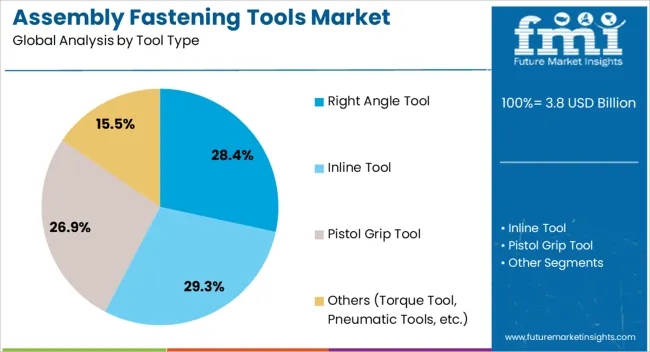
Among tool types, right angle tools dominate with a 28.4% share in 2025. Their design enables efficient fastening in confined or complex assembly spaces where accessibility and precision are crucial. These tools are indispensable in high-volume production environments — especially automotive and electronics assembly — where torque control and ergonomic design directly impact productivity.
Manufacturers continue to refine right angle tools through lightweight materials, improved torque feedback, and integrated digital displays that allow precision tightening. This segment’s balance between functionality and operator comfort ensures its continued leadership through 2035.
Control Mechanism Trends: Transducer-Controlled Systems Take Center Stage
The transducer-controlled segment accounts for approximately 33.7% of the market and remains the backbone of precision fastening. Its dominance is attributed to advanced sensors that provide real-time torque and angle feedback, minimizing assembly errors and ensuring process validation.
Industries with zero-tolerance manufacturing standards, such as aerospace and automotive, prefer these systems for their reliability and data traceability. Integration with Industry 4.0 frameworks allows predictive maintenance, improved calibration accuracy, and seamless connection with enterprise software systems. Though these systems command higher upfront costs, the return on investment in reduced rework and increased reliability makes them a preferred choice among advanced manufacturers.
End-Use Analysis: Aerospace and Defence Drive Precision Demand
The aerospace and defence sector commands roughly 26.9% of the global market share, driven by the critical nature of fastening precision in high-performance environments. These industries demand tools that meet strict quality assurance and compliance standards, as even minor errors can compromise safety.
Modern aircraft and defense equipment rely on lightweight materials such as composites and alloys, necessitating specialized fastening tools with torque control and documentation capabilities. As global defense procurement and aircraft production rise, demand for advanced fastening systems is expected to sustain growth across this high-value segment.
Regional Insights and Growth Hotspots
Regionally, the market’s expansion is led by North America, Asia-Pacific, and Europe. China continues to be the global growth leader, with a projected CAGR of 5.9% through 2035. Industrial expansion, automotive manufacturing, and smart factory initiatives drive domestic tool innovation, supported by major players like Bosch China and Stanley Black & Decker.
India follows closely with a CAGR of 5.5%, reflecting growth in automotive, electronics, and infrastructure development. Partnerships between global and local tool manufacturers are accelerating technology transfer and boosting the adoption of automated fastening solutions.
In Europe, Germany and France lead industrial adoption, supported by stringent EU manufacturing standards and advanced engineering infrastructure. The UK maintains a strong foothold with growing investments in digital assembly technologies. In the United States, the market expands at a steady 3.7%, driven by industrial upgrades and sustained aerospace and automotive production.
Competitive Landscape and Innovation Focus
The assembly fastening tools market is defined by a strong mix of global leaders and innovative entrants. Stanley Black & Decker, Robert Bosch GmbH, Hilti Corporation, Makita Corporation, Atlas Copco, Ingersoll Rand, and Snap-on Incorporated dominate the competitive landscape. These companies emphasize precision, cordless mobility, ergonomic designs, and smart connectivity.
Bosch and Hilti are pioneering brushless motor technologies for efficiency and longevity, while Atlas Copco and Ingersoll Rand focus on integrating pneumatic systems with automation networks. Makita and Snap-on continue to enhance operator comfort through lightweight, vibration-controlled designs.
Emerging manufacturers entering the market are focusing on modular systems, localized production, and digital monitoring features to meet regional demands and establish niche footholds. Strategic collaborations between tool makers and OEMs are also shaping the future of smart fastening ecosystems.
Purchase this Report for USD 5,000 Only | Get an Exclusive Discount Instantly! https://www.futuremarketinsights.com/checkout/26056
Everything You Need—within Your Budget. Request a Special Price Now! https://www.futuremarketinsights.com/reports/sample/rep-gb-26056
About Future Market Insights (FMI)
Future Market Insights, Inc. (ESOMAR certified, recipient of the Stevie Award, and a member of the Greater New York Chamber of Commerce) offers profound insights into the driving factors that are boosting demand in the market. FMI stands as the leading global provider of market intelligence, advisory services, consulting, and events for the Packaging, Food and Beverage, Consumer Technology, Healthcare, Industrial, and Chemicals markets. With a vast team of over 400 analysts worldwide, FMI provides global, regional, and local expertise on diverse domains and industry trends across more than 110 countries.
Contact Us:
Future Market Insights Inc.
Christiana Corporate, 200 Continental Drive,
Suite 401, Newark, Delaware – 19713, USA
T: +1-347-918-3531
For Sales Enquiries: sales@futuremarketinsights.com
Website: https://www.futuremarketinsights.com
LinkedIn| Twitter| Blogs | YouTube