The air separation unit (ASU) market is entering a phase of sustained expansion, reflecting its essential role in industrial gas production and the growing interconnection between energy, metallurgy, healthcare, and chemical industries. Valued at USD 6.4 billion in 2025, the market is projected to reach USD 9.7 billion by 2035, advancing at a CAGR of 4.3% over the forecast period. The market’s steady growth underscores the increasing demand for oxygen, nitrogen, and argon, which form the backbone of industrial operations worldwide.
The ASU industry stands as a critical segment within the broader industrial gases ecosystem, accounting for around 6.1% of the global sector. Its influence extends across the steel, chemical, and healthcare industries, where uninterrupted and high-purity gas supply is indispensable. The underlying production process involves high capital investments in cryogenic distillation, compressors, and pressure systems, which are complemented by innovation in automation, energy recovery, and digital control technologies.
The Core of Industrial Gas Infrastructure
At the heart of the air separation industry lies cryogenic technology, responsible for separating atmospheric air into primary gases—oxygen, nitrogen, and argon—used extensively in manufacturing and energy applications. The cryogenic process segment holds an estimated 67.5% market share in 2025, driven by its unmatched ability to produce gases at high volume and purity levels. Cryogenic air separation remains indispensable for large-scale steelmaking, petrochemical processing, and advanced manufacturing, where reliability and scalability are essential.
As industries modernize, energy efficiency and digital transformation have become key differentiators. Equipment manufacturers are focusing on energy-optimized compressors, intelligent control systems, and AI-driven predictive maintenance, ensuring not only operational efficiency but also long-term sustainability. These innovations are vital as electricity costs constitute a significant share of ASU operating expenses.
Drivers of Market Growth and Industrial Relevance
The air separation unit market is experiencing a resurgence in demand due to rising consumption of industrial gases across multiple sectors. Oxygen remains vital in steelmaking and refining, nitrogen dominates in food, electronics, and chemical manufacturing, while argon supports advanced welding and semiconductor production. The market’s expansion is underpinned by the growing focus on cleaner combustion processes and efficient manufacturing practices.
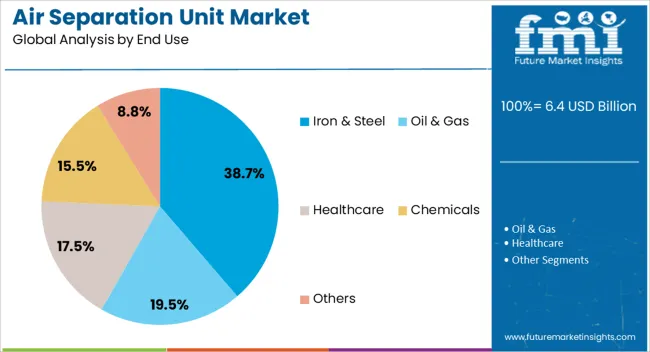
In particular, the iron and steel industry continues to be the leading end-use segment, representing about 38.7% of total ASU demand. The widespread adoption of oxygen injection in blast furnaces and basic oxygen furnaces has enhanced fuel efficiency and reduced emissions. As infrastructure projects accelerate globally, new ASU installations are being integrated directly within steel and metallurgical plants to ensure continuous gas supply and lower production costs.
Meanwhile, the healthcare sector has emerged as a powerful growth catalyst. Following the pandemic, medical-grade oxygen generation has gained strategic importance. Hospitals, clinics, and emergency care facilities are investing in modular and portable ASUs to ensure oxygen security. Rising healthcare expenditure and government focus on infrastructure resilience are creating long-term demand for both large-scale and compact ASU systems.
Energy Transition and Sustainability Integration
The global transition toward low-carbon energy systems is reshaping the ASU landscape. Air separation units are increasingly integrated into hydrogen production, gasification, and carbon capture projects, making them vital for industrial decarbonization. Oxygen produced in ASUs is used in blue hydrogen facilities, while nitrogen plays a critical role in gas storage and transport.
In countries advancing toward net-zero targets, energy-efficient ASUs are being developed with hybrid power sources, incorporating renewable electricity inputs and waste heat recovery. These innovations align with the broader sustainability agenda, positioning ASUs not just as industrial gas producers, but as enablers of the clean energy transition.
Leading industry players such as Linde, Air Liquide, and Air Products and Chemicals are pioneering integration between ASUs and energy transition infrastructure. Their projects often involve supplying oxygen for hydrogen electrolysis or enabling carbon capture systems in refining and chemical complexes. This shift marks a new era of synergy between industrial gas technology and climate-focused industries.
Regional Insights: Market Trends Across Leading Economies
China leads the global ASU market with a 5.8% CAGR, supported by rapid industrialization, steel production, and investment in chemical and refining facilities. Large-scale on-site ASUs have been established near industrial clusters, and domestic firms like Hangyang and Yingde Gases are partnering with international manufacturers to enhance cryogenic system efficiency.
India, expanding at a 5.4% CAGR, is prioritizing modular ASU deployments to serve its fast-growing steel, refining, and fertilizer industries. Collaborations between Linde India, INOX Air Products, and Praxair are enabling localized production capacity and technological efficiency through joint ventures.
In Germany, the market grows at 4.9%, characterized by a focus on high-purity gas applications for electronics, automotive, and precision manufacturing. Companies like Messer Group and Linde Germany are deploying energy-efficient, digitally automated ASUs near industrial parks, supporting Europe’s push for decarbonized production.
The United Kingdom, with a 4.1% CAGR, is driven by demand from healthcare and refining sectors. Hospitals are adopting on-site ASUs for oxygen generation, while refiners prefer build-own-operate models to minimize capital risks. BOC UK, Air Products, and Linde Engineering are key suppliers ensuring safety, reliability, and compliance with strict environmental standards.
Meanwhile, the United States maintains a stable 3.7% CAGR, with growth supported by industrial gas consumption in refining, LNG, and electronics manufacturing. Major players like Air Products and Praxair US are focusing on digital optimization and predictive maintenance to maximize uptime and minimize power costs.
Emerging Players and Industry Innovation
The competitive environment of the ASU market is shaped by a blend of global corporations and specialized regional manufacturers. Linde, Air Liquide, and Air Products and Chemicals dominate large-scale cryogenic projects worldwide through technological leadership and global service networks. Messer and Praxair Technology have positioned themselves as process optimization experts, developing modular, flexible solutions to meet varying industrial needs.
Asian manufacturers such as Taiyo Nippon Sanso, Kaifeng Air Separation Group, and Sichuan Air Separation Plant Group are rapidly expanding production capacity, offering cost-effective, energy-efficient systems tailored for local markets. Universal Industrial Gases and Ranch Cryogenics in North America have gained recognition for compact plant designs and customized engineering, while European innovators like Cryotec Anlagenbau focus on sustainability-driven designs integrating automation and waste heat recovery.
Purchase this Report for USD 5,000 Only | Get an Exclusive Discount Instantly! https://www.futuremarketinsights.com/checkout/26032
Everything You Need—within Your Budget. Request a Special Price Now! https://www.futuremarketinsights.com/reports/sample/rep-gb-26032
About Future Market Insights (FMI)
Future Market Insights, Inc. (ESOMAR certified, recipient of the Stevie Award, and a member of the Greater New York Chamber of Commerce) offers profound insights into the driving factors that are boosting demand in the market. FMI stands as the leading global provider of market intelligence, advisory services, consulting, and events for the Packaging, Food and Beverage, Consumer Technology, Healthcare, Industrial, and Chemicals markets. With a vast team of over 400 analysts worldwide, FMI provides global, regional, and local expertise on diverse domains and industry trends across more than 110 countries.
Contact Us:
Future Market Insights Inc.
Christiana Corporate, 200 Continental Drive,
Suite 401, Newark, Delaware – 19713, USA
T: +1-347-918-3531
For Sales Enquiries: sales@futuremarketinsights.com
Website: https://www.futuremarketinsights.com
LinkedIn| Twitter| Blogs | YouTube