

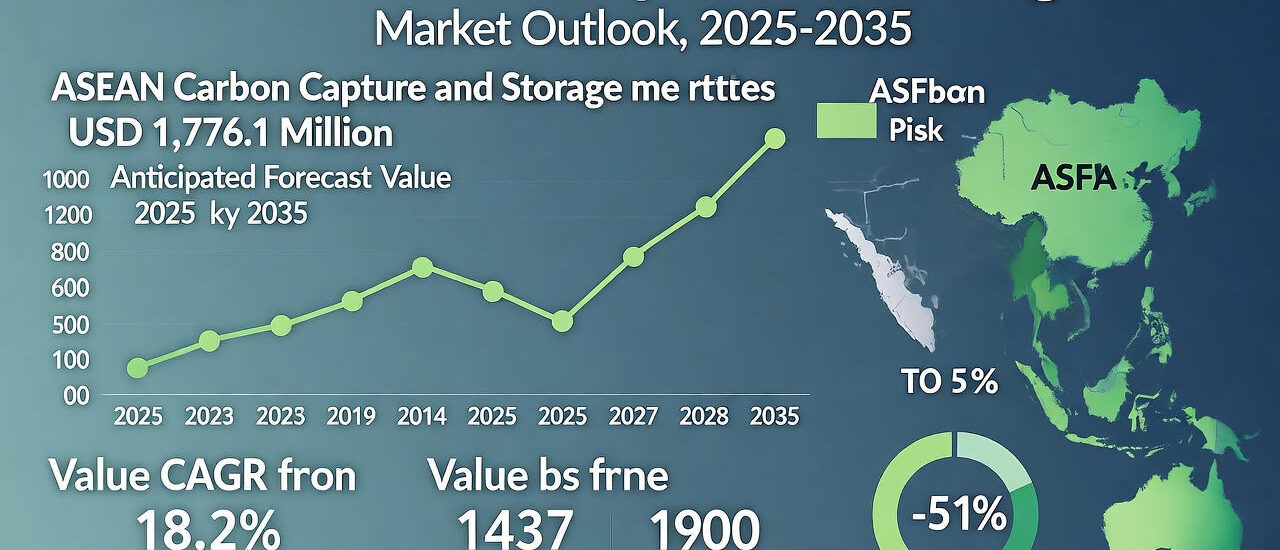
The ASEAN Carbon Capture and Storage market is entering a phase of transformative growth, with the market projected to reach USD 1,776.1 million by 2035, expanding at a CAGR of 18.2% from 2025 to 2035. The surge is fueled by rising industrial decarbonization efforts, regional policy initiatives such as the ASEAN Plan of Action for Energy Cooperation (APAEC), and private sector investments in large-scale CCS projects.
Countries across the region—led by Malaysia, Indonesia, Vietnam, and Thailand—are positioning themselves as early adopters of CCS to meet their climate targets and net-zero emission goals. The Kasawari CCS Project in Malaysia, for example, is set to be the largest in Southeast Asia, capturing up to 3.3 million tons of CO₂ annually.
Get this Report at $5000 Only (Report price) | Exclusive Discount Inside!: https://www.futuremarketinsights.com/reports/sample/rep-gb-20232
Expanding Industrial Decarbonization and Energy Transition
ASEAN’s strong reliance on fossil fuels, combined with the need to reduce emissions in energy-intensive industries, has made CCS a cornerstone of its energy transition strategy. The cement, steel, and chemical sectors are leading the way, integrating CCS into production to mitigate process emissions. Indonesia’s largest cement producers have already begun deploying CCS technologies as part of the nation’s carbon neutrality roadmap.
In the power generation segment, coal and natural gas plants are being retrofitted with post-combustion CCS systems, which now hold over 50% market share. These installations allow existing infrastructure to achieve significant emissions reductions without compromising energy security.
Oil and Gas Sector at the Forefront of CCS Integration
The oil and gas sector remains the foundation for CCS development in ASEAN. Malaysia, Indonesia, and Brunei are leveraging depleted offshore reservoirs for long-term CO₂ storage. Pertamina in Indonesia and Petronas in Malaysia are pioneering CCS applications in upstream and downstream operations, working alongside global technology partners like ExxonMobil and TotalEnergies.
The Kasawari CCS Project, spearheaded by Petronas in 2025, marks a milestone for the region’s decarbonization journey. Simultaneously, Indonesia has signed multiple collaboration agreements with global energy giants to explore offshore storage opportunities, signaling the sector’s pivotal role in regional emission reduction.
Government Support and Policy Evolution
Policy and regulatory frameworks are evolving rapidly to encourage investment in carbon capture infrastructure. Initiatives such as Malaysia’s National Energy Policy 2022–2040 and Indonesia’s Carbon Neutral Roadmap highlight the growing emphasis on reducing industrial emissions. These frameworks are further supported by international cooperation, where ASEAN countries collaborate with global research centers to develop best practices for CCS deployment.
Governments are also offering incentives for industrial players to adopt CCS, ensuring that both established and emerging manufacturers can expand their technological capabilities and play a role in the region’s carbon management goals.
Emerging Technologies and Market Segments
The post-combustion capture segment dominates the ASEAN CCS market, largely due to its compatibility with existing facilities and ease of integration. Pre-combustion capture, growing at a projected CAGR of 9%, is gaining traction in gasification and hydrogen production projects across Indonesia and Malaysia.
In terms of end-use, power plants account for approximately 30% of total market share, while oil and gas operations contribute 25%. Both sectors are expected to witness significant adoption as the demand for low-carbon solutions intensifies.
Competitive Landscape and Industry Collaboration
The ASEAN CCS market features a blend of global leaders and regional innovators. International players such as Shell, ExxonMobil, and TotalEnergies continue to drive large-scale projects with technological and operational expertise. On the regional front, Petronas and Pertamina are leading the charge with extensive CCS integration into domestic energy portfolios.
Academic institutions and research organizations are also playing an essential role, fostering innovation in carbon capture techniques and training the next generation of CCS experts.
Recent developments include Petronas’ launch of the Kasawari CCS Project in early 2025, Indonesia’s collaboration with ExxonMobil in May 2025, and TotalEnergies’ announcement of a new CCS hub in Malaysia later that year.
Buy Now Report Here: https://www.futuremarketinsights.com/checkout/20232
Future Outlook: A Decarbonized ASEAN Energy Landscape
Looking ahead, the ASEAN CCS market is set to grow as governments strengthen policy support and international partnerships deepen. Offshore storage expansion in Malaysia and Indonesia will be central to regional carbon management, while LNG and natural gas operations continue to integrate CCS for sustainable competitiveness.
Direct Air Capture (DAC) technology, though nascent, is expected to gain traction in the coming decade as ASEAN nations aim for negative emissions strategies. Cross-border CO₂ transport agreements and regional cooperation will further accelerate deployment, marking ASEAN’s transition into a global hub for carbon capture innovation and sustainable industrial growth.
Related Reports:
Clean Coal Technology Market- https://www.futuremarketinsights.com/reports/clean-coal-technology-market
Traction Battery Market- https://www.futuremarketinsights.com/reports/traction-batteries-market
Asia Pacific Biochar Market- https://www.futuremarketinsights.com/reports/apac-biochar-report-market
About Future Market Insights (FMI)
Future Market Insights, Inc. (ESOMAR certified, recipient of the Stevie Award, and a member of the Greater New York Chamber of Commerce) offers profound insights into the driving factors that are boosting demand in the market. FMI stands as the leading global provider of market intelligence, advisory services, consulting, and events for the Packaging, Food and Beverage, Consumer Technology, Healthcare, Industrial, and Chemicals markets. With a vast team of over 400 analysts worldwide, FMI provides global, regional, and local expertise on diverse domains and industry trends across more than 110 countries.
Join us as we commemorate 10 years of delivering trusted market insights. Reflecting on a decade of achievements, we continue to lead with integrity, innovation, and expertise.
Contact Us:
Future Market Insights Inc.
Christiana Corporate, 200 Continental Drive,
Suite 401, Newark, Delaware – 19713, USA
T: +1-347-918-3531
For Sales Enquiries: sales@futuremarketinsights.com
Website: https://www.futuremarketinsights.com
LinkedIn| Twitter| Blogs | YouTube
