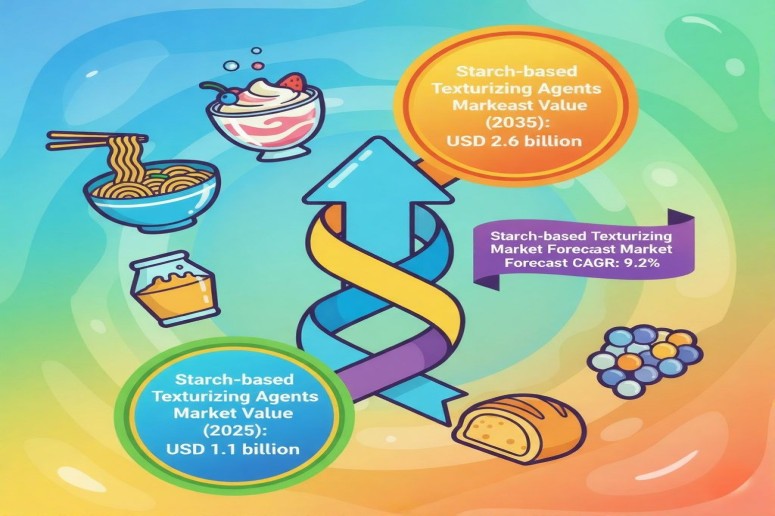
The global Starch-Based Texturizing Agents Market is entering a transformative growth phase, set to rise from USD 1.1 billion in 2025 to an impressive USD 2.6 billion by 2035. Registering a healthy CAGR of 9.2%, this expansion underscores the growing global appetite for natural, clean-label, and multifunctional food ingredients.
A Market Fueled by Natural and Clean-Label Demands
The surge in demand for starch-based texturizing agents is deeply rooted in a paradigm shift across the food and personal care industries consumers are now more informed, label-conscious, and environmentally aware than ever before. As synthetic and artificial additives fall out of favor, plant-derived starches have gained prominence for their ability to thicken, stabilize, emulsify, and enhance mouthfeel in food, beverages, and cosmetic formulations.
In 2025, conventional and modified starches will dominate the market, delivering superior product consistency and sensory performance. Manufacturers are leveraging these agents to strike the perfect balance between texture, taste, and nutritional integrity key attributes in today’s competitive consumer landscape. Moreover, regulatory bodies worldwide are increasingly encouraging natural and sustainable ingredient usage, further fueling the adoption of starch-based texturizing agents.
Growth Opportunities for Established and Emerging Manufacturers
While industry leaders such as Cargill, ADM, Roquette Frères, and Ingredion continue to set benchmarks in starch innovation, a new wave of regional and mid-sized manufacturers is entering the field with specialized expertise and novel technologies. These new entrants are not only expanding the competitive landscape but are also driving technological advancement in starch modification, extraction efficiency, and application diversity.
For instance, companies in Asia-Pacific are experimenting with eco-friendly extraction technologies that minimize water usage and energy consumption. Meanwhile, European innovators are focusing on non-GMO and organic starches tailored for premium food products. These trends highlight how both established corporations and emerging enterprises are reshaping the future of natural texturizing solutions through sustainability-driven R&D.
Conventional Segment Dominates Market Share
By nature, the conventional starch segment is expected to lead with 63.2% of the total market share in 2025, reaffirming its strong foothold in global production and consumption. The preference for conventionally sourced starch stems from its natural extraction process, cost-effectiveness, and consistency in functionality. These starches offer excellent thickening, stabilizing, and gelling properties that enhance bakery, dairy, and ready-to-eat formulations.
The segment’s dominance is also supported by its alignment with clean-label trends—consumers perceive conventionally processed starch as minimally altered, retaining its natural characteristics. The strong supply chain networks and affordability of conventional starches further position this segment as the market’s cornerstone.
Modified Starches Lead the Innovation Curve
In parallel, the modified starch category is anticipated to command 58.6% of total market revenue in 2025, representing the technological frontier of the industry. Modified starches undergo controlled enzymatic, physical, or chemical treatments to enhance specific attributes like freeze-thaw stability, viscosity, and shear resistance—features that are essential for frozen foods, sauces, dairy products, and convenience meals.
Manufacturers such as Kerry Group, Beneo GmbH, and Avebe Group are at the forefront of this evolution, investing in cutting-edge modification processes that optimize functionality while retaining clean-label credibility. The ability to customize starch performance for niche applications has broadened the market’s scope, enabling manufacturers to meet diverse regulatory and consumer requirements worldwide.
Potato: The Leading Source in Starch Production
From a sourcing perspective, potato starch reigns supreme, projected to account for 46.9% of the market share in 2025. Its natural clarity, high viscosity, and excellent gel strength make it a preferred choice across multiple industries. Beyond performance, potato starch is gaining traction as a gluten-free, allergen-friendly alternative—key advantages in today’s health-conscious consumer environment.
Manufacturers are capitalizing on potato starch’s neutral flavor and flexibility in both conventional and modified forms. Continuous improvements in extraction and processing technologies are enhancing its efficiency, making it a reliable and sustainable choice for large-scale production. This segment’s growth exemplifies the synergy between innovation and consumer well-being.
Regional Insights: Asia-Pacific and North America Lead the Way
The Starch-Based Texturizing Agents Market showcases dynamic growth across key regions, with Asia-Pacific, North America, and Europe standing out as leading growth hubs. China leads globally with a remarkable 12.4% CAGR, driven by surging demand for processed and convenience foods, coupled with a strong domestic starch supply chain. India follows closely at 11.5% CAGR, fueled by expanding food manufacturing capabilities and a young, health-conscious consumer base.
In contrast, mature markets such as Germany (10.6%), France (9.7%), and the United States (7.8%) exhibit stable and sustainable growth. In the U.S. alone, the starch-based texturizing agents market is projected to grow from USD 414.3 million in 2025 to USD 881.0 million by 2035, underscoring robust opportunities for both local producers and global suppliers. Even markets like Brazil, despite a comparatively moderate 6.9% CAGR, reflect the sector’s widespread expansion and resilience.
Applications Across Diverse End-Use Industries
Starch-based texturizing agents are indispensable across multiple end-use sectors. In the food industry, they enhance product texture, extend shelf life, and improve flavor dispersion in bakery, dairy, soups, dressings, and sauces. In confectionery and snacks, they stabilize emulsions and optimize mouthfeel, ensuring product appeal and consistency.
Beyond food, these agents are finding new applications in personal care, pharmaceutical, and industrial formulations, where their natural thickening and stabilizing properties are increasingly valued. Their ability to prevent the evaporation of volatile oils, retain moisture, and maintain product stability positions them as multifunctional ingredients for a wide range of commercial applications.
Get Instant Access for Only $3,500 | Don’t Miss This Exclusive Offer!
https://www.futuremarketinsights.com/reports/sample/rep-gb-7824
Checkout Now to Access Data Insights:
https://www.futuremarketinsights.com/checkout/7824
About Future Market Insights (FMI)
Future Market Insights, Inc. (ESOMAR certified, recipient of the Stevie Award, and a member of the Greater New York Chamber of Commerce) offers profound insights into the driving factors that are boosting demand in the market. FMI stands as the leading global provider of market intelligence, advisory services, consulting, and events for the Packaging, Food and Beverage, Consumer Technology, Healthcare, Industrial, and Chemicals markets. With a vast team of over 400 analysts worldwide, FMI provides global, regional, and local expertise on diverse domains and industry trends across more than 110 countries.
Contact Us:
Future Market Insights Inc.
Christiana Corporate, 200 Continental Drive,
Suite 401, Newark, Delaware – 19713, USA
T: +1-347-918-3531
For Sales Enquiries: sales@futuremarketinsights.com
Website: https://www.futuremarketinsights.com
LinkedIn| Twitter| Blogs | YouTube