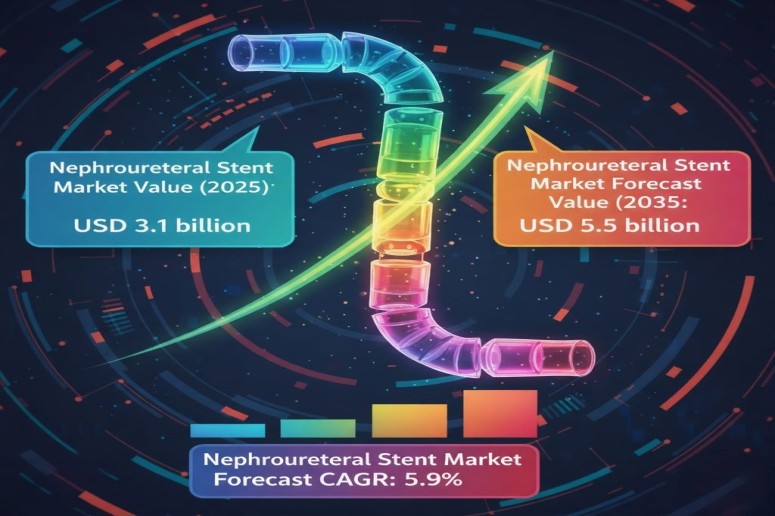
The global Nephroureteral Stent Market is demonstrating steady and promising growth, with its valuation expected to rise from USD 3.1 billion in 2025 to an estimated USD 5.5 billion by 2035. This growth represents a robust compound annual growth rate (CAGR) of 5.9%, underscoring the increasing demand for effective solutions in the management of urological disorders. The market’s expansion is fueled by rising incidences of kidney stones, urinary tract obstructions, and related kidney conditions worldwide.
Market Dynamics Driving Growth
The growing prevalence of urological disorders, particularly among the aging population, is a primary factor driving market growth. As kidney-related health issues become more common with advancing age, healthcare providers are seeking innovative treatments that minimize patient discomfort while improving clinical outcomes. Nephroureteral stents have emerged as a critical intervention, offering reliable solutions for both acute and chronic urinary tract obstructions.
The adoption of minimally invasive procedures is further accelerating market expansion. Modern stent designs, coupled with advanced biomaterials, have enhanced flexibility, durability, and biocompatibility, allowing physicians to deliver safer, more effective care. Additionally, increased healthcare spending, better diagnostic capabilities, and heightened awareness about available treatment options are contributing to the growing adoption of nephroureteral stents across hospitals, specialty clinics, and urology centers.
Segment Insights: Product Perspective
From a product standpoint, the retrograde stents segment is expected to lead the market in 2025, accounting for approximately 40.2% of total revenue. Retrograde stents are particularly favored by urologists due to their ease of insertion and compatibility with minimally invasive procedures. They facilitate smooth urine flow from the kidneys to the bladder, ensuring patient comfort and reducing procedure time.
Technological advancements have further enhanced the functionality of retrograde stents. The incorporation of polyurethane and silicone coatings has improved flexibility, reduced encrustation, and increased biocompatibility. Hospitals and specialty clinics increasingly prefer retrograde stents, recognizing their ability to streamline procedures while delivering optimal patient outcomes. Cost-effectiveness, combined with clinical reliability, has cemented retrograde stents as the preferred choice in contemporary urological care.
Application Insights: Lithotripsy Driving Demand
In terms of application, lithotripsy represents the largest segment, expected to hold 45.7% of market revenue in 2025. The growth of this segment is directly linked to the rising incidence of kidney stones and the preference for non-invasive or minimally invasive stone removal procedures. Nephroureteral stents play a pivotal role in lithotripsy by preventing ureteral obstruction, facilitating smooth drainage, and minimizing postoperative complications.
Advancements in lithotripsy techniques, including extracorporeal shock wave lithotripsy and laser-based procedures, have further emphasized the importance of stent placement. Hospitals increasingly integrate nephroureteral stents as a standard part of lithotripsy protocols, reducing risks and enhancing patient recovery. With lifestyle changes contributing to higher rates of kidney stone formation globally, the lithotripsy application segment is projected to maintain its dominance, supported by continuous innovation in stent technology.
Market Overview: Key Features and Benefits
A nephroureteral stent, also known as a ureteric stent, is a thin tube inserted into the ureter to manage obstruction of urine flow caused by kidney stones, tumors, or infections. Typically 24 to 30 cm in length for adult patients, these stents are available in various diameters to suit different ureteral sizes. They are usually inserted using a cystoscope and are intended for short-term placement, generally between three to six months, to prevent complications such as encrustation or infection.
Several market players are actively researching new materials and designs to overcome challenges such as biofilm formation and mineralogical encrustation. Innovations in this area aim to enhance stent longevity, reduce complications, and improve overall patient experience. The emphasis on patient-friendly, reliable, and clinically efficient stents is driving both established and emerging manufacturers to develop cutting-edge solutions.
Regional Market Analysis
Geographically, the nephroureteral stent market is experiencing varied growth dynamics. China leads the market with the highest projected CAGR of 8.0%, reflecting rapid healthcare infrastructure development and increased access to urology services. India follows closely at 7.4%, driven by a growing patient population and rising healthcare awareness.
In Europe, Germany, France, and the UK are witnessing steady growth, with Germany achieving a CAGR of 6.8% due to strong adoption of advanced stent technologies and comprehensive healthcare coverage. The United States remains a key market, estimated to reach USD 1.9 billion by 2035, growing at a CAGR of 5.0%. Emerging markets, including Brazil, are also showing positive trends, albeit at a relatively lower growth rate of 4.4%, highlighting global opportunities for expansion.
Key Players Shaping the Market
The nephroureteral stent market is characterized by the presence of several leading manufacturers who are actively innovating and expanding their product portfolios. Notable players include Boston Scientific, C.R. Bard, Cook Medical, Medline Industries, Pnn Medical, Allium Medical, B. Braun, and Dextronix. These companies are investing in research and development to introduce stents with improved biocompatibility, reduced encrustation, and enhanced durability.
Established manufacturers are leveraging their expertise to expand into emerging markets, while new entrants are focusing on technological innovation to gain a competitive edge. Collaborative strategies, partnerships, and regulatory approvals of innovative stent designs are enabling companies to strengthen their market presence and address the growing demand for effective urological solutions.
Claim Your Copy for $5,000 Only | Exclusive Offer for Early Buyers!
https://www.futuremarketinsights.com/reports/sample/rep-gb-2829
Checkout Now to Access Market Report:
https://www.futuremarketinsights.com/checkout/2829
About Future Market Insights (FMI)
Future Market Insights, Inc. (ESOMAR certified, recipient of the Stevie Award, and a member of the Greater New York Chamber of Commerce) offers profound insights into the driving factors that are boosting demand in the market. FMI stands as the leading global provider of market intelligence, advisory services, consulting, and events for the Packaging, Food and Beverage, Consumer Technology, Healthcare, Industrial, and Chemicals markets. With a vast team of over 400 analysts worldwide, FMI provides global, regional, and local expertise on diverse domains and industry trends across more than 110 countries.
Contact Us:
Future Market Insights Inc.
Christiana Corporate, 200 Continental Drive,
Suite 401, Newark, Delaware – 19713, USA
T: +1-347-918-3531
For Sales Enquiries: sales@futuremarketinsights.com
Website: https://www.futuremarketinsights.com
LinkedIn| Twitter| Blogs | YouTube