The Middle East & Africa sachet packaging machines market is poised for steady expansion, moving from an estimated value of USD 123.3 million in 2025 to USD 181.1 million by 2035. Registering a compound annual growth rate (CAGR) of 3.9%, this progress highlights the rising demand for small, flexible, and cost-effective packaging solutions across the region’s fast-evolving consumer markets.
Changing lifestyles, price-sensitive purchasing patterns, and a growing inclination for unit-dose and on-the-go products are major forces shaping the outlook. From single-serve food and beverages to affordable pharmaceutical packs, sachet packaging is redefining accessibility for a wide demographic. Manufacturers, both established and emerging, are now recalibrating their strategies to meet this demand by investing in advanced machinery, expanding operations, and building stronger connections with local industries.
Market Dynamics Driving Adoption
The momentum behind sachet packaging machines stems from three clear trends: affordability, convenience, and sustainability. With urban populations growing and disposable incomes varying widely, sachet-sized goods are increasingly favored in the food, personal care, and healthcare sectors. These packaging formats enable manufacturers to reach broader consumer segments, especially in markets where purchasing power remains limited.
Technological innovations are also fueling growth. Advancements in automation and sealing technology have improved production efficiency, reduced wastage, and enhanced product safety. At the same time, sustainability initiatives are prompting manufacturers to design packaging machines capable of handling eco-friendly materials. Governments in the region are encouraging localized solutions to reduce import dependency, which in turn is creating opportunities for new entrants and partnerships.
Segmental Outlook Highlights
Vertical Form Fill Seal (VFFS) machines are expected to dominate with 47.6% of the market share in 2025. Their versatility, compact design, and ability to handle diverse product categories make them indispensable for producers aiming at both efficiency and flexibility.
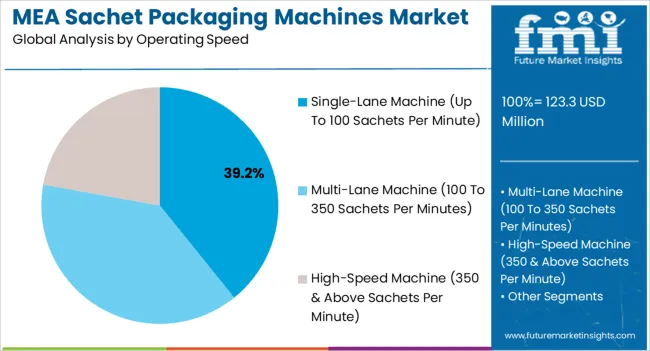
Single-lane machines, capable of producing up to 100 sachets per minute, are also gaining traction. Accounting for 39.2% of market revenues in 2025, these machines align with the needs of small and medium-sized enterprises that value affordability and ease of operation over ultra-high-speed systems.
On the product front, powders will lead the way with a 41.5% share in 2025. From instant coffee and powdered milk to nutritional supplements and pharmaceuticals, sachet-packed powders are in high demand thanks to their convenience and cost-effectiveness.
Country-wise Market Insights
The Middle East & Africa sachet packaging machines industry reveals diverse regional growth drivers. GCC countries are witnessing strong demand for packaged food imports, boosted by rising urbanization and an expanding retail sector. The Food Export Association of the Midwest USA highlighted that U.S. exports of agricultural goods to the GCC reached USD 118.7 billion in 2024, underscoring the growing appetite for packaged goods.
Türkiye and Northern Africa are seeing stable adoption rates as SMEs and local producers embrace sachet solutions to serve price-sensitive consumer bases. Meanwhile, South Africa and Israel demonstrate increasing adoption due to modern retail expansion and consumer preference for tamper-proof packaging. Nigeria and Egypt, with their vast populations, are projected to become crucial markets as sachet packaging continues to meet the needs of lower-income groups.
Informal Markets and Street Vendors as Growth Catalysts
Interestingly, informal markets and street vendors remain pivotal in shaping demand for sachet-packaged goods. In regions where affordability and accessibility drive consumer choices, sachet packaging offers a hygienic, tamper-proof, and portable solution. Lightweight sachets enable vendors to transport products easily, ensuring they can cater to diverse consumer bases. For lower-income populations, sachets provide access to essential goods in affordable quantities, reinforcing their role as a growth engine in MEA markets.
Competitive Landscape and Innovation
The competitive landscape is marked by both global leaders and regional players, each advancing new technologies and sustainable solutions. Prominent companies such as Koerber AG, Syntegon Technology GmbH, Ajinomoto Co., Inc., and Al Thika Packaging LLC are investing heavily in automation, robotics, and eco-friendly materials.
Notable developments include Syntegon Technology GmbH’s launch in November 2025 of a vertical packaging machine designed to produce bags from up to 95% paper, appealing to customers seeking sustainable packaging formats. Similarly, companies like Mentpack Packaging Machines and Wraptech Machines Pvt. Ltd. are tailoring cost-effective solutions for SMEs, while large-scale firms are expanding production facilities and acquiring local players to strengthen their market presence.
The push toward sustainability is reshaping competitive strategies. Manufacturers are now balancing efficiency with environmentally responsible practices, a move that resonates strongly with governments and eco-conscious consumers across MEA.
Opportunities for New Entrants and Stakeholders
For stakeholders and new manufacturers, the MEA sachet packaging machines market represents an opportunity-rich environment. As e-commerce penetration rises, demand for sachet-packaged goods is expanding into new channels. Food and beverage companies, in particular, are embracing sachet formats to capture consumers seeking convenience and variety in smaller portions.
The pharmaceutical and personal care sectors also provide strong prospects. Sachet packaging ensures precise dosage, hygiene, and affordability, meeting essential needs across growing healthcare and cosmetic markets in the region. With governments actively supporting manufacturing and localized production, new entrants can leverage policy backing to establish themselves in high-potential segments.
Purchase this Report for USD 5,000 Only | Get an Exclusive Discount Instantly! https://www.futuremarketinsights.com/checkout/17849
Everything You Need—within Your Budget. Request a Special Price Now! https://www.futuremarketinsights.com/reports/sample/rep-gb-17849
About Future Market Insights (FMI)
Future Market Insights, Inc. (ESOMAR certified, recipient of the Stevie Award, and a member of the Greater New York Chamber of Commerce) offers profound insights into the driving factors that are boosting demand in the market. FMI stands as the leading global provider of market intelligence, advisory services, consulting, and events for the Packaging, Food and Beverage, Consumer Technology, Healthcare, Industrial, and Chemicals markets. With a vast team of over 400 analysts worldwide, FMI provides global, regional, and local expertise on diverse domains and industry trends across more than 110 countries.
Contact Us:
Future Market Insights Inc.
Christiana Corporate, 200 Continental Drive,
Suite 401, Newark, Delaware – 19713, USA
T: +1-347-918-3531
For Sales Enquiries: sales@futuremarketinsights.com
Website: https://www.futuremarketinsights.com
LinkedIn| Twitter| Blogs | YouTube