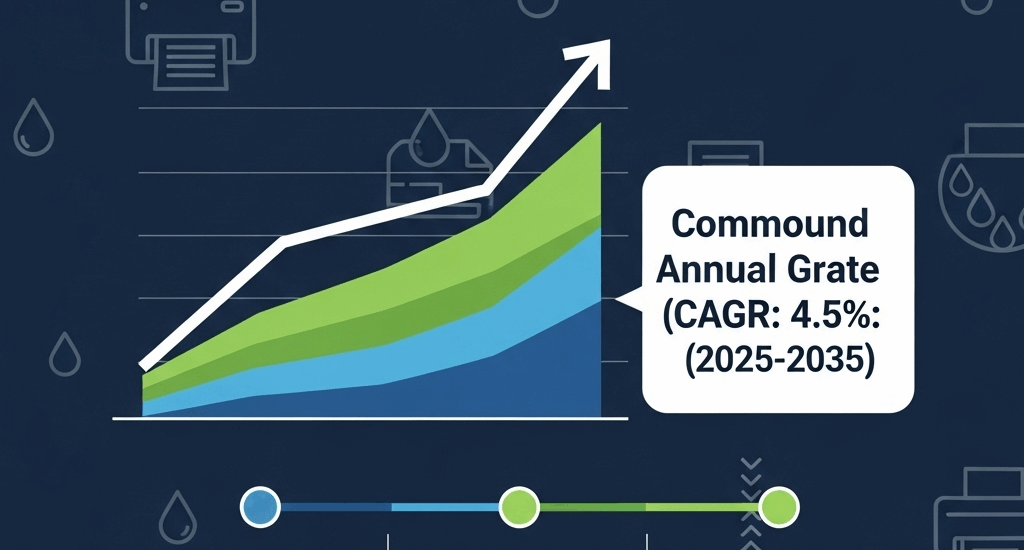
The global inkjet printers market is projected to grow steadily from USD 7.8 billion in 2025 to USD 12.1 billion by 2035, expanding at a CAGR of 4.5%. Valued at USD 7.5 billion in 2024, this sector is entering a decade of transformative growth fueled by demand for cost-efficient, customizable, and digital-first printing solutions across manufacturing, packaging, textiles, and signage.
Inkjet technology is evolving from its traditional consumer focus into a pivotal enabler for industrial transformation. Manufacturers are increasingly integrating inkjet systems into production lines to achieve faster customization, on-demand printing, and sustainable operations — all while reducing waste and costs.
Drop-on-Demand Technology Leading the Digital Revolution
Among the technologies shaping this shift, Drop-on-Demand (DoD) printing is projected to hold over 71% market share by 2035, overtaking conventional continuous inkjet methods. Its precision, ink efficiency, and adaptability make it ideal for short-run production and intricate designs.
DoD printers only release ink when required, minimizing waste while maintaining superior print quality. This not only drives down operational costs but also aligns with the manufacturing sector’s increasing focus on sustainability and resource efficiency.
Manufacturers adopting DoD systems can rapidly switch between print tasks, enabling just-in-time production and eliminating the need for extensive inventories. This capability supports the growing global trend of mass customization — producing personalized products without traditional mass-production constraints.
Buy Now & Save: Premium Market Report at $5,000 | Discount Details Inside:- https://www.futuremarketinsights.com/reports/sample/rep-gb-5306
Driving Factors: Efficiency, Flexibility, and Diverse Material Compatibility
Inkjet printers are reshaping how industries manage small and medium production runs. Unlike traditional print processes requiring costly plate-making and setup, inkjet printing eliminates those barriers, making it an ideal solution for manufacturers operating in low-volume, high-customization environments.
Modern inkjet systems are compatible with a vast array of materials — including paper, plastics, metals, ceramics, and textiles — granting businesses the flexibility to innovate across multiple product lines. This adaptability allows manufacturers to deliver personalized packaging, fashion textiles, and promotional materials without costly retooling.
As sectors like packaging and apparel continue to pursue eco-friendly and efficient manufacturing, inkjet printers have become a cornerstone technology for achieving these dual objectives.
Regional Insights: Strong Industrial Uptake Across North America and Asia
Market growth is not evenly distributed — countries such as India (6.9% CAGR) and China (5.8% CAGR) are set to lead the surge, driven by the rapid adoption of digital and textile printing technologies.
In North America, demand continues to accelerate in advertising, packaging, and signage, particularly in the United States (3.4% CAGR), where brands are investing heavily in on-demand, high-quality visual marketing solutions.
Canada is also emerging as a strong contender, supported by its expanding packaging and textile sectors. The shift toward digital textile printing for sustainable fashion and home décor underscores the country’s move toward greener manufacturing technologies.
In Europe, markets such as Germany (2.7% CAGR) continue to demonstrate steady adoption, driven by the demand for precision industrial printing and the region’s commitment to advanced manufacturing practices.
Market Segmentation: Simple, Scalable, and Sustainable
By printer type, single-function printers are projected to command a 35.7% market share by 2035. Their affordability, simplicity, and speed make them a preferred choice for both small-scale enterprises and home-based businesses.
At the technological forefront, Drop-on-Demand continues to dominate, aligning with manufacturers’ priorities for scalability, precision, and minimal environmental impact. The combination of cost-effectiveness and print versatility ensures that this technology remains the benchmark for industrial and commercial applications.
Industry Challenges: Technical Complexity and Maintenance
Despite their numerous advantages, industrial inkjet printers present challenges in terms of technical maintenance and operational expertise. The advanced components — such as printheads and ink delivery systems — require regular upkeep and trained personnel.
In regions with limited access to skilled technicians, this can slow adoption rates. However, leading manufacturers are addressing these barriers by offering remote diagnostics, automated cleaning systems, and digital connectivity tools to ensure smoother integration into industrial workflows.
Competitive Landscape: Innovation Through Collaboration
The global inkjet printers market is characterized by a mix of Tier 1 leaders, regional Tier 2 players, and niche Tier 3 operators. Tier 1 companies — including HP Inc., Epson Corporation, Canon Inc., and Videojet Technologies Inc. — dominate through technological expertise, high production capacities, and expansive global networks.
Mid-sized Tier 2 players such as Xerox Corporation, Brother Industries Ltd., Konica Minolta, Mimaki Engineering Co., and Roland DG Corporation continue to strengthen local markets with innovative, cost-conscious solutions.
Click Here to Purchase the Report:- https://www.futuremarketinsights.com/checkout/5306
Recent developments demonstrate a clear shift toward connectivity, automation, and strategic localization:
- Videojet Technologies launched the 1880+, 1880 UHS, and 1880 HR CIJ printers, integrating smart digital monitoring to reduce downtime.
- Roland DG Corporation introduced the ER-641 eco-solvent printer, delivering vibrant output with aggressive pricing.
- Leibinger Group expanded into Brazil, enhancing service accessibility through local partnerships and inventory centers.
The Decade Ahead: Digital Print as a Growth Catalyst for Manufacturers
Between 2025 and 2035, the inkjet printers market will create an incremental opportunity of USD 4.6 billion, growing 1.6 times from its 2025 base value. For manufacturers, this represents not just a technology investment, but a strategic shift toward agile, sustainable, and customer-centric production.
As industries embrace digital transformation and environmental responsibility, inkjet printers stand at the intersection of efficiency and innovation — redefining how manufacturers produce, customize, and connect with their markets.
About Future Market Insights (FMI)
Future Market Insights, Inc. (ESOMAR certified, recipient of the Stevie Award, and a member of the Greater New York Chamber of Commerce) offers profound insights into the driving factors that are boosting demand in the market. FMI stands as the leading global provider of market intelligence, advisory services, consulting, and events for the Packaging, Food and Beverage, Consumer Technology, Healthcare, Industrial, and Chemicals markets. With a vast team of over 400 analysts worldwide, FMI provides global, regional, and local expertise on diverse domains and industry trends across more than 110 countries.
Contact Us:
Future Market Insights Inc.
Christiana Corporate, 200 Continental Drive,
Suite 401, Newark, Delaware – 19713, USA
T: +1-347-918-3531
For Sales Enquiries: sales@futuremarketinsights.com
Website: https://www.futuremarketinsights.com
LinkedIn| Twitter| Blogs | YouTube