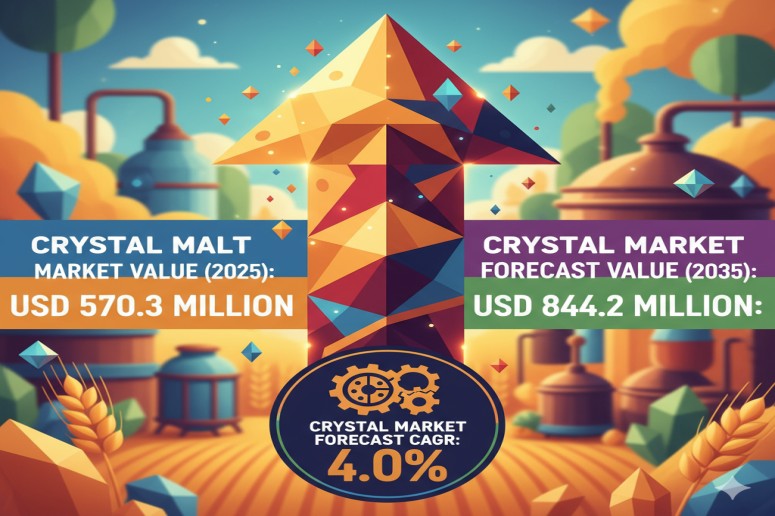
The global Crystal Malt Market is entering a new era of growth and innovation. Valued at USD 570.3 million in 2025, the market is projected to reach USD 844.2 million by 2035, expanding at a Compound Annual Growth Rate (CAGR) of 4.0%, according to the latest industry forecast. This steady growth is being driven by increasing consumer appetite for premium and craft beers, alongside expanding investments by both established and emerging malt producers in sustainable and flavor-enhancing brewing technologies.
Market Overview: The Flavor Backbone of the Brewing Industry
Crystal malt, often referred to as caramel malt, plays a pivotal role in defining the flavor, color, and aroma of beer and other beverages. Produced through a controlled malting and kilning process primarily using barley, crystal malt adds a distinctive caramel sweetness and deep amber tone to brews. It is a cornerstone ingredient in a wide array of beer styles—from pale ales and stouts to lagers and porters.
Beyond brewing, crystal malt also finds applications in confectionery, bakery, and non-alcoholic beverages, reflecting its versatility in flavor and texture enhancement. With the global beverage industry becoming increasingly diversified, the importance of specialty malts like crystal malt has surged, particularly as consumers seek authenticity, craftsmanship, and distinctive taste experiences.
Why the Crystal Malt Market is Growing
The rise of craft and specialty brewing has revolutionized the global malt landscape. Today’s consumers are more discerning, gravitating toward artisanal, flavor-forward beers that emphasize quality ingredients and unique profiles. This shift has encouraged breweries—both large and small—to explore new malt varieties that deliver complex sensory attributes.
Moreover, the ability of crystal malt to integrate seamlessly into existing brewing processes has made it a favorite among brewers aiming for consistency and scalability. As breweries focus on flavor innovation and product differentiation, the demand for specialty malts that enhance taste, color, and aroma continues to climb.
The market is also benefiting from technological advancements in malting, roasting, and fermentation, as well as increasing investments in sustainable sourcing and energy-efficient production. Together, these factors are reshaping how malt manufacturers meet the evolving demands of modern beverage production.
Segmental Insights: Where the Growth Lies
Conventional Crystal Malt Leads with 64.1% Market Share
In 2025, the Conventional Crystal Malt segment is expected to account for 64.1% of total market revenue, reaffirming its dominance in the industry. Its appeal lies in its reliability, flavor stability, and consistent performance in large-scale and craft brewing environments. Conventional crystal malt continues to set the benchmark for beer flavor enhancement, supporting brewers’ ability to maintain quality and uniformity across batches.
Widespread adoption has also been supported by well-established supply chains and standardized production processes, which minimize risk and ensure a dependable flow of high-quality malt. As breweries innovate with premium and flavored beers, the demand for crystal malt that can deliver rich, balanced flavors will remain strong.
Barley Remains the Preferred Source of Crystal Malt
Barley continues to dominate as the primary source of crystal malt, accounting for 58.6% of the total market share in 2025. Its superior malting characteristics—such as high enzyme activity and favorable protein composition—make it the grain of choice for consistent brewing performance.
Barley-based malts not only deliver uniform flavor and aroma but also ensure stability in the brewing process, a critical factor for both industrial and craft producers. Supported by established cultivation networks across North America, Europe, and Asia-Pacific, the barley segment is poised to sustain its leadership as global demand for quality malt intensifies.
Beer Breweries Hold Nearly Half of the Market
The Beer Breweries segment continues to be the primary end-user, representing 47.5% of total market demand in 2025. Breweries—ranging from global brands to small-batch craft producers—depend heavily on crystal malt to achieve distinctive flavor and color profiles that resonate with their target consumers.
The continued global expansion of the beer industry, combined with the rise of premiumization and artisanal brewing, has cemented crystal malt as a key ingredient for differentiation. Moreover, the adoption of innovative brewing methods—such as hybrid fermentation and small-batch roasting—has further amplified the role of crystal malt in creating unique taste experiences.
Regional Market Outlook
- China and India are emerging as the fastest-growing markets, with projected CAGRs of 5.4% and 5.0%, respectively. Expanding brewery infrastructure and the rising popularity of craft beer among young consumers are key growth drivers in these regions.
- Germany, France, and the UK continue to lead the European market, backed by a long-standing brewing tradition and increasing demand for high-quality malts.
- In the United States, the market is estimated to grow from USD 215.4 million in 2025 to USD 300.9 million by 2035, at a steady CAGR of 3.4%. The U.S. craft beer boom remains a crucial engine of demand.
- Brazil, though posting a modest 3.0% CAGR, reflects a positive trend toward premium and locally produced beer products.
Key Players Driving Market Innovation
The global crystal malt landscape is shaped by a mix of established industry leaders and emerging innovators who are investing in advanced production methods and sustainable sourcing.
Prominent players include Cargill, Inc., Minch Malt Ltd, Simpsons Malt, Great Western Malting, Crisp Malting Group Ltd, BSG CraftBrewing, and Proximity Malt. These companies are expanding their capacities, introducing new malt varieties, and collaborating with breweries to develop custom malt profiles tailored to specific beer styles.
- Cargill, Inc. continues to lead in large-scale malt innovation, focusing on sustainability and traceable sourcing.
- Simpsons Malt and Crisp Malting Group Ltd are pioneering advancements in specialty malt flavor development and eco-friendly production techniques.
- BSG CraftBrewing and Proximity Malt are empowering small and medium breweries with high-quality, consistent malt options that enhance experimentation.
Order Now for $3,500 | Unlock Insights with a Special Discount!
https://www.futuremarketinsights.com/reports/sample/rep-gb-7825
Checkout Now to Access Industry Insights:
https://www.futuremarketinsights.com/checkout/7825
About Future Market Insights (FMI)
Future Market Insights, Inc. (ESOMAR certified, recipient of the Stevie Award, and a member of the Greater New York Chamber of Commerce) offers profound insights into the driving factors that are boosting demand in the market. FMI stands as the leading global provider of market intelligence, advisory services, consulting, and events for the Packaging, Food and Beverage, Consumer Technology, Healthcare, Industrial, and Chemicals markets. With a vast team of over 400 analysts worldwide, FMI provides global, regional, and local expertise on diverse domains and industry trends across more than 110 countries.
Contact Us:
Future Market Insights Inc.
Christiana Corporate, 200 Continental Drive,
Suite 401, Newark, Delaware – 19713, USA
T: +1-347-918-3531
For Sales Enquiries: sales@futuremarketinsights.com
Website: https://www.futuremarketinsights.com
LinkedIn| Twitter| Blogs | YouTube