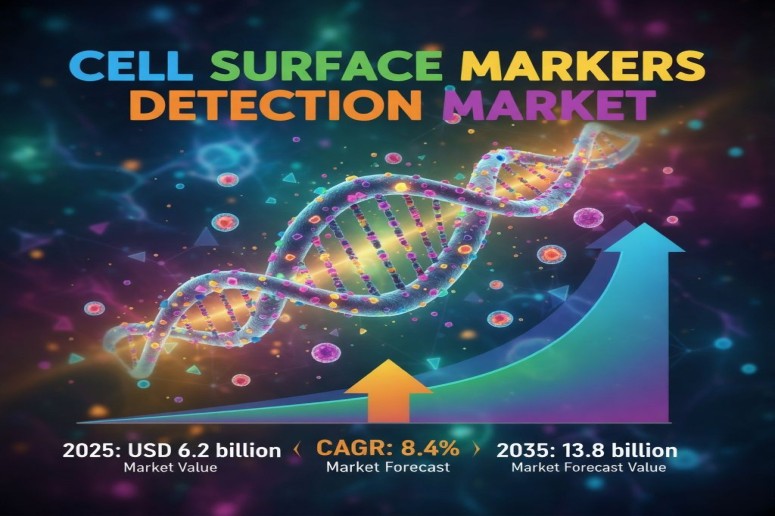
The global Cell Surface Markers Detection Market is poised for substantial growth over the next decade, with its valuation estimated at USD 6.2 billion in 2025 and projected to reach USD 13.8 billion by 2035. This represents a robust compound annual growth rate (CAGR) of 8.4% during the forecast period, reflecting rising investments, technological advancements, and growing demand for precision medicine worldwide.
Cell surface markers are crucial in modern biomedical research and clinical diagnostics. These molecules, present on the exterior of cells, serve as vital indicators for identifying and classifying cell types. They play an indispensable role in disease diagnosis, drug discovery, personalized medicine, and immunology research. As the healthcare and biotechnology sectors expand, the adoption of advanced detection techniques is expected to accelerate, opening new avenues for both established and emerging manufacturers.
Driving Forces Behind Market Expansion
The growth of the Cell Surface Markers Detection Market is largely fueled by the increasing prevalence of chronic and infectious diseases, rising global demand for personalized therapies, and the rapid adoption of cutting-edge detection technologies. Techniques such as flow cytometry, immunofluorescence, and molecular assays have transformed cell analysis, allowing researchers and clinicians to obtain accurate, high-throughput results.
Flow cytometry, in particular, is projected to lead the market in 2025, accounting for 38.4% of the total instrument and reagents segment. Its ability to analyze multiple parameters of individual cells in real time has made it a cornerstone in immunophenotyping, cancer diagnostics, and stem cell research.
Furthermore, rising investments in life sciences research and supportive government funding for cancer and infectious disease studies are enhancing market opportunities. Integration of artificial intelligence (AI) and automation in marker detection platforms is improving data reproducibility and reducing turnaround times, making these solutions more attractive to laboratories and healthcare institutions alike.
Segmental Insights: Instrumentation and Applications
The Cell Surface Markers Detection Market is segmented based on instrument and reagent types, applications, and geographic regions. Instruments and reagents include flow cytometry systems, hematology analyzers, and specialized reagent kits. Among applications, disease diagnosis remains the dominant segment, projected to capture 42.7% of market revenue in 2025. This is attributed to the increasing global burden of cancer, autoimmune disorders, and infectious diseases, where early and accurate detection significantly influences treatment outcomes.
Cell surface markers serve as diagnostic indicators in hematological malignancies, viral infections, and cardiovascular conditions, helping clinicians tailor targeted therapies and monitor disease progression. Advanced detection methods, supported by AI-driven analysis, are enhancing diagnostic precision while streamlining workflow in clinical laboratories.
The growing emphasis on personalized medicine further reinforces the demand for these solutions, as physicians increasingly rely on detailed cellular analyses to determine effective treatment strategies for individual patients.
Market Overview and Regional Dynamics
Cell surface markers, also known as cell surface antigens, function as molecular “monograms” to identify specific cell types. By analyzing these markers, researchers and clinicians can determine receptor expression and cellular responses, offering critical insights for disease treatment, drug discovery, and precision medicine. The ability to classify cells accurately has made these technologies indispensable across research institutions, hospitals, and diagnostic laboratories.
Geographically, the market is expanding across North America, Europe, and Asia-Pacific, with China and India leading in growth rates. China is expected to witness the highest CAGR of 11.3%, followed by India at 10.5%. Developed European markets such as Germany, France, and the UK show steady expansion, with Germany’s market expected to grow at a CAGR of 9.7%. The U.S. market, projected to reach USD 4.3 billion by 2035, remains a critical hub for technological adoption, with a steady growth rate of 7.1%. Brazil, while growing at a relatively lower CAGR of 6.3%, still reflects positive momentum for the broader global market.
Innovations Shaping the Future
The rapid evolution of detection technologies continues to reshape the competitive landscape. Leading manufacturers, including Abbott Laboratories, Danaher Corporation (Beckman Coulter Inc.), Becton, Dickinson and Company, Bio-Rad Laboratories Inc., F. Hoffmann-La Roche Ltd, Diasorin SpA (Luminex Corporation), Nihon Kohden Corporation, Qiagen NV, Siemens Healthineers, and Thermo Fisher Scientific Inc., are leveraging innovation to enhance product accuracy, reduce costs, and improve user experience.
For instance, flow cytometry instruments are undergoing continuous improvements in software algorithms, reagent kits, and design, enabling higher throughput and more precise analysis. Portable and high-throughput cytometry systems are expanding accessibility, particularly for emerging markets where laboratory infrastructure is developing rapidly. Automation integration, coupled with AI-assisted data analytics, allows laboratories to handle larger sample volumes with greater reproducibility, a critical factor for clinical applications.
Applications Beyond Clinical Diagnostics
While disease diagnosis remains the primary driver, cell surface markers are increasingly applied in research for drug discovery, cytological academic research, and immuno-oncology. In stem cell research, these markers facilitate the identification of cell types essential for regenerative therapies. Pharmaceutical companies utilize these tools to screen potential drug candidates and monitor treatment efficacy in clinical trials.
The versatility of cell surface marker detection underscores its potential across multiple sectors. As personalized medicine continues to gain traction, the ability to perform rapid and accurate cellular profiling becomes crucial. Healthcare providers can deliver targeted treatments while researchers gain deeper insights into cellular behavior, ultimately advancing global health outcomes.
Get this Report at $5,000 Only | Exclusive Discount Inside!
https://www.futuremarketinsights.com/reports/sample/rep-gb-2828
Checkout Now to Access Data Insights:
https://www.futuremarketinsights.com/checkout/2828
About Future Market Insights (FMI)
Future Market Insights, Inc. (ESOMAR certified, recipient of the Stevie Award, and a member of the Greater New York Chamber of Commerce) offers profound insights into the driving factors that are boosting demand in the market. FMI stands as the leading global provider of market intelligence, advisory services, consulting, and events for the Packaging, Food and Beverage, Consumer Technology, Healthcare, Industrial, and Chemicals markets. With a vast team of over 400 analysts worldwide, FMI provides global, regional, and local expertise on diverse domains and industry trends across more than 110 countries.
Contact Us:
Future Market Insights Inc.
Christiana Corporate, 200 Continental Drive,
Suite 401, Newark, Delaware – 19713, USA
T: +1-347-918-3531
For Sales Enquiries: sales@futuremarketinsights.com
Website: https://www.futuremarketinsights.com
LinkedIn| Twitter| Blogs | YouTube