The global bariatric lifts market is entering a period of durable expansion, with new market analysis forecasting a climb from USD 97.0 billion in 2025 to USD 175.4 billion by 2035 — a compound annual growth rate (CAGR) of 6.1%. Growth is being powered by rising obesity prevalence worldwide, the urgent need to reduce caregiver injury, and a wave of design and technology upgrades from both long-standing incumbents and ambitious new manufacturers.
- Market Value (2025): USD 97.0 billion
- Forecast Value (2035): USD 175.4 billion
- Forecast CAGR (2025–2035): 6.1%
- Leading Product Segment (2025): 1000-lbs (57.8% revenue share)
- Leading Application (2025): Hospital Use (42.9% revenue share)
- Key Growth Regions: North America, Asia-Pacific, Europe
- Top Players (profiled): Arjo, Hillrom, Invacare, Handicare, VANCARE, Joerns Healthcare, GAINSBOROUGH, Prism Medical, Hengyi, Guldmann
Why the Market Is Growing
Two structural forces are converging. First, global obesity rates and associated mobility challenges are increasing demand for equipment rated for higher capacities. Second, healthcare institutions are under pressure to enhance patient safety and comply with increasingly strict occupational safety standards for staff. That combination has pushed bariatric lifts from a niche into a core procurement item for hospitals, long-term care and rehabilitation centers.
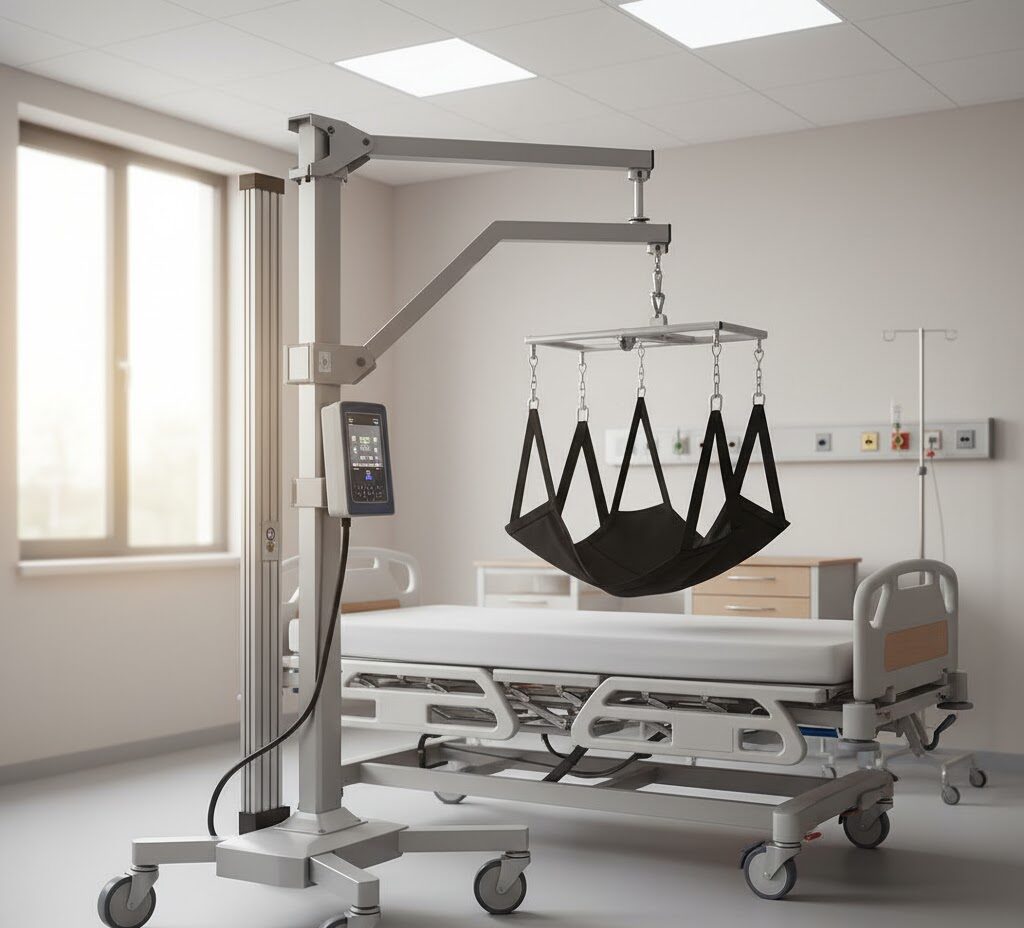
Technological progress is amplifying demand. Modern bariatric lifts increasingly integrate electric and hydraulic drive systems, motorized controls, ergonomic frames, safety interlocks, and electronic monitoring — features that make transfers smoother, safer and less physically demanding. These improvements also create new aftermarket opportunities for service contracts, sensors and retrofit kits, which established and new manufacturers are racing to supply.
Segment Spotlight: 1000-lbs Leading the Charge
The 1000-lbs capacity segment is the market leader, accounting for 57.8% of revenue in 2025. Its dominance reflects real-world needs: more patients present higher weight and transfer complexity, requiring robust, durable lifting solutions. Providers prefer 1000-lbs units for their stability, longer service life and the way they reduce cumulative strain on caregivers. Product innovations — from compact electric actuators to modular slings and integrated weight-sensing — are helping this segment maintain a competitive edge.
Application Focus: Hospitals Remain the Primary Market
Hospitals are the largest application area, representing 42.9% of 2025 revenue. The volume of emergency admissions, bariatric care units, and in-hospital transfers makes hospitals a steady source of demand. Administrators are prioritizing lifts that enhance patient dignity, lower fall risk and comply with internal staff safety policies. With hospitals investing in training, service agreements and integrated patient-handling workflows, demand for advanced bariatric solutions is forecast to remain concentrated in institutional settings.
Regional & Country Momentum
Growth is strongest in Asia-Pacific and parts of Europe, while North America remains a large, mature market. Country CAGRs vary: China (8.2%) and India (7.6%) are among the fastest-growing markets, reflecting healthcare infrastructure expansion and rising obesity rates. European markets like Germany (7.0%) and France (6.4%) show healthy growth as facilities modernize. The United States market is estimated at USD 33.2 billion in 2025, projected to reach USD 55.0 billion by 2035 (CAGR 5.2%), underlining both scale and steady momentum.
Established Players & New Entrants: A Two-Track Opportunity
Leading companies — Arjo, Hillrom, Invacare, Handicare, VANCARE, Joerns Healthcare, GAINSBOROUGH, Prism Medical, Hengyi and Guldmann — continue to invest in incremental innovations, global distribution and service networks. At the same time, a wave of newer manufacturers is entering the market with focused value propositions: lower-cost electric lifts for emerging markets, sensor-enabled lifts for predictive maintenance, and lightweight, compact systems tailored for home care.
This two-track market creates opportunities for partnership and M&A. Established players benefit from the agility and focused innovation of startups, while newcomers gain scale and distribution through alliances with incumbents. The competitive landscape is shifting from a race on price to a race on capability — safety certifications, digital monitoring, ergonomics, and total cost of ownership are becoming decisive procurement criteria.
What Healthcare Buyers Should Expect
Procurement officers should expect a broader set of choices: high-capacity, feature-rich hospital systems; cost-optimized units for clinics and homes; and services that bundle maintenance, training and remote diagnostics. The strongest suppliers will combine proven hardware with software-enabled services — a change that lowers downtime and reduces long-term costs.
Grab This Report Now at Just $5000| Limited-Time Discount Offer! https://www.futuremarketinsights.com/reports/sample/rep-gb-2129
Checkout Now to Access Industry Insights: https://www.futuremarketinsights.com/checkout/2129
About Future Market Insights (FMI)
Future Market Insights, Inc. (ESOMAR certified, recipient of the Stevie Award, and a member of the Greater New York Chamber of Commerce) offers profound insights into the driving factors that are boosting demand in the market. FMI stands as the leading global provider of market intelligence, advisory services, consulting, and events for the Packaging, Food and Beverage, Consumer Technology, Healthcare, Industrial, and Chemicals markets. With a vast team of over 400 analysts worldwide, FMI provides global, regional, and local expertise on diverse domains and industry trends across more than 110 countries.
Contact Us:
Future Market Insights Inc.
Christiana Corporate, 200 Continental Drive,
Suite 401, Newark, Delaware – 19713, USA
T: +1-347-918-3531
For Sales Enquiries: sales@futuremarketinsights.com
Website: https://www.futuremarketinsights.com
LinkedIn| Twitter| Blogs | YouTube