The global ultrasound Doppler market is poised for a new decade of transformation and growth. Valued at USD 3.0 billion in 2025, the industry is projected to climb to USD 4.5 billion by 2035, reflecting a steady compound annual growth rate (CAGR) of 4.3%. This trajectory underscores the market’s resilience and adaptability as stakeholders focus on advanced diagnostic technologies, new business expansions, and regional penetration across both established and emerging economies.
Ultrasound Doppler imaging has already established itself as a cornerstone of non-invasive diagnostic medicine. With increasing cardiovascular disease prevalence, a strong push for early detection, and growing global awareness about preventive healthcare, Doppler systems are no longer confined to high-tech hospitals alone. They are steadily becoming indispensable tools across clinics, diagnostic centers, and even home care setups, creating opportunities for both established brands and newer manufacturers.
Drivers Shaping the Ultrasound Doppler Market
At the heart of the market’s growth is the rising demand for accurate, non-invasive diagnostic imaging. Cardiovascular and vascular disorders remain the leading causes of mortality globally, prompting healthcare systems to strengthen early detection measures. Ultrasound Doppler systems—offering real-time imaging of blood flow, veins, and arteries—are increasingly favored as safer alternatives to invasive procedures.
Technological innovation is another key force reshaping the market. Devices today feature improved imaging resolution, AI-assisted analytics, portability, and seamless integration with hospital information systems. The ongoing evolution from traditional trolley-based models to advanced handheld devices is expanding accessibility, allowing smaller clinics and community healthcare providers to adopt Doppler imaging with reduced upfront investments.
Government-led initiatives on preventive healthcare, particularly in cardiovascular screening programs, are also creating momentum. Additionally, investment in healthcare infrastructure in Asia-Pacific, Latin America, and the Middle East is fueling adoption, strengthening the position of both multinational giants and emerging local manufacturers.
Segmental Insights: Trolley-Based Systems Lead, Handheld Devices Rising
In 2025, trolley-based ultrasound Doppler systems are expected to dominate the market with 58.6% of global revenues. Their robust imaging quality, ability to support multiple diagnostic modalities, and compatibility with large hospital infrastructures keep them in high demand. With modular features, advanced processing units, and larger display panels, trolley-based systems remain the first choice for large healthcare facilities.
However, handheld Doppler systems are set to carve out growing market share over the forecast period. Their appeal lies in affordability, lower operational costs, and suitability for point-of-care diagnostics. With the increasing push toward decentralizing healthcare delivery, handheld models are expected to play a larger role in rural and community care across Asia-Pacific, Africa, and parts of Latin America.
Cardiology Segment Anchors Applications
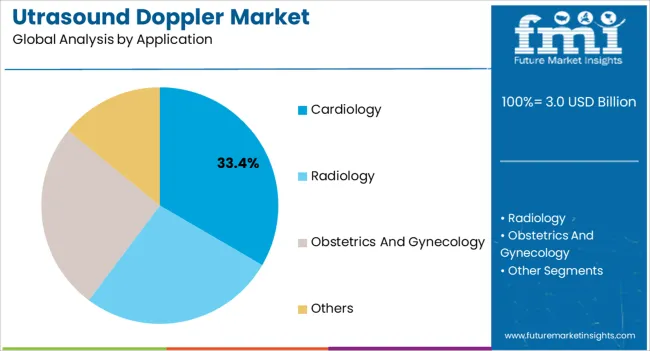
The cardiology application segment, projected to account for 33.4% of market revenues in 2025, highlights how cardiovascular health is central to market growth. Doppler imaging has become essential in early diagnosis, treatment planning, and monitoring of patients with heart conditions. Its ability to visualize blood flow in real time without invasive procedures provides unmatched value to physicians.
As hospitals and outpatient clinics integrate Doppler imaging into routine cardiac assessments, continuous improvements in AI and imaging precision will further cement cardiology’s leading role in market demand. Preventive healthcare measures, backed by governments and insurers, are expected to expand Doppler use cases across patient screening programs.
Hospitals Retain Lead Among End-Users
Hospitals are projected to represent 41.7% of global market share in 2025, reflecting their role as the primary adopters of high-performance ultrasound Doppler devices. Hospitals benefit from devices that enable comprehensive diagnostics for diverse patient groups, covering cardiology, obstetrics, vascular studies, and critical care.
In addition, hospitals’ investments in EHR-integrated Doppler systems have strengthened workflow efficiency, patient safety, and diagnostic accuracy. As healthcare facilities continue expanding in developing economies, hospitals will remain the backbone of demand while creating room for diagnostic centers and home care solutions to grow steadily.
Regional and Country-Level Analysis
Regionally, North America, Asia-Pacific, and Europe remain the key markets. North America’s early adoption of advanced imaging solutions, supported by well-developed healthcare infrastructure, keeps the region at the forefront. Meanwhile, Asia-Pacific is emerging as the most dynamic growth hub, with China forecasted to grow at 5.8% CAGR and India close behind at 5.4%. This expansion is tied to rapid hospital construction, government health initiatives, and rising awareness among healthcare professionals.
In Europe, Germany continues to lead Western Europe with a steady CAGR of 4.9%. The U.S. ultrasound Doppler market alone is estimated at USD 1.1 billion in 2025, reaching USD 1.5 billion by 2035. Even in regions with slower growth, such as Brazil at 3.2% CAGR, the consistent adoption trend highlights the global nature of demand.
Competitive Landscape: Innovation at the Core
The ultrasound Doppler market is defined by strong competition among global leaders and opportunities for regional entrants. Established players such as GE Healthcare, Siemens Healthineers, Koninklijke Philips N.V, Toshiba Medical Systems Corporation, and Fujifilm Holdings Corporation continue to push innovation with enhanced resolution, AI-driven platforms, and user-friendly designs.
Alongside them, companies like Hitachi Ltd., Esaote SpA, Samsung Medison Co., Ltd., Mindray Medical International Limited, and Analogic Corporation are expanding portfolios to include compact, portable solutions catering to emerging markets.
For new manufacturers, the landscape offers abundant opportunities. By focusing on cost-effective handheld solutions, modular add-ons, or specialized applications such as obstetrics and gynecology, newcomers can enter the market with a strong value proposition. The shift toward portability and integration with digital health platforms offers fertile ground for startups and mid-sized companies aiming to differentiate through technology and affordability.
Purchase this Report for USD 5,000 Only | Get an Exclusive Discount Instantly! https://www.futuremarketinsights.com/checkout/2253
Everything You Need—within Your Budget. Request a Special Price Now! https://www.futuremarketinsights.com/reports/sample/rep-gb-2253
About Future Market Insights (FMI)
Future Market Insights, Inc. (ESOMAR certified, recipient of the Stevie Award, and a member of the Greater New York Chamber of Commerce) offers profound insights into the driving factors that are boosting demand in the market. FMI stands as the leading global provider of market intelligence, advisory services, consulting, and events for the Packaging, Food and Beverage, Consumer Technology, Healthcare, Industrial, and Chemicals markets. With a vast team of over 400 analysts worldwide, FMI provides global, regional, and local expertise on diverse domains and industry trends across more than 110 countries.
Contact Us:
Future Market Insights Inc.
Christiana Corporate, 200 Continental Drive,
Suite 401, Newark, Delaware – 19713, USA
T: +1-347-918-3531
For Sales Enquiries: sales@futuremarketinsights.com
Website: https://www.futuremarketinsights.com
LinkedIn| Twitter| Blogs | YouTube