The global transparent paper market is on the verge of a remarkable transformation, projected to rise from USD 1.5 billion in 2025 to USD 2.9 billion by 2035, reflecting a compound annual growth rate (CAGR) of 6.6%. This growth stems from the increasing demand for sustainable, recyclable, and lightweight packaging as industries around the world respond to bans on plastics, regulatory reforms, and consumer preferences for eco-friendly alternatives.
Transparent paper has become a practical substitute for single-use plastics across food, bakery, and decorative packaging. In addition to addressing sustainability goals, it delivers clarity, printability, and durability, making it highly attractive for FMCG brands, e-commerce companies, and publishers.
Market Growth Across Decades
From 2020 to 2024, transparent paper steadily gained traction as industries searched for alternatives to plastic wraps. Bakery, confectionery, and FMCG brands led the way, using glazed and cellulose-based papers for packaging that balanced sustainability with premium aesthetics. By 2025, the market reached USD 1.5 billion, setting the stage for accelerated expansion.
Between 2025 and 2030, demand from FMCG and confectionery is expected to add USD 0.6 billion to the industry’s revenues. As e-commerce and foodservice adopt recyclable wrapping, applications will broaden further. From 2030 to 2035, industrial packaging and publishing will add USD 0.8 billion, strengthening transparent paper’s role in multiple sectors. By 2035, the industry’s value will double, underscoring its potential to transform packaging globally.
Why Transparent Paper is Gaining Ground
The rise of transparent paper reflects a unique convergence of market drivers. On one hand, global bans on plastics are compelling brands to find alternatives that are both compliant and consumer-friendly. On the other, food and beverage packaging—the largest end-use category, projected to hold 42.6% market share by 2025—anchors demand as FMCG and retail brands require reliable, recyclable solutions.
Bakery and confectionery wrapping, gift packaging, and decorative applications are also contributing momentum. Beyond retail, industrial packaging and publishing are adopting transparent paper to combine protection with printability, adding new dimensions to the material’s appeal.
For manufacturers, transparent paper offers the opportunity to align with circular economy principles and respond to consumer demand for plastic-free products. Innovations in barrier coatings and hybrid fiber formats are further enhancing its versatility, ensuring transparent paper can compete with conventional plastics in both performance and cost efficiency.
Segmental Insights: Where Growth Lies
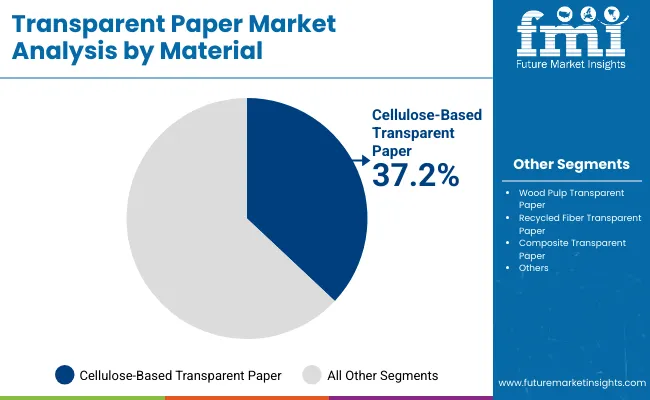
Among materials, cellulose-based transparent paper dominates with a 37.2% share in 2025, favored for its recyclability, durability, and cost efficiency. Improvements in scalability and barrier coatings will keep cellulose-based materials central to growth strategies.
By product type, glazed transparent paper leads with a 39.4% share in 2025, valued for its clarity, strength, and adaptability in food packaging. Lightweight formats, particularly papers up to 40 GSM, are highly sought after by FMCG and retail brands, accounting for 36.8% of share in 2025.
In terms of application, food packaging will continue to dominate with 38.1% share, as bakery and confectionery drive strong uptake. Ready-to-eat and frozen food segments will reinforce future adoption. End-use industries are also evolving, but food and beverages remain the anchor, holding 42.6% share in 2025.
Regional Outlook: Asia-Pacific Takes the Lead
Globally, the transparent paper market exhibits diverse regional growth patterns. Asia-Pacific is the clear leader, supported by rising FMCG demand, retail packaging innovation, and stringent regulations against plastics. South Korea stands out with the highest CAGR at 7.2%, driven by demand in food, bakery, and decorative packaging. Japan follows closely at 7.1%, with its focus on premium food and cosmetics packaging, backed by strong regulations. China and India remain critical markets, each expanding above 6.4% CAGR, propelled by foodservice growth and regulatory bans on plastic packaging.
Europe and North America are emphasizing compliance with recyclability mandates. Germany, the UK, and France drive regional momentum with bakery and retail packaging. The United States, expanding at 6.6% CAGR, is projected to see strong adoption across FMCG packaging and decorative wrapping.
Competitive Landscape: Leaders and Emerging Innovators
The transparent paper market is moderately fragmented, with established leaders such as Ahlstrom, Sappi, Delfortgroup, UPM, Nippon Paper (Papylia), and GrünenpergaPapier Group anchoring global supply. These companies focus on advanced transparent paper with recyclable coatings and hybrid fiber technologies.
In Asia-Pacific, manufacturers like Golden Paper Group, Minfeng Special Paper, Xincheng Paper Co., and SCG Paper/SCG International are scaling rapidly, offering competitive pricing and innovative formats for domestic and international markets.
Recent developments include Ahlstrom’s 2024 expansion in transparent barrier papers with enhanced recyclability, and Nippon Paper’s 2023 launch of high-clarity transparent paper for FMCG packaging. These innovations reflect the industry’s focus on sustainability while meeting functional demands in food and retail sectors.
For new entrants and smaller manufacturers, opportunities lie in developing niche applications such as decorative wrapping, specialty publishing, and lightweight e-commerce packaging. By adopting advanced water-based coatings and exploring hybrid fiber structures, they can establish competitive differentiation while supporting global sustainability mandates.
Stakeholders Driving the Market Forward
The transparent paper market is not just a story of manufacturers; it is also shaped by stakeholders across the value chain. Governments are implementing plastic bans and offering regulatory incentives for eco-friendly packaging. Retailers and FMCG companies are redesigning supply chains to integrate recyclable packaging solutions. Investors are directing capital toward companies that demonstrate sustainability leadership and scalability.
For buyers of this report—whether they are packaging companies, investors, or policymakers—the transparent paper market represents a blueprint for aligning with sustainability while capturing growth in one of the fastest-growing packaging segments worldwide.
Purchase this Report for USD 5,000 Only | Get an Exclusive Discount Instantly! https://www.futuremarketinsights.com/checkout/26742
Everything You Need—within Your Budget. Request a Special Price Now! https://www.futuremarketinsights.com/reports/sample/rep-gb-26742
About Future Market Insights (FMI)
Future Market Insights, Inc. (ESOMAR certified, recipient of the Stevie Award, and a member of the Greater New York Chamber of Commerce) offers profound insights into the driving factors that are boosting demand in the market. FMI stands as the leading global provider of market intelligence, advisory services, consulting, and events for the Packaging, Food and Beverage, Consumer Technology, Healthcare, Industrial, and Chemicals markets. With a vast team of over 400 analysts worldwide, FMI provides global, regional, and local expertise on diverse domains and industry trends across more than 110 countries.
Contact Us:
Future Market Insights Inc.
Christiana Corporate, 200 Continental Drive,
Suite 401, Newark, Delaware – 19713, USA
T: +1-347-918-3531
For Sales Enquiries: sales@futuremarketinsights.com
Website: https://www.futuremarketinsights.com
LinkedIn| Twitter| Blogs | YouTube