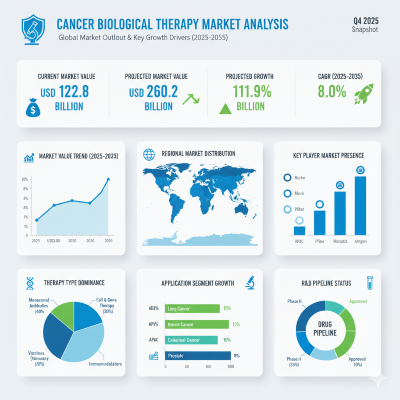
The global Cancer Biological Therapy Market is entering a transformative decade, fueled by breakthroughs in precision medicine and growing access to biologic therapies across regions. Valued at USD 122.8 billion in 2025, the market is projected to reach an impressive USD 260.2 billion by 2035, expanding at a compound annual growth rate (CAGR) of 7.8% over the forecast period, according to the latest report titled “Cancer Biological Therapy Market Size and Share Forecast Outlook 2025 to 2035.”
Get this Report at $5000 | Claim Your Report at a Discount: https://www.futuremarketinsights.com/reports/sample/rep-gb-2044
Rising Demand for Targeted and Personalized Cancer Therapies
The steady growth of the cancer biological therapy market is primarily driven by the rising global burden of cancer and the increasing adoption of targeted treatment approaches. Unlike conventional chemotherapy, biological therapies harness the body’s immune system or molecular mechanisms to fight cancer cells with greater precision and fewer side effects.
Technological progress in biotechnology and molecular diagnostics is paving the way for innovative therapies that not only improve patient survival but also enhance the quality of life. As more healthcare systems expand access to advanced oncology treatments, both developed and emerging markets are witnessing heightened adoption of biologics.
In addition, growing investments in oncology R&D, coupled with supportive regulatory pathways for biologic drug approvals, are accelerating market expansion. The integration of biomarkers and companion diagnostics has further enabled personalized treatment strategies tailored to individual patient profiles.
Segmental Highlights
The cancer biological therapy market is segmented based on therapy type, route of administration, cancer type, end user, and region.
- Monoclonal Antibody Therapy Leads the Way (32.5% Share in 2025)
Monoclonal antibodies are projected to remain the dominant therapy type, accounting for 32.5% of the market revenue in 2025. These therapies precisely target cancer cells while minimizing harm to healthy tissues. Their applications range from immune checkpoint inhibitors to antibody-drug conjugates, significantly improving patient outcomes across multiple cancer types.
Continuous innovation in manufacturing technologies has enhanced scalability and reduced production costs, enabling broader accessibility. As oncology shifts toward precision-based care, monoclonal antibodies will continue to drive both clinical and commercial success for companies investing in biologics.
- Intravenous Route Dominates Administration Methods (45.3% Share in 2025)
The intravenous route of administration will account for 45.3% of the market share in 2025, remaining the preferred delivery method for biologics. Intravenous infusion ensures precise dosing and rapid distribution, essential for maintaining the stability and potency of large-molecule biologic drugs.
Established hospital infrastructure and improved infusion protocols have made this route both safe and effective. As more complex biologic formulations enter clinical use, intravenous administration will continue to be the gold standard for therapeutic delivery.
- Lung Cancer Emerges as the Leading Indication (29.7% Share in 2025)
The lung cancer segment is expected to represent 29.7% of market revenue in 2025. Rising global incidence rates and advancements in molecularly targeted therapies are key factors driving this growth. Biological therapies are increasingly used in treating both non-small cell and small cell lung cancers, with significant survival benefits for patients harboring specific genetic mutations or biomarkers.
Ongoing clinical research, coupled with the availability of multiple approved biologics, is reinforcing the dominance of this segment in the coming decade.
Regional and Country-Level Insights
The global market is witnessing strong growth momentum across all major regions, led by North America, Europe, and Asia-Pacific.
- China leads with a projected CAGR of 10.5%, supported by large-scale investments in biotechnology and expanding domestic production capabilities.
- India follows closely with a 9.8% CAGR, fueled by rising healthcare infrastructure and government-backed cancer care initiatives.
- Among developed regions, Germany (9.0%), France (8.2%), and the UK (7.4%) continue to exhibit steady growth.
- The United States, valued at USD 42.0 billion in 2025, is expected to reach USD 79.8 billion by 2035, expanding at 6.6% CAGR, driven by continuous innovation and widespread clinical adoption of biologic therapies.
- Emerging economies such as Brazil also show positive growth trends, highlighting a global movement toward broader access to advanced cancer treatment options.
Competitive Landscape: Collaboration and Innovation Take Center Stage
The Cancer Biological Therapy Market is characterized by a dynamic mix of established pharmaceutical leaders and emerging biotechnology innovators. Key players include F. Hoffmann-La Roche Ltd., Novartis AG, Pfizer Inc., Merck & Co., Inc., Sanofi, GSK plc, Lilly, Bayer AG, Teva Pharmaceutical Industries Ltd., Mylan N.V., and Sun Pharmaceutical Industries.
These companies are investing heavily in next-generation biologics, such as immunotherapies, gene-based treatments, and cancer vaccines. Many are also forming strategic collaborations to accelerate clinical trials, expand production capacity, and introduce biosimilars that enhance treatment affordability and accessibility.
Emerging biotech startups are contributing to innovation by exploring novel molecular targets, improving drug delivery mechanisms, and leveraging AI-driven clinical research. This collaboration between established and new entrants is expected to redefine the future of cancer therapy over the next decade.
Get Instant Access & Discount: https://www.futuremarketinsights.com/checkout/2044
Outlook
As cancer incidence continues to rise worldwide, biological therapies are redefining the landscape of cancer care. Supported by policy reforms, R&D funding, and the global shift toward personalized medicine, the market is on a robust upward trajectory.
With monoclonal antibodies leading the charge, intravenous delivery methods ensuring therapeutic precision, and lung cancer therapies driving adoption, the Cancer Biological Therapy Market stands at the forefront of the next generation of oncology treatments—promising a future of more effective, targeted, and patient-centric cancer care.
About Future Market Insights (FMI)
Future Market Insights, Inc. (ESOMAR certified, recipient of the Stevie Award, and a member of the Greater New York Chamber of Commerce) offers profound insights into the driving factors that are boosting demand in the market. FMI stands as the leading global provider of market intelligence, advisory services, consulting, and events for the Packaging, Food and Beverage, Consumer Technology, Healthcare, Industrial, and Chemicals markets. With a vast team of over 400 analysts worldwide, FMI provides global, regional, and local expertise on diverse domains and industry trends across more than 110 countries.
Contact Us:
Future Market Insights Inc.
Christiana Corporate, 200 Continental Drive,
Suite 401, Newark, Delaware – 19713, USA
T: +1-347-918-3531
For Sales Enquiries: sales@futuremarketinsights.com
Website: https://www.futuremarketinsights.com
LinkedIn| Twitter| Blogs | YouTube