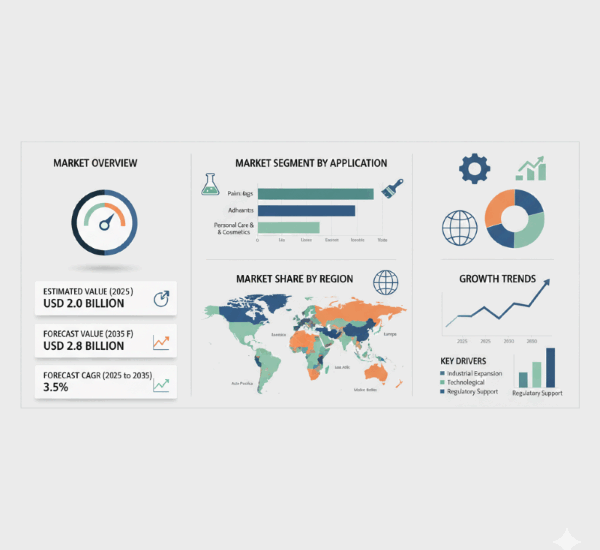
The global Viscosity Reducing Agents Market is poised for substantial growth, with an estimated market value of USD 2.0 billion in 2025 and a projected value of USD 2.8 billion by 2035. This growth, at a compound annual growth rate (CAGR) of 3.5%, is driven by the increasing demand for more efficient fluid transportation and processing across multiple industries. Viscosity reducing agents are key components in improving flow efficiency, reducing energy costs, and minimizing environmental impact.
Factors Driving Market Growth
The demand for viscosity reducing agents is primarily being fueled by their effectiveness in improving fluid flow across industries such as oil and gas, chemicals, and construction. These agents reduce the viscosity of crude oil, heavy liquids, and industrial fluids, thereby optimizing transportation through pipelines and refining processes.
Viscosity reducing agents, particularly polymers, are gaining traction for their ability to lower pumping energy costs, improve operational efficiency, and reduce wear and tear on infrastructure. Their role in enhancing flow assurance in the oil and gas sector has become particularly important as the industry faces growing challenges in transporting crude oil from unconventional sources and deepwater fields.
Technological advancements are also contributing to the market’s growth, with innovations in chemical formulations that improve agent performance at lower dosages. This not only reduces operational costs but also supports sustainability by lowering energy consumption and emissions. Additionally, the increasing focus on energy efficiency and the need for solutions that align with stringent environmental regulations have further accelerated the adoption of viscosity reducing agents.
Segment Analysis
- By Product Type:
- Polymers: The polymers segment is expected to account for 27.3% of market revenue in 2025, driven by their versatility and ability to reduce viscosity in diverse fluid systems. Polymers offer substantial reductions in pumping pressure, which directly correlates to lower energy requirements.
- Surfactants, Dispersants, Additives, and Others are also contributing to the market’s growth, with each product type catering to specific fluid applications across different industries.
- By End-Use Industry:
- Oil and Gas: This sector is forecast to represent 32.5% of market share in 2025. Viscosity reducing agents play a critical role in pipeline operations, improving flow efficiency and reducing the energy intensity of pumping operations. This is especially important as the industry continues to expand in unconventional resources and deepwater fields.
- Cement & Construction, Paints & Coatings, Rubber, and Others are also significant contributors to the overall demand for viscosity reducing agents.
Regional Growth Insights
Geographically, the Viscosity Reducing Agents Market is witnessing dynamic growth. North America, led by the USA and Canada, continues to dominate, driven by extensive pipeline infrastructure and the region’s push towards energy efficiency. Asia-Pacific, particularly China and India, is expected to grow at the fastest rate, driven by expanding oil and gas operations and infrastructure development projects. Europe, especially Germany and France, remains a strong player due to its advanced chemical and manufacturing sectors.
Competitive Landscape
Key market players, such as Henkel, Omya AG, ExxonMobil, Rhodia Group, Lubrizol, and BASF, are actively contributing to market innovation and expansion. These companies are focusing on developing next-generation viscosity reducing agents that provide better performance, higher efficiency, and are cost-effective.
As demand for more efficient industrial and oil transportation systems grows, these companies are poised to benefit from a market that is increasingly leaning towards sustainable and energy-efficient solutions.
Conclusion
The Viscosity Reducing Agents Market is set to grow steadily over the next decade, with polymers leading as the preferred product type and the oil and gas sector driving demand. As industries continue to seek ways to enhance operational efficiency and reduce environmental impact, viscosity reducing agents are positioned to play a pivotal role in shaping the future of fluid management technologies.
Order Now for $5,000 | Unlock Insights with a Special Discount! https://www.futuremarketinsights.com/reports/sample/rep-gb-2085
Checkout Now to Access Industry Insights: https://www.futuremarketinsights.com/checkout/2085
About Future Market Insights (FMI)
Future Market Insights, Inc. (ESOMAR certified, recipient of the Stevie Award, and a member of the Greater New York Chamber of Commerce) offers profound insights into the driving factors that are boosting demand in the market. FMI stands as the leading global provider of market intelligence, advisory services, consulting, and events for the Packaging, Food and Beverage, Consumer Technology, Healthcare, Industrial, and Chemicals markets. With a vast team of over 400 analysts worldwide, FMI provides global, regional, and local expertise on diverse domains and industry trends across more than 110 countries.
Contact Us:
Future Market Insights Inc.
Christiana Corporate, 200 Continental Drive,
Suite 401, Newark, Delaware – 19713, USA
T: +1-347-918-3531
For Sales Enquiries: sales@futuremarketinsights.com
Website: https://www.futuremarketinsights.com
LinkedIn| Twitter| Blogs | YouTube