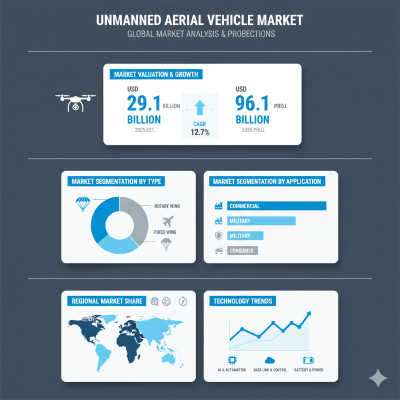
The global Unmanned Aerial Vehicle Market is on a steep growth trajectory, estimated at USD 29.1 billion in 2025 and projected to reach USD 96.1 billion by 2035, expanding at an impressive compound annual growth rate (CAGR) of 12.7%. This robust expansion is driven by widespread adoption across defense, commercial, and civil sectors, as UAVs redefine how industries capture data, monitor assets, and ensure safety and efficiency in operations.
Get this Report at $5000 | Claim Your Report at a Discount: https://www.futuremarketinsights.com/reports/sample/rep-gb-2574
Strong Market Dynamics Backed by Technological Advancements
The demand for UAVs continues to rise as governments, enterprises, and private operators embrace drones for intelligence, surveillance, reconnaissance, logistics, and precision agriculture. Advanced flight control systems, autonomous navigation technologies, and sensor integration are revolutionizing UAV capabilities—enhancing performance, endurance, and operational reliability.
Battery-operated UAVs are emerging as a preferred choice due to their low operational costs, energy efficiency, and environmental sustainability. Recent improvements in lithium-ion and lithium-polymer batteries have boosted flight times, minimized maintenance, and supported broader commercial adoption. As sustainability and digitalization continue to converge, the UAV industry is evolving into a hub for next-generation mobility and intelligent automation.
Tactical UAVs Lead Market Share with 40.5% Contribution in 2025
The tactical class segment is forecasted to hold a commanding 40.5% market share in 2025, making it the leading category. This segment’s growth stems from the expanding use of versatile UAVs for defense and security missions that require rapid deployment, real-time surveillance, and precision targeting.
Tactical UAVs are known for their modular design, scalability, and adaptability, allowing seamless integration of advanced payloads such as electro-optic sensors, radar systems, and communication modules. These features enable defense and border patrol agencies to conduct multifaceted missions efficiently. As governments increase defense budgets and invest in multi-role platforms, tactical UAVs are set to remain at the forefront of the market.
Battery-Operated UAVs: Powering the Future of Aerial Mobility
Battery-operated UAVs are anticipated to capture 38.7% of the global market share in 2025, reflecting growing industry confidence in electric propulsion technologies. These UAVs offer quiet operation, portability, and quick deployment, making them ideal for industrial inspections, emergency response, and agricultural mapping.
Ongoing innovation in energy density, battery management systems, and lightweight composite materials is pushing operational limits and enabling extended missions. With environmental regulations tightening and industries emphasizing carbon neutrality, electric-powered UAVs are becoming integral to sustainable aviation strategies.
Medium Endurance UAVs Dominate with 45.2% Market Share
UAVs with medium endurance (5–24 hours) are projected to account for 45.2% of global revenues in 2025. Their ability to balance payload capacity, flight range, and mission flexibility makes them ideal for applications requiring sustained monitoring without frequent refueling or recharging.
These UAVs are widely deployed in infrastructure inspection, disaster management, border security, and environmental research. Enhanced battery technologies, aerodynamic designs, and energy optimization systems are further extending mission durations, providing reliable performance across diverse terrains and weather conditions.
Global Market Outlook and Regional Insights
From 2025 to 2035, the UAV market is expected to grow from USD 29.1 billion to USD 96.1 billion, supported by both defense modernization and civilian innovation. Regionally, North America, Asia-Pacific, and Europe remain the key growth hubs.
- China is forecasted to lead with a CAGR of 17.1%, driven by strong government support and expanding manufacturing capabilities.
- India follows with a 15.9% CAGR, propelled by defense upgrades and new drone policies fostering domestic production.
- Germany, France, and the UK are strengthening their positions in advanced UAV research and regulatory frameworks.
- The U.S. market, valued at USD 10.2 billion in 2025, is set to reach USD 28.4 billion by 2035, supported by growing adoption in logistics, homeland security, and precision agriculture.
Despite varying growth rates, every major economy is experiencing rising UAV penetration, marking a transformative phase in aerial technology integration.
Rising Role of AI and Autonomous Flight
The next decade will witness UAVs evolving into fully autonomous systems capable of self-navigation, obstacle avoidance, and intelligent decision-making. Integration of artificial intelligence (AI) and machine learning (ML) is enabling drones to perform complex missions—ranging from precision farming to real-time mapping—without human intervention.
These innovations are reshaping operations across defense, logistics, and infrastructure management, improving safety, productivity, and mission accuracy while reducing costs. Autonomous flight is also expected to drive adoption among new players entering the UAV ecosystem, including startups developing specialized platforms for niche applications.
Access Premium Reports – Buy Today: https://www.futuremarketinsights.com/checkout/2574
Competitive Landscape: Established Leaders and Emerging Innovators
The UAV market is characterized by intense competition, with leading manufacturers and emerging innovators investing in new technologies and partnerships. Prominent players include SZ DJI Technology Co. Ltd., Parrot SAS, Delair SAS, AeroVironment Inc., Northrop Grumman Corporation, Elbit Systems Ltd., General Atomics, Israel Aerospace Industries Ltd., THALES, The Boeing Company, Microdrones GmbH, BAYKAR TECH, Leonardo S.p.A., and Textron Inc.
While established players are focusing on improving payload capacity, AI integration, and energy efficiency, new entrants are leveraging modular design, open-source systems, and hybrid propulsion technologies to capture niche segments. Collaborative ventures, mergers, and government-backed R&D programs are also shaping a dynamic and competitive UAV landscape.
About Future Market Insights (FMI)
Future Market Insights, Inc. (ESOMAR certified, recipient of the Stevie Award, and a member of the Greater New York Chamber of Commerce) offers profound insights into the driving factors that are boosting demand in the market. FMI stands as the leading global provider of market intelligence, advisory services, consulting, and events for the Packaging, Food and Beverage, Consumer Technology, Healthcare, Industrial, and Chemicals markets. With a vast team of over 400 analysts worldwide, FMI provides global, regional, and local expertise on diverse domains and industry trends across more than 110 countries.
Contact Us:
Future Market Insights Inc.
Christiana Corporate, 200 Continental Drive,
Suite 401, Newark, Delaware – 19713, USA
T: +1-347-918-3531
For Sales Enquiries: sales@futuremarketinsights.com
Website: https://www.futuremarketinsights.com
LinkedIn| Twitter| Blogs | YouTube