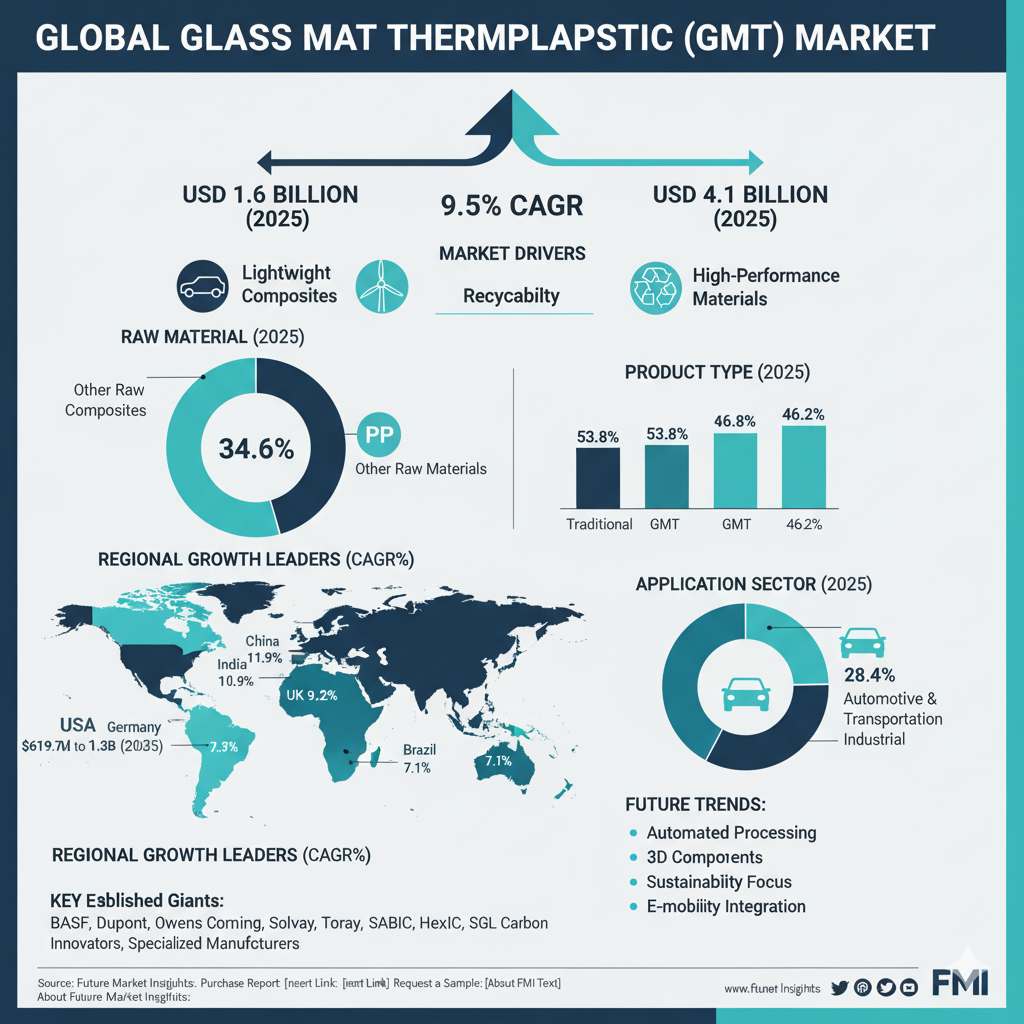
The global Glass Mat Thermoplastic (GMT) Market is entering an unprecedented growth phase, set to nearly triple in size over the next decade. Valued at USD 1.6 billion in 2025, the market is projected to reach USD 4.1 billion by 2035, recording an impressive compound annual growth rate (CAGR) of 9.5%. As industries accelerate their shift toward lightweight, recyclable, and high-performance materials, GMT is cementing its role as a cornerstone in automotive, aerospace, and industrial manufacturing.
The Rising Demand for Lightweight and Durable Materials
At the heart of this market expansion lies the increasing demand for lightweight composites that do not compromise on strength or durability. Glass Mat Thermoplastics are replacing conventional metals such as steel and aluminum, offering significant weight reduction and efficiency gains. With regulatory pressure to cut emissions and improve fuel efficiency, automotive and transportation industries are adopting GMT at record levels.
The material’s appeal lies not only in its physical properties—impact resistance, thermal stability, and rigidity—but also in its recyclability. For manufacturers looking to balance performance with sustainability, GMT presents an ideal solution. This dual advantage is capturing the attention of both established stakeholders and emerging players eager to make their mark in the composites sector.
Polypropylene Emerges as the Leading Raw Material
Among raw materials, polypropylene (PP) is set to dominate the market in 2025 with a revenue share of 34.6%. Its lightweight profile, high chemical resistance, and compatibility with reinforcement make it the top choice for mass production. Automotive manufacturers, in particular, are turning to PP-based GMT solutions to reduce vehicle weight while maintaining safety standards and production efficiency.
Continuous improvements in polypropylene formulations are enabling higher impact resistance and thermal stability, opening doors for advanced applications in electric vehicles and industrial equipment. For manufacturers, PP offers a cost-effective, versatile, and scalable entry point into the rapidly expanding GMT market.
Traditional GMT Maintains Stronghold
While innovation in advanced GMT products is gaining attention, traditional GMT will remain the backbone of the market, accounting for 53.8% of revenue in 2025. Its established manufacturing processes support high-volume production with consistent quality, making it indispensable for automotive and industrial applications.
Traditional GMT’s proven strength-to-weight ratio, dimensional stability, and compatibility with compression molding ensure cost efficiency and reliability. For companies scaling up their composite production capabilities, traditional GMT provides both security and opportunity, serving as the foundation on which more advanced products can be built.
Automotive and Transportation Applications Lead the Charge
The automobile and transportation sector will remain the largest application area, expected to hold 28.4% of market revenue in 2025. As global automakers confront stricter emissions standards and rising demand for fuel-efficient vehicles, GMT is increasingly being integrated into structural components, interior panels, and exterior body parts.
The rapid growth of electric and hybrid vehicles is further amplifying the need for lightweight materials. With battery efficiency closely linked to overall vehicle weight, GMT provides a competitive edge for manufacturers. Its balance of strength, flexibility, and sustainability positions it as a critical enabler of next-generation mobility solutions.
Geographic Hotspots: Asia-Pacific in the Lead
The global GMT market will display diverse growth trajectories across regions. China is forecasted to lead with a CAGR of 12.8%, followed by India at 11.9%, reflecting strong industrial expansion and rising automotive production. Germany, France, and the UK continue to anchor European demand, with Germany alone expected to grow at 10.9%.
In the United States, the market is estimated at USD 619.7 million in 2025 and is projected to nearly double to USD 1.3 billion by 2035. Though Brazil records the lowest growth rate at 7.1%, it still represents a steadily expanding opportunity within South America.
This geographic spread illustrates the global appeal of GMT, offering opportunities for both multinational corporations and local manufacturers to align their strategies with regional demand trends.
Established Leaders and New Entrants Shape the Market
Industry giants such as BASF, DuPont, Owens Corning, Solvay, Toray Industries, SABIC, Hexcel, Teijin, and SGL Carbon are already driving innovation in this market. Their global reach and investment in R&D ensure continuous advancements in thermoplastic formulations, processing technologies, and composite integration.
At the same time, new entrants and regional players are finding fertile ground to compete by focusing on niche markets and specialized applications. For startups and medium-sized manufacturers, the opportunity lies in leveraging new technologies, emphasizing sustainability, and delivering cost-effective solutions tailored to local market needs.
Technology, Sustainability, and the Road Ahead
The future of the Glass Mat Thermoplastic market is being shaped not only by demand but also by technological innovation. Advancements in automated processing, 3D structural GMT components, and recyclable composites are setting new performance benchmarks. Environmental sustainability is another defining driver, as regulators, manufacturers, and consumers alike prioritize materials that minimize ecological impact.
GMT’s ability to be recycled and reprocessed positions it favorably against traditional metals and non-recyclable composites. This sustainability advantage is attracting investment across industries, from automotive to consumer goods, ensuring long-term market resilience.
Opportunities for Stakeholders
For stakeholders—including investors, manufacturers, suppliers, and policymakers—the GMT market presents a wealth of opportunities. Established leaders are strengthening their positions with large-scale innovations, while new manufacturers are carving paths through specialized solutions. The rising tide of automotive electrification, coupled with industrial modernization, creates a landscape where both global corporations and ambitious newcomers can thrive.
Acquiring the detailed Glass Mat Thermoplastic Market Report provides in-depth analysis of growth segments, competitive strategies, and country-level performance trends. For businesses aiming to expand or innovate in the composites market, these insights offer a strategic edge.
Purchase this Report for USD 5,000 Only | Get an Exclusive Discount Instantly! https://www.futuremarketinsights.com/checkout/2579
Everything You Need—within Your Budget. Request a Special Price Now! https://www.futuremarketinsights.com/reports/sample/rep-gb-2579
About Future Market Insights (FMI)
Future Market Insights, Inc. (ESOMAR certified, recipient of the Stevie Award, and a member of the Greater New York Chamber of Commerce) offers profound insights into the driving factors that are boosting demand in the market. FMI stands as the leading global provider of market intelligence, advisory services, consulting, and events for the Packaging, Food and Beverage, Consumer Technology, Healthcare, Industrial, and Chemicals markets. With a vast team of over 400 analysts worldwide, FMI provides global, regional, and local expertise on diverse domains and industry trends across more than 110 countries.
Contact Us:
Future Market Insights Inc.
Christiana Corporate, 200 Continental Drive,
Suite 401, Newark, Delaware – 19713, USA
T: +1-347-918-3531
For Sales Enquiries: sales@futuremarketinsights.com
Website: https://www.futuremarketinsights.com
LinkedIn| Twitter| Blogs | YouTube