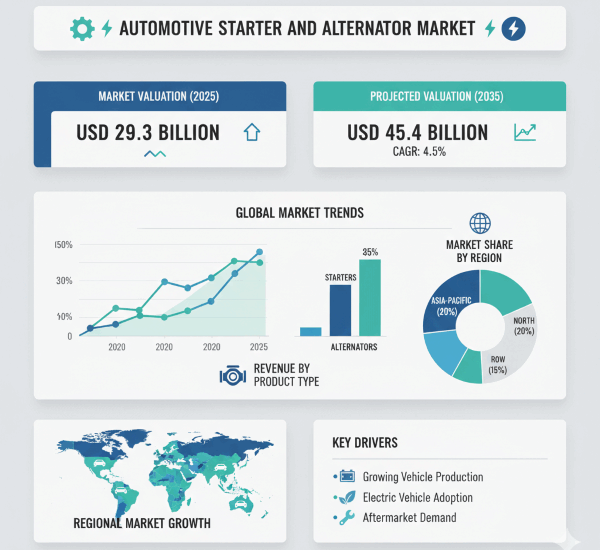
The Automotive Starter and Alternator Market is poised for significant expansion over the next decade, with its valuation expected to grow from USD 29.3 billion in 2025 to USD 45.4 billion by 2035, registering a steady CAGR of 4.5%. This growth reflects a dynamic transformation within the automotive ecosystem—driven by electrification trends, stricter emission norms, and heightened demand for performance and reliability in both traditional and hybrid vehicles.
Get this Report at $5000 | Claim Your Report at a Discount: https://www.futuremarketinsights.com/reports/sample/rep-gb-2575
Industry Momentum Fueled by Technological Advancements
The surge in vehicle production, coupled with global emphasis on fuel-efficient and low-emission engines, is driving adoption of advanced starters and alternators. These components remain critical in ensuring smooth engine performance, improved power output, and reduced emissions.
Technological innovations are redefining the landscape, particularly in electric starter motors and lightweight alternator systems. Modern designs now integrate better heat dissipation, magnetic efficiency, and compactness—helping OEMs meet evolving efficiency and sustainability targets.
Established players such as Valeo SA, Denso Corporation, Robert Bosch GmbH, and Mitsubishi Electric Corporation are investing heavily in R&D to introduce smarter, compact, and energy-efficient starter and alternator units. At the same time, emerging manufacturers like Ningbo Zhongwang Auto Fittings Co., Ltd. and ASIMCO Technologies Ltd. are expanding globally, tapping into rising demand from Asia-Pacific and Latin America.
Why the Market Is Accelerating
The market’s upward trajectory is attributed to several converging factors:
- Growing global vehicle production—particularly in Asia and Europe—boosting demand for reliable engine-start systems.
- Electrification of powertrains, as manufacturers move toward hybrid and micro-hybrid configurations that require high-performance alternators.
- Regulatory pressure promoting emission control and efficiency, pushing OEMs to adopt more advanced and compliant starter-alternator technologies.
- Expanding fleet and logistics operations, especially in the light commercial vehicle (LCV) sector, demanding durable and efficient components capable of withstanding frequent engine cycles.
These dynamics have encouraged both established and new market entrants to expand production capacities, form strategic alliances, and explore new materials and digital control systems to enhance performance.
Segmental Analysis: Electric Starters Lead the Way
By starter type, the electric starter segment is set to capture 40.2% of the market share in 2025, maintaining dominance throughout the forecast period. Electric starters are increasingly preferred for their high torque, energy efficiency, and low maintenance. Their compatibility with modern vehicle electronics, hybrid systems, and start-stop technologies has further accelerated adoption.
Manufacturers are focusing on lightweight, compact electric starter designs that can fit smaller engines without compromising performance. This segment’s growth is further amplified by increasing vehicle production in emerging economies like China and India, where cost-effective and durable starter solutions are in high demand.
Claw Pole Alternators Retain Leadership
In the alternator category, claw pole alternators are projected to hold 55.7% of the global market share in 2025. Known for their compact design, cost-effectiveness, and consistent power output, they remain a staple in both passenger and light commercial vehicles.
Continuous innovation in magnetic materials and winding configurations has boosted their energy conversion efficiency while reducing thermal losses. Moreover, their compatibility with hybrid powertrains and energy recuperation systems ensures their relevance in next-generation vehicles.
Light Commercial Vehicles Dominate the Vehicle Type Segment
By vehicle type, light commercial vehicles (LCVs) will lead the market, accounting for 42.1% of total revenue in 2025. The surge in e-commerce, last-mile delivery, and logistics activities has significantly increased LCV demand worldwide. These vehicles require robust and energy-efficient starter and alternator systems to handle frequent stops, restarts, and extended operating hours.
As delivery fleets expand in urban regions, automakers are integrating more efficient powertrain components to enhance reliability and reduce downtime—further strengthening this segment’s dominance.
Regional Insights: Asia-Pacific Leads Global Growth
Regionally, Asia-Pacific, North America, and Europe remain the key markets for automotive starters and alternators.
- China leads the global market with a 6.1% CAGR, driven by rapid industrialization, growing vehicle production, and local OEM expansion.
- India follows with a 5.6% CAGR, supported by rising automobile exports and increased focus on electrified powertrains.
- Germany, France, and the UK remain crucial European markets, reflecting steady innovation and adoption in premium vehicle segments.
- The U.S. market, valued at USD 10.1 billion in 2025, is projected to reach USD 14.7 billion by 2035, expanding at a CAGR of 3.8%.
Emerging economies in South America and Southeast Asia are also witnessing rapid adoption, supported by growing automotive manufacturing bases and infrastructure development.
Competitive Landscape: Collaboration and Innovation Drive Progress
Leading global players such as Valeo SA, Denso Corporation, Robert Bosch GmbH, and Hitachi Automotive Systems, Ltd. are focusing on innovation, partnerships, and localized production. Meanwhile, companies like Hella KGaA Hueck & Co., BBB Industries, Remy International, Inc., and Mitsuba Corporation are developing integrated starter-alternator modules (ISAs) and advanced control units to support hybrid vehicle architecture.
New entrants and regional manufacturers are increasingly emphasizing cost-effective production, modular designs, and next-gen materials to enhance their competitive edge and enter new international markets.
Get Instant Access & Discount: https://www.futuremarketinsights.com/checkout/2575
Outlook: A Decade of Innovation and Expansion
The Automotive Starter and Alternator Market is entering a transformative decade. As manufacturers embrace electrification, digitization, and sustainability, the market will witness strong growth opportunities across every segment.
For both established brands and emerging players, innovation in energy-efficient designs, smart alternators, and lightweight starter systems will define success in this evolving landscape—making the industry a cornerstone of the future mobility revolution.
About Future Market Insights (FMI)
Future Market Insights, Inc. (ESOMAR certified, recipient of the Stevie Award, and a member of the Greater New York Chamber of Commerce) offers profound insights into the driving factors that are boosting demand in the market. FMI stands as the leading global provider of market intelligence, advisory services, consulting, and events for the Packaging, Food and Beverage, Consumer Technology, Healthcare, Industrial, and Chemicals markets. With a vast team of over 400 analysts worldwide, FMI provides global, regional, and local expertise on diverse domains and industry trends across more than 110 countries.
Contact Us:
Future Market Insights Inc.
Christiana Corporate, 200 Continental Drive,
Suite 401, Newark, Delaware – 19713, USA
T: +1-347-918-3531
For Sales Enquiries: sales@futuremarketinsights.com
Website: https://www.futuremarketinsights.com
LinkedIn| Twitter| Blogs | YouTube