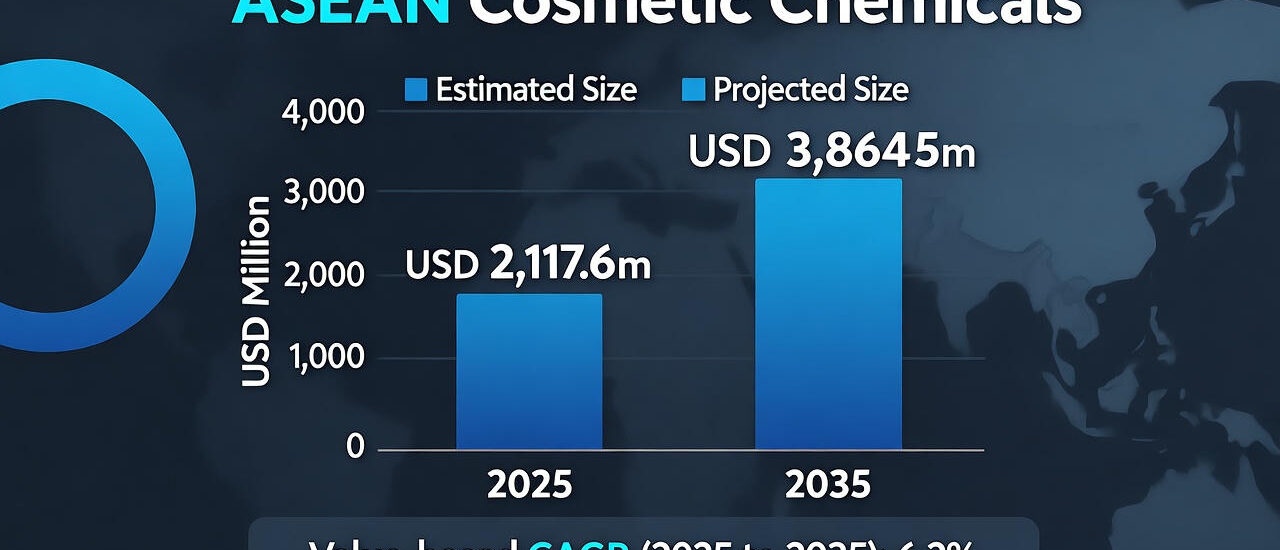
The ASEAN cosmetic chemicals market has emerged as a dynamic and rapidly evolving sector, reflecting the region’s growing consumer focus on beauty, personal care, and wellness. Valued at USD 1,994.0 million in 2024, the market is projected to reach USD 2,117.6 million in 2025, registering a robust year-over-year growth of 5.7%. Over the decade-long forecast period, the market is anticipated to expand at a 6.2% CAGR, reaching USD 3,864.5 million by 2035. This surge is fueled by increasing consumer demand for quality, innovative, and personalized beauty products, alongside rising disposable incomes and the proliferation of digital shopping channels.
Get this Report at $5000 Only (Report price) | Exclusive Discount Inside!: https://www.futuremarketinsights.com/reports/sample/rep-as-31
Diverse Applications Fuel Market Expansion
Cosmetic chemicals, the essential ingredients in products such as shampoos, soaps, deodorants, lipsticks, and mascaras, continue to dominate the industry landscape. ASEAN companies currently utilize over 5,000 chemical compositions, ranging from surfactants and emollients to conditioning polymers and UV absorbers. These ingredients not only ensure product stability and extended shelf life but also integrate vitamins, antioxidants, minerals, herbs, and fragrances to create formulations that cater to evolving consumer preferences.
Surfactants Lead the Charge
Among product types, surfactants remain the cornerstone of cosmetic formulations, accounting for 33% of the market in 2024. Surfactants play a crucial role in personal care, providing cleansing and foaming properties essential for shampoos, body washes, facial cleansers, and toothpaste. With growing awareness of personal hygiene and grooming across ASEAN countries, demand for surfactant-based products continues to rise, driving innovation and product diversification.
Skin Care Dominates Application Segments
In terms of applications, skincare products captured the largest share in 2024 at 42.6%, highlighting a shift in consumer priorities towards wellness and self-care. Moisturizers, anti-aging creams, sunscreens, and facial masks are increasingly sought after by consumers keen on maintaining healthy, glowing skin. Furthermore, the preference for natural, organic, and eco-friendly ingredients has prompted manufacturers to adopt sustainable formulations, aligning with global trends and consumer expectations.
E-Commerce and Digital Influence
The rise of e-commerce platforms such as Lazada, Shopee, and Tokopedia has transformed cosmetic consumption across ASEAN. Digital shopping enables consumers to browse, compare, and purchase products conveniently, significantly boosting the reach of both established brands and emerging startups. Social media and beauty influencers further amplify trends, introducing new products to millions of consumers and shaping purchasing behavior. The resulting online ecosystem has become a critical driver for cosmetic chemicals demand, encouraging companies to enhance their digital presence and marketing strategies.
Balancing Traditional and Natural Preferences
While there is growing enthusiasm for natural and cruelty-free beauty products, chemical-based cosmetics continue to maintain a strong foothold in some markets, driven by affordability and familiarity. Manufacturers are navigating this landscape by offering a diverse portfolio that caters to both traditional and eco-conscious consumers, ensuring market inclusivity and resilience.
Regional Insights: Thailand, Indonesia, and Vietnam Lead Growth
Thailand’s cosmetic chemicals market benefits from strong consumer awareness and a well-developed e-commerce infrastructure, fueling demand for both mass-market and premium skincare products. Indonesia, with its vast population of over 270 million, continues to drive market expansion through rising disposable incomes and urbanization, alongside increasing online shopping penetration. Vietnam’s young, health-conscious demographic has created significant opportunities for natural and premium beauty products, supported by growing middle-class incomes and urban lifestyles. Collectively, these markets are anticipated to register a CAGR of around 6.2% through 2035.
Competitive Landscape and Key Players
The ASEAN cosmetic chemicals industry is characterized by a tiered competitive structure. Tier 1 companies, including Akzo Nobel NV, Ashland Global Holdings Inc, BASF SE, and Dow Inc., dominate with extensive production capacities and global reach, collectively capturing 55% to 65% of the market. Tier 2 firms, such as Eastman Chemical Company, Evonik Industries AG, and Firmenich SA, exert influence regionally with mid-sized operations and specialized expertise. Tier 3 players, including Givaudan SA, International Flavors & Fragrances Inc., and P&G Chemicals, cater to localized needs and niche markets.
Leading companies are investing in research and development, mergers, and strategic acquisitions to remain competitive. Notable developments include Givaudan’s 2024 acquisition of a significant cosmetic ingredient portfolio from Amyris, Inc., aimed at expanding its Active Beauty segment, and L’Oréal’s acquisition of luxury personal care brand Aesop in 2023 for USD 2.5 billion, reflecting a strategic move to strengthen market presence.
Buy Now Report Here: https://www.futuremarketinsights.com/checkout/31
Outlook and Opportunities
The ASEAN cosmetic chemicals market is poised for sustained growth from 2025 to 2035. Consumer demand for sustainable, natural, and cruelty-free products will continue to drive innovation in ingredients and packaging. Expansion in men’s grooming, skincare, and haircare, coupled with the influence of e-commerce and social media, will shape the market trajectory. Established manufacturers and emerging players alike have opportunities to expand geographically, introduce innovative formulations, and cater to an increasingly discerning and digitally connected consumer base.
As the market continues to evolve, ASEAN cosmetic chemicals are set to thrive, balancing tradition with modernity, and creating vibrant growth opportunities for all stakeholders across the beauty and personal care ecosystem.
Related Reports:
Alkyl Polyglucosides Market- https://www.futuremarketinsights.com/reports/alkyl-polyglucosides-market
High Entropy Alloy Market- https://www.futuremarketinsights.com/reports/high-entropy-alloy-market
Copper Fungicides Market- https://www.futuremarketinsights.com/reports/copper-fungicides-market
About Future Market Insights (FMI)
Future Market Insights, Inc. (ESOMAR certified, recipient of the Stevie Award, and a member of the Greater New York Chamber of Commerce) offers profound insights into the driving factors that are boosting demand in the market. FMI stands as the leading global provider of market intelligence, advisory services, consulting, and events for the Packaging, Food and Beverage, Consumer Technology, Healthcare, Industrial, and Chemicals markets. With a vast team of over 400 analysts worldwide, FMI provides global, regional, and local expertise on diverse domains and industry trends across more than 110 countries.
Join us as we commemorate 10 years of delivering trusted market insights. Reflecting on a decade of achievements, we continue to lead with integrity, innovation, and expertise.
Contact Us:
Future Market Insights Inc.
Christiana Corporate, 200 Continental Drive,
Suite 401, Newark, Delaware – 19713, USA
T: +1-347-918-3531
For Sales Enquiries: sales@futuremarketinsights.com
Website: https://www.futuremarketinsights.com
LinkedIn| Twitter| Blogs | YouTube