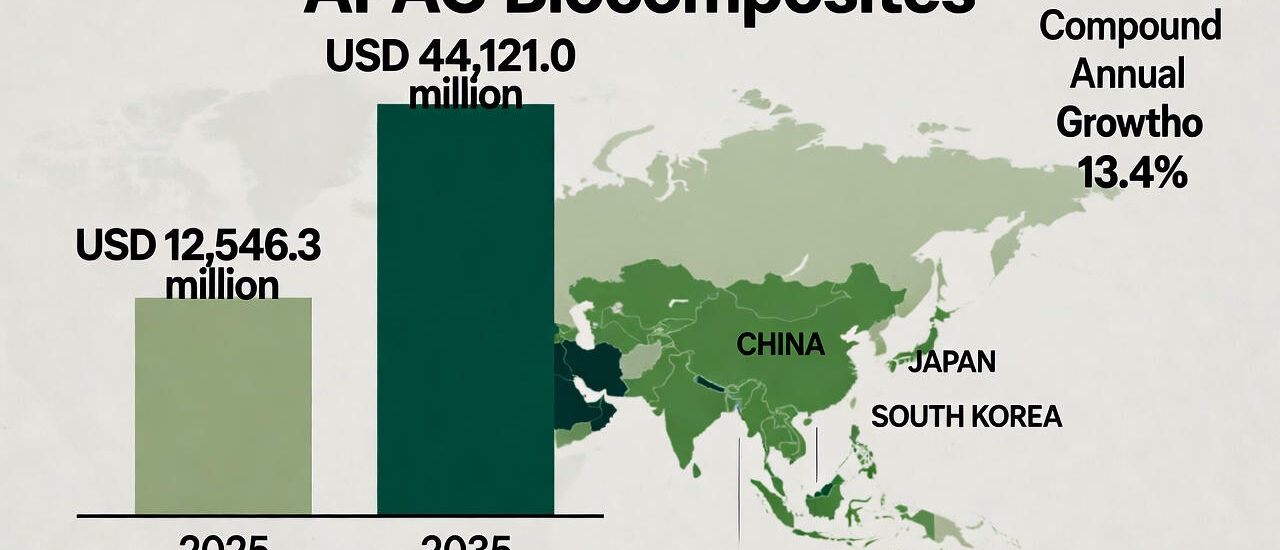
The APAC biocomposites market is entering a period of transformative growth, with sales projected to reach USD 12,546.3 million in 2025 from USD 11,063.7 million in 2024. This represents a year-on-year growth of 12.5%, and analysts anticipate the market will surge at a CAGR of 13.4% to reach USD 44,121.0 million by 2035. Biocomposites, which are materials manufactured from natural fibers like wood, hemp, and flax combined with natural or synthetic polymers, are emerging as the sustainable alternative to conventional composites. Their adoption is being driven by environmental concerns, demand for sustainable materials, and increasing regulatory pressures to reduce carbon footprints.
Get this Report at $5000 Only (Report price) | Exclusive Discount Inside!: https://www.futuremarketinsights.com/reports/sample/rep-ap-77
Expanding Applications Across Industries
Biocomposites are finding applications across a variety of industries, including construction, automotive, consumer goods, and packaging. In construction, they are used for insulation, flooring, and light panels, providing eco-friendly alternatives that reduce environmental impact. The automotive sector increasingly leverages biocomposites to replace traditional materials in vehicle interiors and exteriors, helping reduce vehicle weight and enhance fuel efficiency. Consumer goods, from electronics to furniture, benefit from the design flexibility, durability, and sustainability that biocomposites offer.
China Leading the APAC Market Growth
China has emerged as the largest producer and consumer of biocomposites in the APAC region, fueled by a strong manufacturing base and growing demand for sustainable materials. Government policies promoting green technologies and reducing carbon emissions, combined with abundant natural fiber resources such as bamboo, hemp, and wood, have accelerated market adoption. Rapid urbanization and infrastructure development further drive the demand for biocomposites in construction and automotive applications.
Green Biocomposites and Synthetic Polymers Dominate Market Share
Green biocomposites, made entirely from renewable and natural materials, are projected to hold a dominant market share of 67.4% in 2025. Their eco-friendly, biodegradable, and recyclable nature has made them highly attractive across sectors striving for sustainability. Synthetic polymers, such as polypropylene and polyethylene, are expected to account for 72.1% of the market due to their cost-effectiveness, availability, and versatility. These polymers offer superior mechanical properties, including strength, durability, and stability under environmental stresses, making them suitable for automotive, construction, and packaging applications.
Semi-Annual Market Performance Trends
The APAC biocomposites market has witnessed steady growth in recent years. From 2020 to 2024, the market recorded a CAGR of 11.1%, growing from USD 6,799.5 million to USD 11,063.7 million. Projections for 2025 to 2035 indicate a slightly higher CAGR, ranging between 13.5% and 13.6% across the first and second halves of the year, signaling robust momentum and continued adoption of sustainable materials across industries.
Driving Factors in Market Adoption
The construction and consumer goods sectors are major drivers of biocomposite demand. Companies are increasingly prioritizing sustainable alternatives to traditional building materials and automotive components. Biocomposites, with their lower carbon footprint compared to plastics and metals, offer a renewable and environmentally responsible choice. In automotive, the trend toward lightweighting reduces vehicle weight, improves fuel efficiency, and lowers carbon emissions, reinforcing the appeal of biocomposites for manufacturers focused on sustainability.
Country-Wise Market Insights
Key markets within APAC include China, India, Japan, and South Korea. India’s packaging industry is witnessing strong adoption of biocomposites as bans on single-use plastics encourage eco-friendly alternatives. In South Korea, the automotive industry uses biocomposites to reduce vehicle weight and enhance electric vehicle efficiency. Japan shows one of the highest projected CAGRs at 17.4% from 2025 to 2035, driven by technological innovation and demand for high-performance sustainable materials.
Competitive Landscape and Key Players
The APAC biocomposites market is moderately concentrated. Tier-I players, including Flexform Technologies, Technaro GmbH, Procotex, and NV, dominate 40–45% of the market, leveraging expertise, advanced technology, and customized solutions to reinforce their positions. Tier-II players, such as Greengran B.V., Stemergy, and Bast Fibers LLC, account for 20–30% of the market, offering specialized or region-specific solutions. Smaller Tier-III firms like Crailar and NetComposites target niche applications and leverage flexibility and competitive pricing to carve out a space in the market.
Technological Innovations and Market Expansion
Leading companies are investing in new technologies, partnerships, and joint ventures to co-develop innovative biocomposite products. In January 2024, Metsä Fibre introduced a sustainable fiber product that enhances performance while reducing environmental impact, targeting automotive and construction applications. Similarly, Biocomposites launched SYNICEMTM preformed spacers in the United Kingdom in November 2023, showcasing applications in medical and specialized industries. Start-ups are also expected to emerge through 2035, further intensifying competition and driving innovation.
Buy Now Report Here: https://www.futuremarketinsights.com/checkout/77
Challenges and Market Constraints
Despite the strong growth trajectory, the market faces challenges. High production costs of natural fibers and bio-based polymers limit large-scale adoption, particularly in countries like India and China. Inconsistent supply of raw materials due to regional variability and underdeveloped infrastructure further constrains scalability. Overcoming these obstacles will be essential for manufacturers seeking to fully capitalize on the expanding APAC biocomposites market.
Outlook
With rapid urbanization, increased sustainability awareness, and a shift toward eco-friendly solutions, the APAC biocomposites market is well-positioned for long-term growth. Companies leveraging innovation, cost-effective production, and strategic partnerships are likely to reap significant benefits as demand across automotive, construction, and consumer goods sectors continues to rise.
Related Reports:
Biocatalyst Market- https://www.futuremarketinsights.com/reports/biocatalyst-market
Phosphate Salts Market- https://www.futuremarketinsights.com/reports/phosphate-salts-market
Anionic Surfactants Market- https://www.futuremarketinsights.com/reports/anionic-surfactants-market
About Future Market Insights (FMI)
Future Market Insights, Inc. (ESOMAR certified, recipient of the Stevie Award, and a member of the Greater New York Chamber of Commerce) offers profound insights into the driving factors that are boosting demand in the market. FMI stands as the leading global provider of market intelligence, advisory services, consulting, and events for the Packaging, Food and Beverage, Consumer Technology, Healthcare, Industrial, and Chemicals markets. With a vast team of over 400 analysts worldwide, FMI provides global, regional, and local expertise on diverse domains and industry trends across more than 110 countries.
Join us as we commemorate 10 years of delivering trusted market insights. Reflecting on a decade of achievements, we continue to lead with integrity, innovation, and expertise.
Contact Us:
Future Market Insights Inc.
Christiana Corporate, 200 Continental Drive,
Suite 401, Newark, Delaware – 19713, USA
T: +1-347-918-3531
For Sales Enquiries: sales@futuremarketinsights.com
Website: https://www.futuremarketinsights.com
LinkedIn| Twitter| Blogs | YouTube