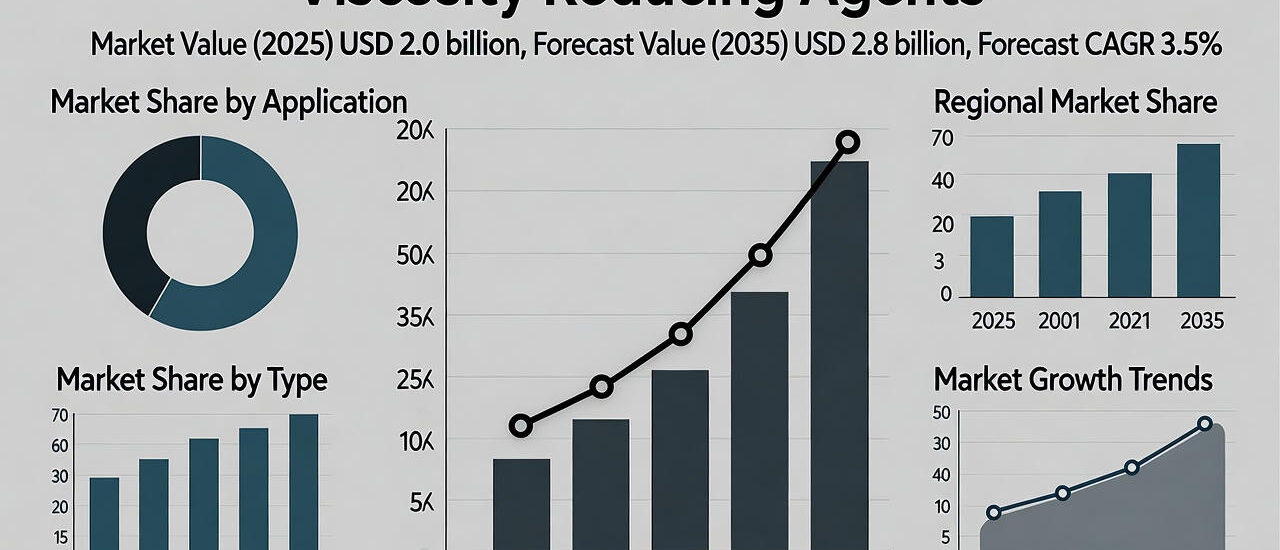
The global viscosity reducing agents market is on a steady growth path, estimated at USD 2.0 billion in 2025 and projected to reach USD 2.8 billion by 2035, reflecting a compound annual growth rate (CAGR) of 3.5% over the forecast period. This growth is largely driven by the increasing need for operational efficiency and sustainability in industries that rely heavily on fluid transportation, including oil and gas, chemical processing, and construction.
Viscosity reducing agents, often referred to as drag-reducing agents, play a crucial role in lowering fluid resistance, improving pipeline throughput, and minimizing energy consumption. These agents allow thick and heavy fluids, such as crude oil, to flow more smoothly through pipelines, reducing pumping energy requirements and operational costs. As energy efficiency and environmental sustainability gain priority, the adoption of these agents is becoming essential across industrial applications.
Get this Report at $5000 Only (Report price) | Exclusive Discount Inside!: https://www.futuremarketinsights.com/reports/sample/rep-gb-2085
Innovation and Technological Advancements Driving Market Growth
Technological advancements in chemical formulations are significantly enhancing the effectiveness of viscosity reducing agents. Modern formulations offer higher efficiency at lower dosages, making them cost-effective and environmentally sustainable. Polymer-based agents, in particular, are projected to hold 27.3% of the market share in 2025, due to their ability to substantially reduce fluid friction and improve flow under a variety of conditions. Advanced polymer chemistry now enables agents to remain stable under extreme temperatures and pressures, broadening their applicability in complex industrial processes.
Established players, including Henkel, Omya AG, ExxonMobil, Rhodia Group, Lubrizol, Kao Chemicals, Sanyo Chemical Industries, Royal Dutch Shell, Toray Industries, Stepan Company, BASF, and Evonik, continue to lead the market by investing in research and development. At the same time, emerging manufacturers are seizing opportunities to innovate and expand their presence, introducing new solutions tailored to evolving industry demands. This competitive environment is fostering both innovation and efficiency, benefiting end users across sectors.
Oil and Gas Remains the Largest End-Use Segment
The oil and gas industry represents the largest end-use segment, accounting for an estimated 32.5% of the market revenue in 2025. The sector relies on viscosity reducing agents to optimize the flow of crude oil and refined products through extensive pipeline networks. By reducing flow resistance, these agents allow higher throughput, lower energy consumption, and reduced operational costs.
With increasing exploration and production activities, especially in unconventional and deepwater fields, demand for advanced viscosity reducing solutions is on the rise. The global push for sustainable operations further emphasizes the need for agents that can lower emissions and energy usage, positioning these products as indispensable tools for oil and gas operators worldwide.
Geographic Insights and Growth Drivers
Regionally, North America, Asia-Pacific, and Europe are the key markets for viscosity reducing agents. China and India are leading the growth trajectory, with CAGRs of 4.7% and 4.4% respectively, fueled by rapid infrastructure development and energy exploration projects. Developed markets, including Germany, France, the UK, and the USA, are experiencing steady growth as industries seek operational efficiency and compliance with environmental regulations. In particular, the USA market is projected to grow from USD 705.1 million in 2025 to USD 944.5 million by 2035, reflecting a CAGR of 3.0%.
Emerging markets in South America, the Middle East, and Africa are also demonstrating increased adoption, as investment in pipeline infrastructure and industrial processes accelerates. The diverse applications of viscosity reducing agents, from oil pipelines to cement and construction, paints and coatings, and rubber processing, underscore the broad market potential.
Polymers Lead Product Type Segment
Among product types, polymers dominate the market due to their proven performance in reducing viscosity across a wide range of fluid systems. Their high molecular weight allows effective interaction with fluid molecules, significantly lowering pumping pressure and energy usage. Advances in polymer technology have made these agents versatile and adaptable to various crude oils, refined products, and industrial liquids, making them the preferred choice for operators seeking efficiency and cost savings.
Other product types, including surfactants, dispersants, and additives, complement the polymer segment by addressing specific industrial requirements and enabling tailored solutions for specialized processes. The ongoing innovation in chemical compositions is expected to further strengthen the role of viscosity reducing agents in improving operational performance and sustainability.
Buy Now Report Here: https://www.futuremarketinsights.com/checkout/2085
Future Outlook and Market Potential
The viscosity reducing agents market is poised for long-term growth as industries increasingly prioritize efficiency, energy savings, and environmental compliance. With rising global demand for oil, chemicals, and industrial products, and a growing focus on sustainable practices, the need for advanced fluid flow solutions will continue to expand. Both established and new manufacturers are actively exploring innovations, partnerships, and expansions to capture market opportunities and meet evolving customer needs.
Viscosity reducing agents, with their ability to enhance pipeline throughput, reduce energy consumption, and extend operational life, are positioned as a critical component of modern industrial operations. As technological advancements continue and adoption spreads across emerging and developed markets, the global market is expected to witness consistent growth through 2035 and beyond.
Related Reports:
Cooling Water Treatment Chemicals Market- https://www.futuremarketinsights.com/reports/cooling-water-treatment-chemicals-market
Iron Ore Pellets Market- https://www.futuremarketinsights.com/reports/iron-ore-pellet-market
Asia Pacific Flexible Glass Market- https://www.futuremarketinsights.com/reports/apac-flexible-glass-market
About Future Market Insights (FMI)
Future Market Insights, Inc. (ESOMAR certified, recipient of the Stevie Award, and a member of the Greater New York Chamber of Commerce) offers profound insights into the driving factors that are boosting demand in the market. FMI stands as the leading global provider of market intelligence, advisory services, consulting, and events for the Packaging, Food and Beverage, Consumer Technology, Healthcare, Industrial, and Chemicals markets. With a vast team of over 400 analysts worldwide, FMI provides global, regional, and local expertise on diverse domains and industry trends across more than 110 countries.
Join us as we commemorate 10 years of delivering trusted market insights. Reflecting on a decade of achievements, we continue to lead with integrity, innovation, and expertise.
Contact Us:
Future Market Insights Inc.
Christiana Corporate, 200 Continental Drive,
Suite 401, Newark, Delaware – 19713, USA
T: +1-347-918-3531
For Sales Enquiries: sales@futuremarketinsights.com
Website: https://www.futuremarketinsights.com
LinkedIn| Twitter| Blogs | YouTube