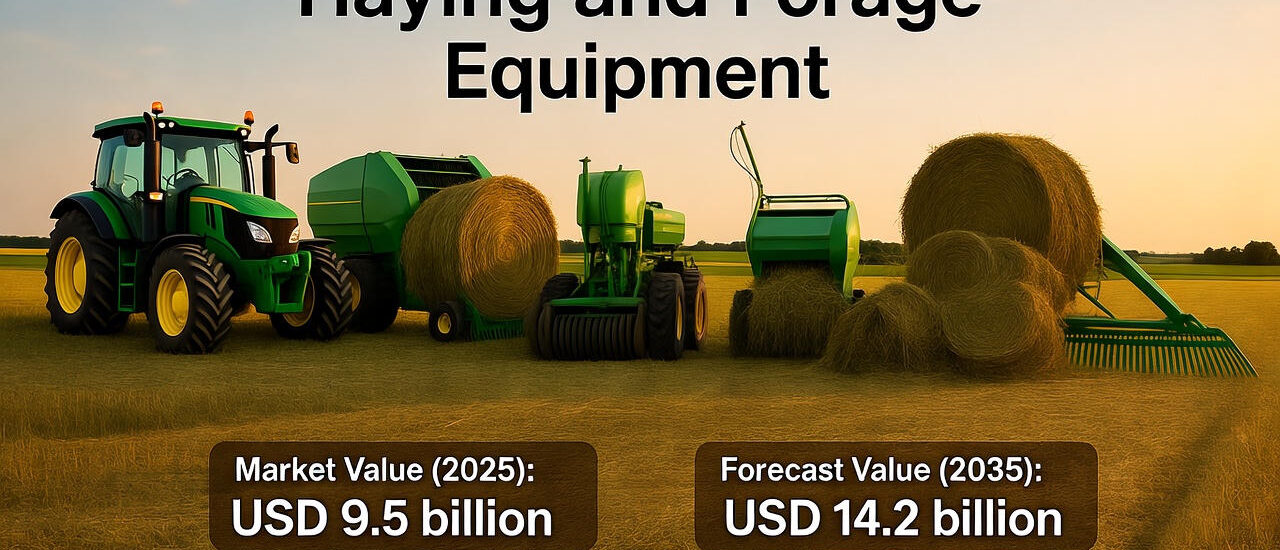
The global haying and forage equipment market is set on a steady path of expansion, projected to grow from USD 9.5 billion in 2025 to USD 14.2 billion by 2035, registering a CAGR of 4.1%. This reflects an absolute dollar opportunity of USD 4.7 billion over the next decade, signaling consistent demand across livestock farming and commercial agriculture. As both established leaders and emerging players aim to modernize and scale operations, the market is witnessing an era of innovation and competitive expansion.
Full Market Report available for delivery. For purchase or customization, please request here: https://www.futuremarketinsights.com/reports/sample/rep-gb-25499
Growth Momentum Across Livestock and Forage Operations
The need for reliable forage handling has never been more critical, with rising livestock production and expanding dairy and meat industries fueling equipment adoption. Farmers and commercial operators are prioritizing efficient, mechanized solutions to reduce labor dependency, improve feed quality, and enhance yield preservation. This demand is pushing companies to increase manufacturing capacity, strengthen distribution networks, and invest in customer service to secure long-term market share.
Revenue growth will be sustained not only by new installations but also by the replacement of outdated machinery. This combination of replacement demand and new adoption ensures a steady trajectory for the industry, encouraging manufacturers to align sales, service, and distribution strategies with market demand.
Drivers of Market Expansion
The adoption of mechanized farming practices and precision agriculture is reshaping haying and forage equipment demand. Government subsidies in agriculture, coupled with the rising cattle population, have accelerated mechanization in forage management. Farmers are embracing innovations such as automatic balers, smart mowers, and IoT-enabled harvesters, which reduce harvest losses and improve feed quality.
By integrating GPS, sensors, and automation, manufacturers are transforming traditional processes into highly efficient, data-driven operations. This transition is particularly strong in North America and Europe, where precision farming practices are widely adopted. Meanwhile, Asia-Pacific is emerging as a high-growth region due to rising livestock farming and government-backed mechanization programs.
Segment Insights
Among equipment types, mowers are projected to hold 26.8% share in 2025, establishing themselves as the leading segment. Their critical role in the initial forage processing stage makes them indispensable, with advancements in disc and drum technologies enabling faster, more precise cutting.
In terms of applications, silage production will account for 39.4% share in 2025, driven by the need for year-round livestock feed supply. Investments in silage choppers, wrappers, and automated balers are expanding as dairy and beef industries scale operations.
Operationally, the market is shifting toward fully automatic systems, expected to capture 52.7% of market share in 2025. Precision automation and reduced human intervention are allowing farmers to maximize productivity while minimizing downtime.
Country-Level Growth Highlights
Growth trends reveal significant opportunities across global regions. China, with a forecast CAGR of 5.5%, is seeing accelerated adoption driven by modernization and government-backed mechanization. India follows closely at 5.1%, fueled by rising dairy production and cooperative farming. In Europe, Germany is recording 4.7% growth supported by sustainable mechanized farming, while the United Kingdom is expanding at 3.9% through livestock-focused modernization programs. Meanwhile, the United States is growing steadily at 3.5%, with large-scale farms driving equipment adoption.
Opportunities and Challenges
The haying and forage equipment market is ripe with opportunity, as commercial farming expansion and rising livestock demand push adoption higher. Manufacturers offering durable, energy-efficient, and technologically advanced machines are positioned to capture greater market share. The integration of GPS-guided mowing systems, IoT-enabled monitoring, and precision cutting solutions is shaping the future of forage operations worldwide.
However, challenges remain. High acquisition costs for advanced equipment and the complexity of operations create barriers for small-scale farmers. Seasonal demand fluctuations also affect equipment utilization and cash flow. To overcome these hurdles, leading companies are introducing financing programs, modular designs, and training initiatives, ensuring accessibility for a broader customer base.
Request a Draft Report Here: https://www.futuremarketinsights.com/reports/brochure/rep-gb-25499
Competitive Landscape
The competitive landscape reflects a mix of global leaders and specialized regional players. John Deere, AGCO, and Claas KGaA continue to dominate with robust portfolios of mowers, balers, and forage harvesters, while CNH Industrial and Kongskilde are strengthening their offerings in harvesting machines. Krone and Kubota cater to both large-scale and compact operations, providing flexibility across diverse markets.
On the other hand, Kuhn Group, Morra Group, and Tonutti-Wolagri focus on modular and specialized solutions, competing on adaptability and serviceability. Emerging regional players are carving niches through cost-efficient designs and localized service networks, particularly in Asia-Pacific and Latin America.
The dynamic competition ensures continuous product innovation, with a strong emphasis on efficiency, durability, and operational versatility.
Outlook Toward 2035
The outlook for the haying and forage equipment market remains resilient, with the USD 4.7 billion growth opportunity providing a clear incentive for investment and innovation. Companies that balance operational efficiency with technological advancement will be best positioned to thrive. As precision agriculture, IoT, and automation take center stage, the market will continue to evolve toward smarter, more sustainable solutions that support livestock and forage operations worldwide.
Related Reports:
Instrumentation Valve and Fitting Market- https://www.futuremarketinsights.com/reports/instrumentation-valve-and-fitting-market
Industry Analysis of Solar Panel Mounting Structure in India- https://www.futuremarketinsights.com/reports/industry-analysis-of-solar-panel-mounting-structure-in-india
Industry Analysis of Low and Medium Voltage Drive in Australia and New Zealand- https://www.futuremarketinsights.com/reports/industry-analysis-of-low-and-medium-voltage-drive-in-australia-and-new-zealand
About Future Market Insights (FMI)
Future Market Insights, Inc. (ESOMAR certified, recipient of the Stevie Award, and a member of the Greater New York Chamber of Commerce) offers profound insights into the driving factors that are boosting demand in the market. FMI stands as the leading global provider of market intelligence, advisory services, consulting, and events for the Packaging, Food and Beverage, Consumer Technology, Healthcare, Industrial, and Chemicals markets. With a vast team of over 400 analysts worldwide, FMI provides global, regional, and local expertise on diverse domains and industry trends across more than 110 countries.
Join us as we commemorate 10 years of delivering trusted market insights. Reflecting on a decade of achievements, we continue to lead with integrity, innovation, and expertise.
Contact Us:
Future Market Insights Inc.
Christiana Corporate, 200 Continental Drive,
Suite 401, Newark, Delaware – 19713, USA
T: +1-347-918-3531
For Sales Enquiries: sales@futuremarketinsights.com
Website: https://www.futuremarketinsights.com
LinkedIn| Twitter| Blogs | YouTube